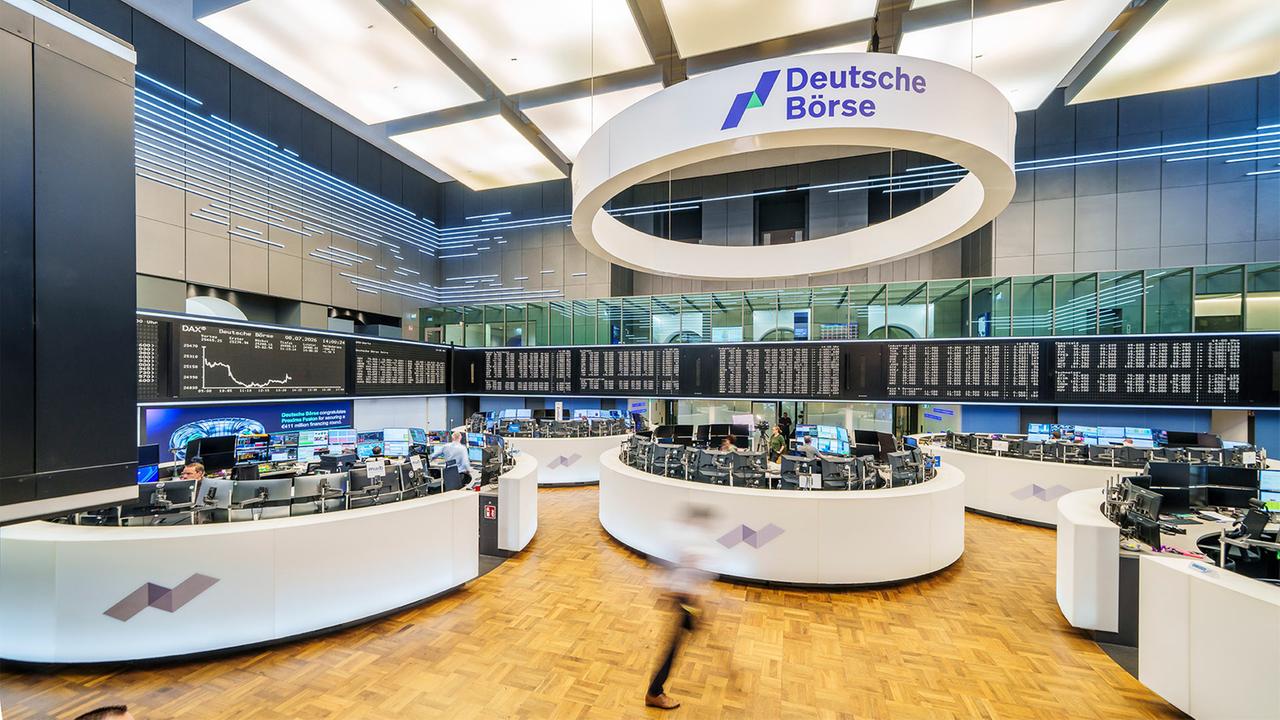
Frankfurt, Germany – October 14, 2026 – The German stock market, represented by the DAX index, concluded the trading day with moderate gains, yet remained firmly entrenched in a sideways trend. Despite the release of new U.S. inflation data, which initially offered a glimmer of hope, investors largely maintained a cautious stance. The overarching sentiment continues to be dominated by the persistent geopolitical tensions in the Middle East, casting a long shadow over global economic stability and market outlooks.
The benchmark DAX index closed at 25,298 points, marking a modest increase of 0.15 percent. This slight uptick follows a volatile trading session on Tuesday, which saw the index initially surge before drifting into negative territory, ultimately settling at 25,259 points. The current movement signifies a period of consolidation, with the index hovering stubbornly around the critical 25,000-point psychological threshold as market participants weigh conflicting signals from economic data, corporate earnings, and international crises.
Main Facts: A Market in Limbo
The key takeaways from today’s market performance paint a picture of an investment community grappling with uncertainty:
- DAX’s Sideways Trajectory: The German blue-chip index continues its recent pattern of trading within a narrow range, unable to break decisively upwards or downwards, reflecting a lack of strong conviction among investors.
- U.S. Inflation Higher Than Expected: Consumer Price Index (CPI) data from the United States revealed a 3.7 percent year-over-year increase in September, surpassing August’s 3.4 percent and exceeding market forecasts. This figure is significantly above the Federal Reserve’s 2.0 percent target, intensifying concerns about further interest rate hikes.
- Geopolitical Headwinds: The ongoing conflict in the Middle East remains a primary source of anxiety, directly influencing crude oil prices and indirectly contributing to inflationary pressures and broader market instability.
- Mixed Corporate Earnings: The nascent U.S. earnings season presented a mixed bag, with some major banks underperforming expectations while others showed resilience, particularly in equity trading.
- Sectoral Divergence: Technology stocks on Wall Street, particularly the Nasdaq, experienced a downturn due to their sensitivity to interest rates, while certain European giants like ASML thrived on the back of the AI boom, and Lufthansa announced a strategic acquisition.
Chronology: A Day of Measured Responses
The trading day in Frankfurt began with a sense of guarded optimism, following Tuesday’s mild retreat. Early indicators suggested that some investors were looking for reasons to push the DAX higher, but this momentum proved fragile.
Morning Session: The DAX opened marginally higher, attempting to consolidate above the 25,000-point level. Initial trading was characterized by cautious buying, as market participants awaited crucial economic data from the United States. Volumes remained relatively subdued, indicative of the "wait-and-see" approach that has defined recent sessions. European indices largely mirrored this tentative sentiment, with minor fluctuations across the board.
Mid-Day – The Inflationary Jolt: The release of the U.S. Consumer Price Index (CPI) data mid-day served as the primary catalyst for market movements. When the figures revealed a higher-than-anticipated inflation rate of 3.7 percent for September, market sentiment immediately shifted. This news, driven primarily by elevated energy costs, quickly dampened any lingering hopes for an imminent pause in the Federal Reserve’s tightening cycle. The immediate reaction was a slight dip in equity futures and a strengthening of the dollar, as the prospect of sustained higher interest rates became more concrete. Bond yields, particularly U.S. Treasuries, also saw an upward movement, reflecting increased investor demand for higher returns in an inflationary environment.
Afternoon Trading – Consolidation and Divergence: In the aftermath of the inflation report, the DAX, along with other major European indices, found itself grappling with renewed uncertainty. While a significant sell-off was averted, the upward momentum was effectively capped. Investors began to digest the implications of persistent inflation, particularly in the context of the ongoing Middle East conflict, which continues to exert upward pressure on global energy prices.
Meanwhile, across the Atlantic, Wall Street opened to a more pronounced reaction. The Nasdaq, heavily weighted towards growth-oriented technology stocks, quickly retreated as the implications of higher borrowing costs became apparent. The Dow Jones Industrial Average, representing a broader mix of industrial and financial giants, showed more resilience, reflecting a rotation towards value-oriented sectors.
Closing Bell: As the European trading day drew to a close, the DAX managed to eke out a small gain, settling at 25,298 points. This demonstrated a degree of underlying support but underscored the powerful gravitational pull of the prevailing uncertainties. The overall narrative remained consistent: a market treading water, caught between the promise of corporate resilience and the threats of inflation, higher rates, and geopolitical instability.
Supporting Data: Dissecting the Economic and Corporate Landscape
The day’s market movements were underpinned by a confluence of macroeconomic data and specific corporate announcements, each contributing to the complex tapestry of investor sentiment.
U.S. Inflationary Pressures Persist
The U.S. Labor Department’s report on consumer prices was undoubtedly the most significant economic release of the day. The Consumer Price Index (CPI) rose by 3.7 percent year-over-year in September, a notable acceleration from the 3.4 percent recorded in August. This figure not only exceeded analysts’ consensus forecasts but also represented a significant divergence from the Federal Reserve’s long-term target of 2.0 percent.
A primary driver of this inflationary surge was identified as elevated gasoline prices, a direct consequence of the escalating conflict in the Middle East. Energy costs, being a fundamental component of economic activity, have a cascading effect, influencing transportation, manufacturing, and ultimately, consumer goods. Core inflation, which excludes volatile food and energy components, also remained stubbornly high, indicating broad-based price pressures within the economy. This persistent inflation complicates the Federal Reserve’s mandate, placing renewed pressure on policymakers to consider further monetary tightening measures.
Global Energy Markets Under Strain
The ongoing geopolitical instability in the Middle East continues to exert a profound influence on global energy markets. Brent crude oil, the international benchmark, hovered around $105 per barrel throughout the day, showing little significant change but maintaining its elevated levels. This price point represents a substantial increase from pre-conflict levels and underscores the market’s sensitivity to supply disruptions and regional tensions.
The sustained high oil prices feed directly into inflation, impacting everything from fuel costs for consumers and businesses to the expenses of transportation and logistics for global supply chains. For central banks, including the European Central Bank (ECB) and the Federal Reserve, this acts as a significant headwind in their efforts to tame inflation, as higher energy prices are largely beyond their direct control through monetary policy.
Corporate Earnings Season: A Mixed Bag for U.S. Financials
The nascent U.S. corporate earnings season provided a mixed picture, particularly within the crucial financial sector.
- Bank of America: The banking giant’s quarterly results reportedly disappointed investors. While specific figures were not immediately available in the initial report, the market reaction suggested that earnings, revenue, or outlook fell short of expectations. This likely reflects challenges such as slowing loan growth, increased provisions for potential loan losses, or higher operating costs.
- Morgan Stanley: In contrast, the investment bank Morgan Stanley delivered stronger-than-expected results, primarily driven by robust performance in its equity trading division. This highlights the divergence within the financial sector, where capital markets and advisory services can perform differently from traditional lending operations.
- Broader Banking Sector: The previous day had seen four other major American banks report their earnings. Despite some of these institutions posting "brilliant profits," their stock prices had come under pressure. This counter-intuitive reaction suggests that even strong earnings may not be enough to appease investors worried about the broader economic outlook, potential future headwinds, or perhaps the quality of earnings given the current interest rate environment. Investors are likely scrutinizing guidance and future prospects more intensely than past performance.
ASML: Powering the AI Revolution
In a significant positive development for the technology sector, the Dutch chip equipment manufacturer ASML Holding NV provided strong impulses for the market. ASML, a critical player in the global semiconductor supply chain, indicated that its planned production capacity for 2027 and 2028 might not fully meet anticipated customer demand. Consequently, the company is actively exploring options to increase its 2028 capacity beyond the previously communicated 30 percent boost.
This announcement underscores the immense and accelerating demand for advanced semiconductors, fueled by the global artificial intelligence (AI) boom. ASML’s tools are essential for manufacturing the most advanced chips, making it a bottleneck in the industry. The company reported a significant increase in both revenue and profit for the third quarter, further solidifying its dominant position. With a market capitalization exceeding 600 billion euros, ASML stands as Europe’s most valuable company, and experts widely believe that the current investment cycle driven by AI is far from over.
Lufthansa’s Strategic Move: Acquiring TAP Portugal
The German airline group Lufthansa secured a significant strategic victory in the bidding war for a stake in the Portuguese airline TAP. Lufthansa successfully outmaneuvered its competitor, the Franco-Dutch Air France-KLM consortium. According to the Portuguese government in Lisbon, Lufthansa’s offer of 1.025 billion euros for a 44.9 percent stake in TAP was accepted. TAP had been nationalized and rescued by the Portuguese state during the COVID-19 pandemic.
This acquisition is of immense strategic importance for Lufthansa. TAP Portugal, with its strong network to South America and Africa, serves as a crucial Atlantic hub. This move will significantly expand Lufthansa’s global reach, strengthen its competitive position against other major European and global carriers, and potentially unlock synergies in network planning, fleet utilization, and operational efficiencies.
Official Responses and Expert Commentary: Awaiting Clarity
The market’s current state of "waiting" is a dominant theme in expert commentary. Analysts are grappling with the conflicting forces at play and the implications for future monetary policy.
Thomas Altmann of QC Partners succinctly described the current environment as an "Abwarte-Markt" (a waiting market), observing that "hardly anyone wants to position themselves on a large scale at the moment." This sentiment reflects the heightened uncertainty and the reluctance of institutional investors to commit significant capital in either direction until a clearer picture emerges regarding inflation, interest rates, and geopolitical stability.
The unexpectedly high U.S. inflation data immediately triggered responses from financial analysts regarding the Federal Reserve’s next steps. Salah-Eddine Bouhmidi, an analyst at the trading house IG, stated, "For the Federal Reserve, a rate hike pause in October thus becomes less self-evident. Another hike already in October is therefore a serious scenario." This highlights the increased probability of the Fed maintaining its hawkish stance, potentially delivering another rate increase to combat persistent price pressures, even if it risks dampening economic growth. The market had largely priced in a pause, so this shift in probability is a significant factor.
On the other hand, some experts hold out hope for corporate resilience to outweigh macroeconomic concerns. Jake Dollarhide, CEO of Longbow Asset Management, noted, "Many investors are relieved that markets may now look more at corporate earnings and less at the bond market, persistently high oil prices, and high interest rates." This suggests a potential pivot in investor focus, where strong corporate performance could act as a buffer against broader economic headwinds. The hope is that robust earnings reports could provide the necessary catalyst to break the market out of its sideways trend, by demonstrating the underlying strength and adaptability of businesses.
Implications: Navigating a Complex Future
The current market dynamics carry significant implications for various sectors, monetary policy, and the broader economic outlook.
Monetary Policy and Interest Rate Trajectory
The elevated U.S. inflation figures strongly suggest that central banks, particularly the Federal Reserve, will maintain a vigilant and potentially aggressive stance on monetary policy. The expectation of further interest rate hikes, possibly as early as October, has profound implications:
- Increased Borrowing Costs: Higher rates translate to increased borrowing costs for businesses and consumers, which can slow down investment, reduce consumer spending, and potentially lead to an economic slowdown or even recession.
- Impact on Growth Stocks: Technology and other high-growth sectors, often reliant on debt financing for expansion, are particularly vulnerable to rising interest rates. Higher refinancing costs erode profitability and make future earnings less attractive when discounted at a higher rate.
- Strengthening of the Dollar: A more hawkish Fed stance typically leads to a stronger U.S. dollar, which can make U.S. exports more expensive and impact the earnings of multinational corporations.
- Global Spillover Effects: The Fed’s decisions have a ripple effect globally. Other central banks may feel compelled to follow suit to prevent currency depreciation and imported inflation, potentially leading to synchronized global tightening.
Geopolitical Risks and Energy Security
The ongoing Middle East conflict is more than just a regional crisis; it’s a global economic disruptor. The sustained high oil prices are a direct consequence of this instability and carry several implications:
- Inflationary Headwind: High energy costs will continue to fuel inflation across economies, making the job of central banks even harder.
- Corporate Profit Margins: Businesses, especially those with high energy consumption (e.g., transportation, manufacturing), will see their profit margins squeezed, potentially impacting investment and employment decisions.
- Consumer Spending Power: Higher fuel and energy bills reduce disposable income for households, dampening overall consumer spending, a critical component of economic growth.
- Supply Chain Vulnerability: Geopolitical tensions highlight the fragility of global supply chains and the need for greater energy independence and diversification.
Corporate Earnings as a Potential Anchor
While macroeconomic headwinds are significant, the performance of corporate earnings remains a critical factor.
- Resilience vs. Vulnerability: The mixed results from U.S. banks underscore the varying degrees of resilience within the corporate sector. Companies with strong balance sheets, diversified revenue streams, and effective cost management strategies are better positioned to weather the storm.
- Sectoral Divergence: The strong performance of ASML, driven by the AI boom, demonstrates that certain sectors can thrive even in a challenging environment. Investors will continue to seek out these growth pockets.
- Guidance is Key: Beyond historical performance, investor focus will heavily be on forward-looking guidance. Any signs of weakening outlooks from companies could further exacerbate market anxieties.
Strategic Shifts and Consolidation
Lufthansa’s acquisition of a stake in TAP Portugal exemplifies strategic moves by corporations to enhance their competitive positioning amidst global uncertainties.
- Industry Consolidation: Such acquisitions signal a trend towards consolidation in sectors like aviation, as companies seek economies of scale, expanded networks, and greater market share to navigate fierce competition and economic volatility.
- Regional Hub Importance: The emphasis on TAP as an "Atlantic hub" highlights the strategic value of key geographical locations for global connectivity and trade.
- Long-Term Vision: These types of investments indicate a long-term strategic vision by companies, looking beyond immediate market fluctuations to secure future growth and market dominance.
Conclusion: A Cautious Outlook Amidst Volatility
The DAX’s moderate gains on October 14, 2026, mask a deeper underlying uncertainty. While the German benchmark managed to stay above the 25,000-point mark, it remains trapped in a sideways consolidation pattern, indicative of a market searching for direction. The persistent shadow of geopolitical conflict in the Middle East, coupled with higher-than-expected U.S. inflation figures, has fueled expectations of continued monetary tightening by central banks, casting a pall over investor sentiment.
The divergence in corporate earnings, with some sectors like semiconductors (ASML) showing remarkable resilience driven by structural growth trends like AI, while others face headwinds, highlights the complex landscape. Strategic moves like Lufthansa’s acquisition of TAP underscore the ongoing adaptation and pursuit of competitive advantage by leading corporations.
Moving forward, investors will be keenly observing the unfolding geopolitical situation, further inflation data, and the Federal Reserve’s next policy decisions. The hope remains that a robust corporate earnings season could provide the necessary catalyst to shift market focus from macroeconomic anxieties to fundamental business strength. However, until greater clarity emerges on these critical fronts, the global equity markets, including the DAX, are likely to continue their cautious dance, characterized by volatility and a persistent "wait-and-see" approach. The path ahead promises to be challenging, demanding agility and discernment from market participants.