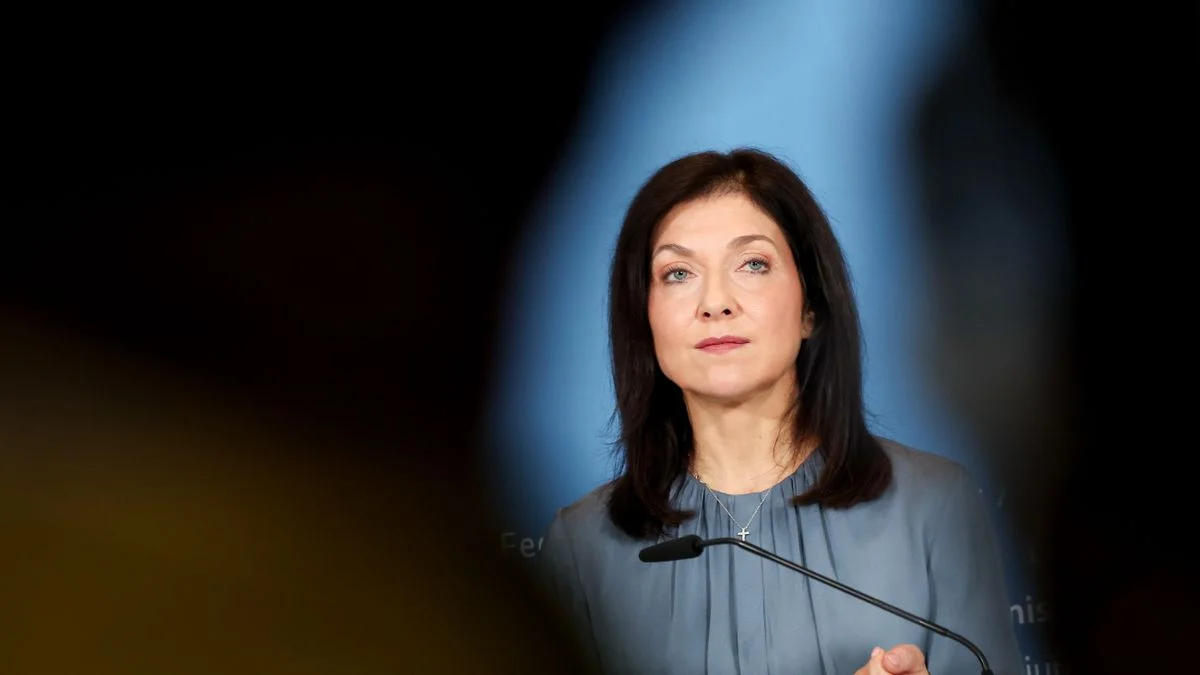
Berlin, Germany – In a significant challenge to the ethical and legal boundaries of political communication on government platforms, Germany’s left-wing party, Die Linke, has escalated a dispute with a federal minister to the highest court in the land. The party has filed an urgent application with the Federal Constitutional Court in Karlsruhe, accusing Federal Minister of Economics, Reiche, of misusing an official ministry Instagram account for partisan political attacks following Die Linke’s strong showing in the Berlin state election. The core of the complaint centers on a video published by the ministry, featuring Minister Reiche, which Die Linke alleges constitutes an unlawful intervention in the political competition and a violation of the principle of political equality of opportunity.
The controversy erupted in the wake of the Berlin House of Representatives election on September 20th, where Die Linke emerged as the strongest political force, positioning itself as a key player in the subsequent coalition negotiations. Shortly after this electoral success, the Ministry of Economics’ official Instagram channel published a video containing excerpts from a speech by Minister Reiche. In these remarks, Reiche issued stark warnings regarding Die Linke’s policy proposals and character, asserting that it would be "dangerous for the capital and Germany as an investment location" if a party advocating for expropriation and "openly living antisemitism, which makes Jews in this city afraid," were to gain power. Die Linke views this dissemination via a government-funded and officially sanctioned channel as a direct and unlawful attack, arguing that while a minister is free to criticize political opponents in their private capacity, they cannot leverage state resources and official channels to do so.
The party’s legal team had initially demanded the video’s removal by September 29th. However, despite this ultimatum, the controversial content remained online until Sunday evening, prompting Die Linke to take their grievance to the Federal Constitutional Court. Their application for an interim injunction contends that Minister Reiche, acting in her official capacity as Federal Minister of Economics, "unlawfully and partisanly" expressed herself and was "part of a systematic campaign" by the conservative CDU party against Die Linke. This legal action underscores a growing tension in German politics regarding the appropriate conduct of government officials in the age of social media and the delicate balance between freedom of expression and the constitutional mandate for state neutrality.
Chronology of a Constitutional Challenge
The dispute’s roots trace back to a pivotal moment in Berlin’s political landscape and quickly escalated into a national constitutional debate.
September 20th: Election Day and Die Linke’s Surge
The chain of events began on September 20th, with the election for the Berlin House of Representatives. Die Linke, campaigning on a platform that included robust social housing policies and, controversially, the potential expropriation of large corporate landlords, achieved a significant victory. Emerging as the strongest party, they secured a mandate to lead coalition negotiations, signaling a potential shift in the capital’s governance and placing their distinctive policy agenda firmly on the political map. This outcome naturally drew intense scrutiny and criticism from opposing parties, particularly the more conservative factions.
Post-Election: The Controversial Instagram Video
In the immediate aftermath of Die Linke’s electoral triumph, the Federal Ministry of Economics’ official Instagram account published a video featuring Minister Reiche. The video contained excerpts from a speech delivered on September 23rd, just days after the Berlin election. In her address, Minister Reiche voiced strong objections to Die Linke’s platform, specifically highlighting two contentious points: their advocacy for the expropriation of private property and the serious accusation of "openly living antisemitism, which makes Jews in this city afraid." The timing and content of this video, disseminated through a government ministry’s official communication channel, immediately ignited a firestorm of criticism from Die Linke.
September 29th: The Demand for Removal
Recognizing what they perceived as a blatant misuse of state resources for partisan political purposes, Die Linke’s legal representatives swiftly issued a formal demand for the video’s removal. The deadline for compliance was set for September 29th. This demand was predicated on the constitutional principle of political equality of opportunity, which prohibits government bodies from engaging in partisan campaigning or using public resources to favor or disparage specific political parties.
Failure to Comply and Escalation to Karlsruhe
Despite Die Linke’s explicit demand and the looming deadline, the controversial video remained accessible on the Ministry of Economics’ Instagram account well past September 29th, persisting until Sunday evening. This refusal to comply prompted Die Linke to escalate the matter to the highest legal authority in Germany: the Federal Constitutional Court in Karlsruhe. The party’s decision to file an urgent application for an interim injunction underscores the gravity with which they view the minister’s actions, seeking immediate judicial intervention to prevent what they argue is ongoing constitutional harm. The application explicitly states that Minister Reiche acted unlawfully in her official capacity, engaging in "one-sided and partisan" political activity and aligning herself with what Die Linke terms a "systematic campaign" by the CDU against their party. This move transformed a social media spat into a high-stakes constitutional confrontation, setting the stage for a landmark decision on the boundaries of political speech by government officials.
Supporting Data and Broader Context
The legal challenge mounted by Die Linke against Minister Reiche is not an isolated incident but rather a symptom of deeper political, social, and constitutional currents in Germany. Understanding the broader context—from Berlin’s unique political landscape to the evolving role of social media and the fundamental principles of German constitutional law—is crucial for appreciating the significance of this case.
The Berlin Political Landscape and Die Linke’s Rise
Berlin has long been a bastion of left-leaning politics, characterized by a diverse and often progressive electorate. The September 20th election saw Die Linke solidify its position as a major political force, becoming the strongest party and underscoring a growing appetite among Berliners for their distinct policy agenda. This agenda is often centered on social justice, affordable housing, and a critical stance towards unchecked capitalism.
One of the most contentious aspects of Die Linke’s program, and a direct target of Minister Reiche’s criticism, is the concept of "Enteignung" (expropriation). In Berlin, this debate primarily revolves around the housing crisis. Rapidly rising rents and a shortage of affordable housing have fueled a powerful movement advocating for the expropriation of large corporate landlords, returning their vast housing portfolios to public ownership. Proponents argue this is a necessary measure to stabilize rents, ensure housing as a fundamental right, and combat speculative real estate practices. Opponents, like Minister Reiche, warn that such policies would deter investment, harm the economy, and undermine property rights, potentially damaging Berlin’s and Germany’s reputation as a reliable business location. This policy debate is not merely theoretical; a popular referendum on the issue has also garnered significant support in Berlin, adding democratic weight to Die Linke’s position.
The Gravity of Antisemitism Accusations in Germany
Minister Reiche’s second accusation – that Die Linke "openly lives antisemitism, which makes Jews in this city afraid" – carries immense weight and historical resonance in Germany. Given Germany’s Nazi past and the Holocaust, any accusation of antisemitism, especially against a political party, is profoundly serious and can have devastating consequences for a party’s reputation and legitimacy.
While Die Linke firmly rejects such accusations, the party has, at times, faced criticism regarding its stance on Israel and its historical ties to certain left-wing movements that have been accused of anti-Zionist positions that cross into antisemitism. For instance, debates surrounding the BDS (Boycott, Divestment, Sanctions) movement against Israel, which some view as antisemitic, have occasionally caused internal friction and external scrutiny for Die Linke. However, the party’s official stance condemns antisemitism unequivocally, and it actively participates in efforts to combat it. The specific phrasing used by Minister Reiche, implying that Die Linke actively "lives" antisemitism and instills fear in the Jewish community, is therefore perceived by the party as an exceptionally damaging and unfounded attack, particularly when broadcast from an official government platform.
The Principle of Political Equality of Opportunity (Chancengleichheit)
At the heart of Die Linke’s legal challenge lies the fundamental principle of "Chancengleichheit der Parteien" (political equality of opportunity for parties), enshrined in German constitutional law. This principle, derived from Article 21 of the Basic Law (Grundgesetz), ensures that all political parties have an equal chance to participate in the democratic process and compete for voter support. It explicitly prohibits the state, including government ministries and officials, from using public resources, funds, or official platforms to unfairly favor or disadvantage any particular political party.
The rationale behind Chancengleichheit is to maintain a level playing field in political competition, preventing the party or parties in power from entrenching their position by leveraging state authority and assets. This principle is particularly relevant in the context of government communication. While ministers, as individuals and members of a political party, are entitled to express their political opinions and criticize opponents, they must do so in a manner that clearly distinguishes between their partisan activities and their official functions. Using an official ministry account, which is funded by taxpayers and represents the state, for partisan attacks is generally considered a violation of this neutrality requirement. The Federal Constitutional Court in Karlsruhe frequently adjudicates cases related to Chancengleichheit, establishing precedents that guide the conduct of government officials and institutions. This case could further refine these boundaries in the digital age.
Social Media in Government and the "Systematic Campaign" Allegation
The incident also highlights the evolving and often problematic role of social media in modern governance. Official government accounts are increasingly used not just for public service announcements but also for policy advocacy and, sometimes, for political messaging that blurs the lines between factual information and partisan opinion. This case will undoubtedly contribute to the ongoing debate about appropriate guidelines for government social media use.
Die Linke’s accusation that Minister Reiche’s actions are part of a "systematic campaign" by the CDU against their party adds another layer of complexity. The CDU, Germany’s leading conservative party, and Die Linke represent fundamentally different ideological poles. Historically, the CDU has often positioned itself as a bulwark against what it perceives as the radical left, frequently criticizing Die Linke’s economic policies and historical lineage. If proven, a "systematic campaign" utilizing state resources would represent a severe breach of constitutional principles, suggesting a coordinated effort to undermine a political opponent through illegitimate means. This claim elevates the dispute beyond a simple social media gaffe to a potentially deliberate constitutional infraction.
Broader Legal Actions by Die Linke
The legal action against Minister Reiche is not an isolated incident for Die Linke. The party has demonstrated a willingness to pursue legal avenues to counter what it perceives as unfair and defamatory attacks. The provided information notes that Die Linke is also pursuing legal action, through lawyers’ letters, against other politicians who have accused the party of antisemitism and proximity to criminal clans via social media. Some politicians have subsequently deleted their posts, while others have not. Notably, Die Linke is also suing Interior Minister Alexander Dobrindt (CSU), indicating a broader strategy to legally challenge what they see as baseless and damaging accusations disseminated through social media, thereby asserting their right to fair political competition and protecting their reputation. This broader pattern suggests Die Linke is systematically challenging the boundaries of political discourse on social media, especially when it involves serious accusations and the potential misuse of public platforms.
Official Responses and Anticipated Arguments
The confrontation at the Federal Constitutional Court pits Die Linke’s constitutional arguments against the anticipated defense of Minister Reiche and the Ministry of Economics, with the CDU likely to offer political support. Each party will articulate its position, seeking to persuade the court and public of the legitimacy of its actions or complaints.
Die Linke’s Official Stance
Die Linke’s position is clear and rooted in fundamental constitutional principles. Their legal application, seeking an interim injunction, articulates several key arguments:
- Violation of Political Equality of Opportunity (Chancengleichheit): This is the central tenet of their complaint. Die Linke argues that by using the official Instagram account of the Federal Ministry of Economics, Minister Reiche leveraged state resources and the authority of her office to disseminate partisan political attacks. This, they contend, constitutes an unfair advantage for the minister’s party (presumably the CDU, though not explicitly stated in the provided text as her party affiliation, it is a reasonable inference given the context of a "systematic campaign" by the CDU) and an unwarranted disadvantage for Die Linke, thereby violating the constitutional requirement for fair political competition.
- Misuse of Public Resources: Government ministries are funded by taxpayers and are meant to serve the public interest impartially. Die Linke asserts that using an official ministry account for what is essentially party political campaigning is an egregious misuse of public resources and a breach of the neutrality expected of state institutions.
- Unlawful and Partisan Expression: The application explicitly states that Minister Reiche acted "unlawfully and partisanly" (einseitig und parteipolitisch) in her position as Federal Minister of Economics. This phrasing emphasizes that her actions were not merely an error in judgment but a deliberate breach of the constitutional duty to remain neutral when acting in an official capacity.
- Part of a "Systematic Campaign": Die Linke frames the minister’s actions not as an isolated incident but as an element within a broader "systematic campaign" by the CDU against their party. This suggests a coordinated effort to delegitimize Die Linke, potentially through unconstitutional means, and aims to portray the minister’s actions as part of a pattern rather than an individual oversight.
- Damage to Reputation and Electoral Prospects: The accusations of advocating for expropriation and, more severely, "openly living antisemitism" are profoundly damaging to any political party, especially one seeking to form a government. Die Linke will argue that the dissemination of these accusations through an official government channel lends them an unwarranted veneer of authority and truth, unfairly harming their reputation and potentially influencing public opinion against them.
Anticipated Defense from Minister Reiche and the Ministry
While the provided text does not contain Minister Reiche’s direct response or defense, several arguments can be anticipated based on common political rhetoric and legal principles:
- Freedom of Speech and Political Debate: Minister Reiche might argue that, as a political figure and a member of parliament (if applicable), she has the right to express her concerns about the policies and character of other political parties. She could frame her statements as legitimate contributions to a vital political debate, particularly concerning issues like property rights and antisemitism, which are of significant public interest.
- Warning to the Public: The minister could assert that her statements were intended as a legitimate warning to the public about the potential dangers of Die Linke’s policies (e.g., expropriation’s impact on the economy) and their alleged ideological leanings (e.g., antisemitism). She might argue that it is her duty, as a federal minister, to highlight issues that she believes could harm the country or its citizens.
- Distinction Between Official and Personal Views: While the video was posted on a ministry account, Minister Reiche might attempt to argue that her statements, even if critical, represented her political opinion rather than an official policy position of the ministry. This defense would seek to draw a fine line between a minister’s role as a government official and their role as a political personality. However, the use of an official ministry account would make this argument challenging to sustain.
- No Intent to Violate Neutrality: The defense might claim that there was no deliberate intent to violate the principle of state neutrality or to engage in partisan campaigning. Any perceived breach could be attributed to an oversight or a misjudgment regarding the appropriate use of social media, rather than a malicious constitutional violation.
- Severity of Accusations Justifies Strong Language: Given the extreme nature of the accusations (expropriation, antisemitism), the defense might argue that the minister’s strong language was warranted by the perceived severity of the issues, even if it was conveyed via an official channel. They might attempt to shift the focus from the channel to the content’s importance.
CDU’s Political Support (Anticipated)
As Die Linke’s application explicitly mentions a "systematic campaign" by the CDU, it is highly probable that the CDU would politically defend Minister Reiche’s actions, at least in principle.
- Legitimate Criticism of Political Opponents: The CDU would likely frame the criticism against Die Linke as legitimate and necessary political discourse. They would emphasize the fundamental ideological differences between the parties and their right to highlight what they perceive as problematic aspects of Die Linke’s platform, such as their economic policies and past controversies.
- Concerns for Germany’s Future: The CDU might echo Minister Reiche’s concerns about the impact of Die Linke’s policies on Germany’s investment climate and economic stability. They would argue that raising these concerns is a responsible act for a party dedicated to the nation’s prosperity.
- Addressing Antisemitism: The CDU would likely underscore the importance of combating antisemitism in all its forms and might argue that raising such concerns, even if controversial, is a moral imperative. They might attempt to deflect criticism about the "how" (official channel) by emphasizing the "what" (the seriousness of antisemitism).
The Federal Constitutional Court will have to weigh these competing arguments, considering the constitutional principle of Chancengleichheit against the rights of ministers to engage in political debate, even on sensitive issues.
Implications and Future Outlook
The Federal Constitutional Court’s eventual ruling in Die Linke’s urgent application against Minister Reiche carries significant implications, not only for the immediate parties involved but for the broader landscape of German politics, government communication, and the interpretation of constitutional principles in the digital age.
Implications for Die Linke
A favorable ruling for Die Linke, particularly an interim injunction ordering the video’s removal or prohibiting similar future actions, would represent a substantial victory. It would:
- Validate their constitutional arguments: Reinforce the party’s assertion that state organs cannot be used for partisan attacks, upholding the principle of political equality.
- Boost their public image: Portray Die Linke as a party willing to defend democratic principles and capable of challenging powerful government figures. This could enhance their credibility, especially in the context of their ongoing efforts to form a government in Berlin.
- Strengthen their hand in broader legal battles: A win would lend weight to their other legal actions against politicians accused of misrepresenting or defaming the party on social media, such as the case against Interior Minister Dobrindt.
- Mitigate reputational damage: A court order might help to counter the severe accusations of antisemitism and economic irresponsibility, signaling that such claims, when disseminated improperly, are legally actionable.
Conversely, a ruling against Die Linke would be a setback, potentially weakening their legal strategy and exposing them to continued accusations, though the court’s reasoning would be crucial.
Implications for Minister Reiche and the Ministry
For Minister Reiche and the Federal Ministry of Economics, the implications could be significant:
- Reputational damage: A court finding that Minister Reiche misused her official position for partisan purposes would undoubtedly damage her personal and professional reputation, as well as the perceived neutrality of her ministry.
- Clarification of boundaries: A judicial order would force the ministry to re-evaluate and strictly adhere to guidelines for official social media use, ensuring a clear separation between government communication and party political statements.
- Potential for further action: Depending on the severity of the court’s findings, there could be calls for internal investigations or even political consequences for the minister.
- Precedent for future conduct: The ruling would serve as a binding precedent for how federal ministers and ministries can (or cannot) use their official platforms, particularly during election cycles or in highly politicized debates.
Implications for German Politics and Government Communication
The case’s broader implications for German political culture and the use of social media in government are profound:
- Redefining "Chancengleichheit" in the Digital Age: The ruling will provide crucial clarification on how the constitutional principle of political equality applies to modern digital communication channels. It will help establish clearer rules for what constitutes acceptable and unacceptable conduct for government officials on platforms like Instagram, Twitter, and Facebook.
- Strengthening State Neutrality: A decision upholding Die Linke’s complaint would reaffirm the importance of state neutrality and the separation of party and state, sending a strong message that public resources cannot be weaponized for partisan advantage.
- Impact on Inter-Party Relations: The legal battle itself reflects heightened tensions between Germany’s political parties. The outcome could either exacerbate these tensions or, by clarifying rules, potentially lead to more disciplined and less confrontational official communication.
- Guidelines for Official Social Media: The case will likely prompt all government ministries and agencies to review and update their social media policies. It could lead to the development of more stringent guidelines to prevent similar constitutional challenges in the future, fostering greater transparency and accountability in public communication.
- Broader Debate on Democratic Fairness: At its core, the case is about ensuring fair competition in a democratic system. By challenging the alleged misuse of power, Die Linke is contributing to a vital debate about the health and integrity of German democracy, particularly in an era where misinformation and politically charged content can spread rapidly.
In conclusion, Die Linke’s urgent application to the Federal Constitutional Court is more than just a dispute over an Instagram video. It is a landmark case that will likely shape the future of political communication by government officials in Germany, reinforce constitutional safeguards against the abuse of state power, and provide crucial guidance on maintaining a level playing field in the nation’s vibrant democratic process. The decision from Karlsruhe is eagerly awaited, promising to leave an indelible mark on German constitutional law and political practice.