The Berlin Volksbühne, an institution synonymous with avant-garde experimentation and structural defiance, has entered a high-stakes chapter under the stewardship of new Intendant Matthias Lilienthal. The theater’s season opening was not merely a series of performances but a manifesto—a sprawling, multi-disciplinary assault on the senses that sought to reconcile Berlin’s fractured past with its transient, hyper-modern present. From the ritualistic cleansing of the theater’s exterior by Florentina Holzinger to the surrealist explorations of identity and gender in the main house, the opening days signaled a deliberate break from traditional dramaturgy in favor of experiential, globalized theater.
The Ritual of Renewal: Florentina Holzinger’s "House Wash"
The season commenced with an arresting visual spectacle. Water erupted from fountains flanking the Volksbad, while a massive, inflatable figure—devoid of limbs or a head, yet explicitly modeled after the anatomy in Gustave Courbet’s L’Origine du monde—loomed over the theater roof. Ten naked performers moved in concert, five of whom rappelled down the building’s facade to rhythmically scrub the stone with white cloths, their movements blending labor with eroticized performance art.
This act, titled House Wash, served as a symbolic purification. As the performers moved to a soundscape oscillating between epic rock and industrial techno, the message was clear: the Lilienthal era demands a scrubbing away of the old to accommodate the new. Yet, the irony was not lost on observers; the Volksbühne is a place where history is never truly erased, only layered.
Chronology of the Opening: Rimini Protokoll and the "House of Hopes"
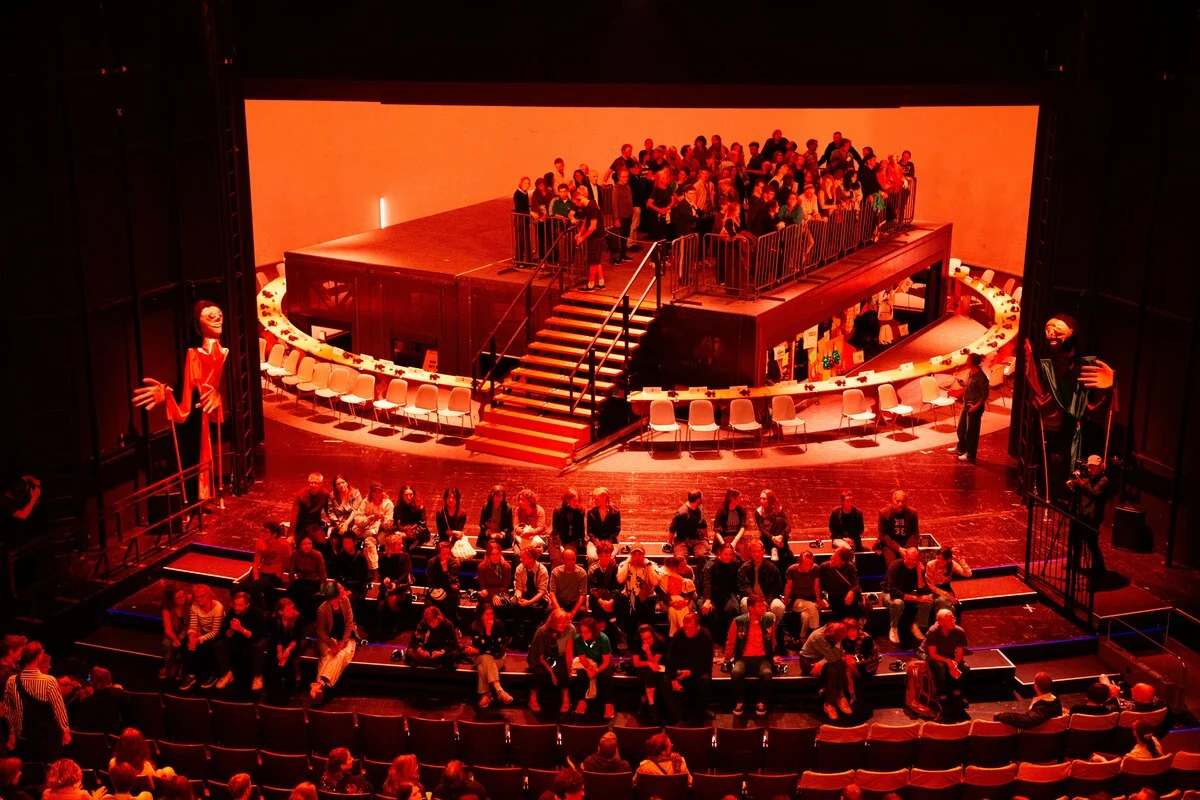
Following the exterior spectacle, the focus shifted to House of Hopes, an ambitious, site-specific work by the collective Rimini Protokoll. Eschewing the conventional seating arrangement of the main auditorium, the production forced the audience into a kinetic, multi-station journey through the building’s bowels—foyers, hidden chambers, and backstage zones.
A Journey Through Time
The project acted as a historiographical experiment. Ten stations, each lasting approximately twelve minutes, were staged simultaneously, requiring the audience to navigate the theater like participants in a living archive. The narratives were deeply personal, featuring individuals from various nations whose lives intersected with the historical gravity of the fall of the Berlin Wall.
Participants were equipped with headphones, receiving not just historical context regarding the genocide of the Herero and Nama people or the complexities of the Iranian Revolution, but also behavioral instructions. At one moment, audience members were directed to gesture aggressively at a group representing soldiers; moments later, they were transformed into the soldiers themselves, rushing through the Star Foyer during a recreation of the Romanian Revolution. This synchronized, minute-by-minute choreography underscored the production’s central thesis: history is not a static object but a repetitive cycle that risks re-enactment.
The "Expat" Condition: Anta Recke’s Perfections
As the event moved to the newly renovated Prater on Kastanienallee, the focus shifted from global historical trauma to the contemporary, micro-historical struggle of the "International Nobody." Anta Recke’s production Perfections, based on the novel by Vincenzo Latronico, offered a sharp, linguistic exploration of the expatriate experience in Berlin.
The Aesthetics of Displacement
The play, performed in a polyglot mix of German, English, French, Spanish, and Italian, captures the "bubble" of creative professionals who navigate the city while remaining fundamentally detached from it. Six actors, all wearing oversized shirts labeled "International Nobody," embody a couple, Tom and Anna, as they navigate the shifting landscape of a gentrifying Berlin.
Recke’s staging highlights the hollowness of this existence. The protagonists, who view their lives through the lens of digital curation and interior design, find themselves alienated by the very city they consume. The performance addresses the tension between the "possibility rush" of the early 2010s and the subsequent reality of rising rents and disappearing art spaces. The production’s strength lies in its ability to dramatize the lack of dialogue inherent in the source material, using silence, repetitive movement, and techno beats to articulate the existential dread of a generation that is "anywhere" and therefore nowhere.
The Metaphysical Puzzle: Satoko Ichihara’s Mononoke
The final pillar of the opening was Satoko Ichihara’s Mononoke, a production that pushed the boundaries of the surreal. Centered on the character Tatako, who seeks help for a "foreign object"—an iron egg stuck in her vagina—the play spiraled into a complex, often confusing meditation on gender, industrial history, and the commodification of the body.
A Geflecht of Steel and Spirit
Ichihara utilizes a Bunraku puppet, "Princess Monoprix," to act as a cynical, profit-driven advisor. The narrative weaves together disparate threads: Japan’s role as a global steel producer, the absurdity of beauty standards, and the search for parental connection. The stage, dominated by a mechanical, alien-like womb structure created by artist Mire Lee, served as a stark contrast to the human performances.
While the play lacked a singular, coherent emotional arc, it succeeded as a "super-specific form of historiography." It challenged the audience to engage with a narrative that refused to resolve, mirroring the complexities of modern identity where the personal (a medical/sexual issue) is inextricably linked to the geopolitical (the steel industry).

Supporting Data and Production Context
- Participation: The opening weekend involved over 30 performers across three major productions, utilizing almost every square meter of the main Volksbühne and the newly reopened Prater.
- Accessibility: In keeping with the theater’s commitment to transparency, the production utilized diverse linguistic formats to ensure the "international" reality of Berlin was reflected on stage.
- Logistics: The synchronization of the ten-station House of Hopes required technical coordination rarely seen in theater, functioning with the precision of a clockwork mechanism.
Official Responses and Critical Reception
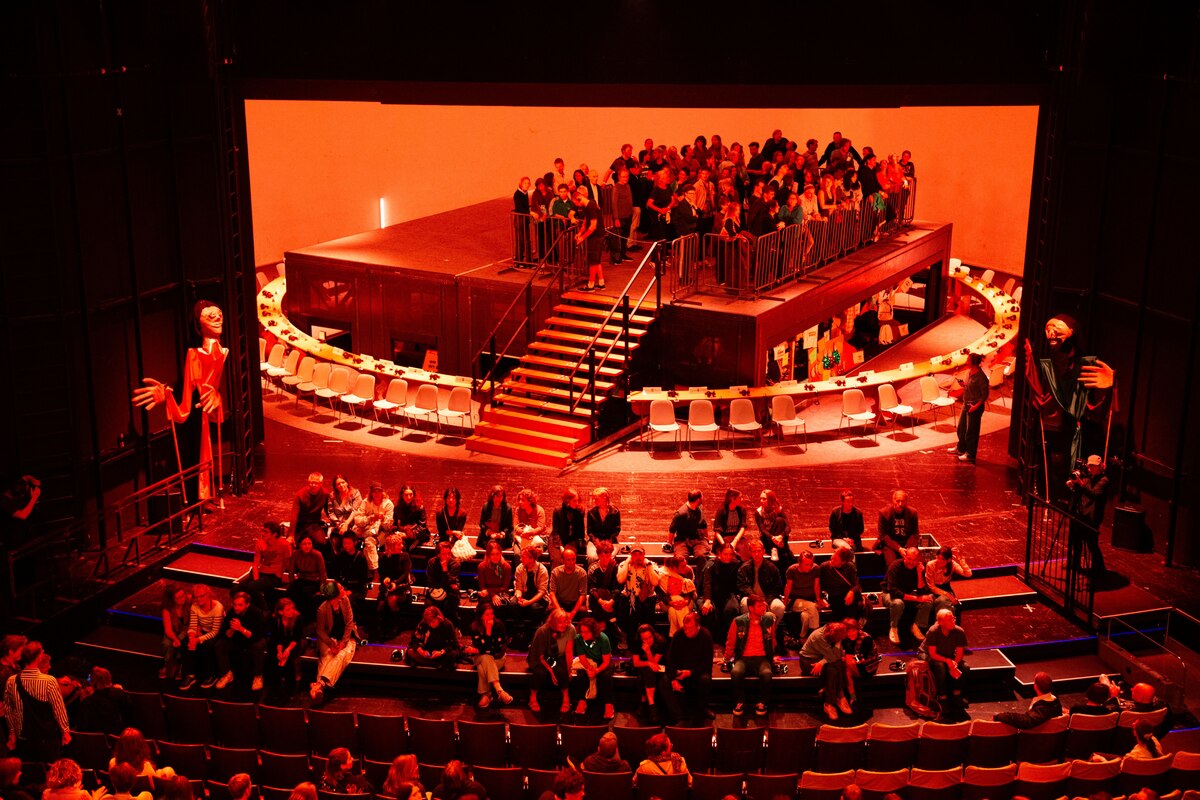
The atmosphere during the final applause, particularly following the Rimini Protokoll performances, was one of overwhelming community. The audience, many of whom ended up on the stage, provided standing ovations that transcended the barriers between performer and observer.
However, critical reception remains nuanced. While the ambition of the opening is undeniable, some critics have pointed to a "sperrig" (cumbersome) quality in the more experimental pieces like Mononoke. The absence of a unifying dramaturgical "sog" (pull) in the main house production left some viewers feeling alienated. Yet, within the context of the Berliner "narrative frame," these challenges are viewed not as failures, but as essential components of a theater that seeks to provoke rather than merely entertain.
Implications for the Future of the Volksbühne
The start of the Lilienthal era suggests that the Volksbühne will move away from the "cult of the director" that defined the René Pollesch era and toward a more collective, international, and historiographical approach.
- Decentralization: By pushing the audience out of the main hall and into the hidden spaces of the theater, Lilienthal is breaking the hierarchical relationship between stage and viewer.
- Globalized Narratives: The inclusion of non-European historical perspectives (Herero/Nama, Iran, Romania, Japan) indicates a shift toward a theater that views Berlin as a node in a global network rather than an isolated German capital.
- The "Expat" Critique: By focusing on the transient, international class of Berlin, the theater is holding a mirror up to its own demographic, forcing an uncomfortable self-reflection on the nature of privilege and gentrification.
Ultimately, the opening of the Volksbühne was a declaration of intent: this is a space where the "impossible" act of creation—whether it is turning a novel without dialogue into a play or exploring the spiritual weight of an iron egg—is valued above traditional cohesion. Whether this leads to a new golden age or a period of productive confusion remains to be seen, but the theater has successfully reclaimed its position as the most vital, if volatile, cultural laboratory in Berlin.