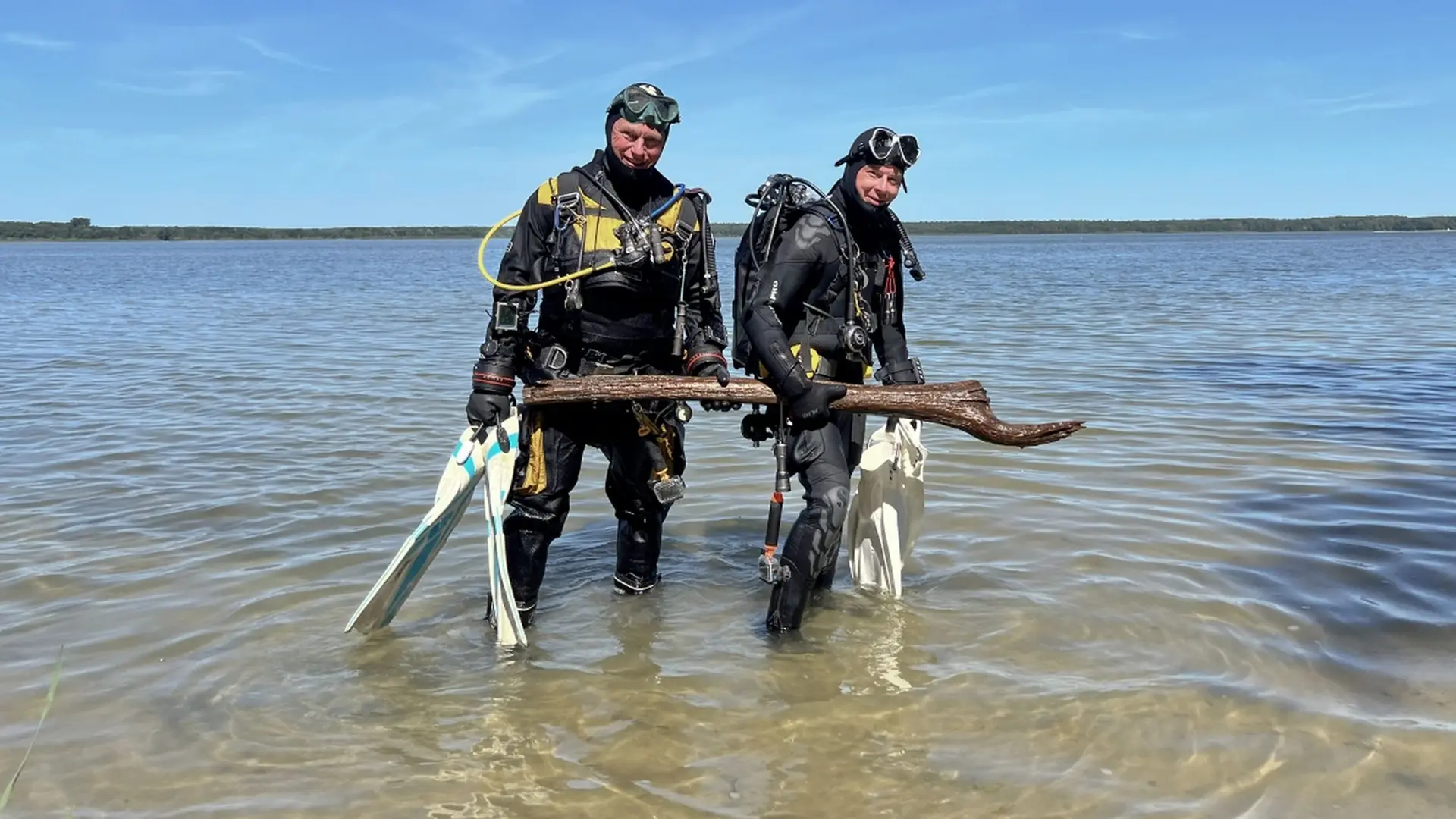
In the serene, deep waters of the Arendsee, a natural lake located in the Altmark region of Saxony-Anhalt, Germany, a discovery has been made that is currently challenging the established narrative of early human history in Central Europe. Divers conducting routine archaeological underwater surveys have recovered wooden artifacts that, while appearing deceptively simple, are being hailed as a "small sensation" by the State Office for Heritage Management and Archaeology of Saxony-Anhalt. These relics, dating back approximately 10,500 years to the Mesolithic period, are providing more questions than answers, as their purpose and origin remain shrouded in mystery.
The Discovery: A Rare Glimpse into the Mesolithic
The artifacts in question—including a large wooden post and several split boards—measure up to 1.60 meters in length. Despite their significant age, the wood is remarkably well-preserved, a phenomenon attributed to the unique geological conditions of the Arendsee. The lake bed is characterized by a gradual, continuous subsidence, which has, over millennia, buried organic materials under thick, protective layers of sediment. This anaerobic environment effectively shielded the wood from decay, allowing it to survive for over ten millennia.
What makes these finds so extraordinary is the clear evidence of human intervention. The wood was not merely lying in the water by chance; it shows unmistakable signs of having been worked, shaped, and manipulated by human hands. For archaeologists, this is a rare window into the lives of people living in the middle of the Stone Age, a period traditionally associated with nomadic hunter-gatherer societies who, according to standard historical consensus, had not yet transitioned to sedentary lifestyles.
Chronology of a Discovered Mystery
The timeline of the Arendsee research is a testament to the patience and precision required in underwater archaeology.
- Pre-Holocene to Present: Over 10,500 years ago, the environment surrounding the Arendsee was vastly different from the modern landscape. As the climate warmed following the end of the last glacial period, nomadic groups traversed these lands.
- The Subsidence Mechanism: The unique geological shift of the lake basin created a "natural time capsule." As the floor sank, organic debris was pulled down and sealed off from oxygen, the primary driver of rot.
- Modern Discovery: In recent years, as technological capabilities for underwater surveying improved, the State Office for Heritage Management and Archaeology intensified its efforts. These latest finds emerged during a series of systematic dives aimed at mapping submerged cultural assets.
- The 2026 Assessment: Following laboratory analysis of the recovered wood, authorities confirmed the dating to the Mesolithic era, sparking a renewed debate about the capabilities and habits of the people of that time.
Supporting Data: Why This Matters
The Mesolithic period is often overshadowed by the Neolithic, which saw the birth of agriculture and permanent settlements. By contrast, the Mesolithic (Middle Stone Age) is viewed as a time of intense mobility. The existence of "constructed" wooden pieces from this era at the bottom of a lake suggests a higher degree of complexity than previously attributed to these groups.
Are these the remnants of a fishing weir, a platform, or perhaps part of a primitive shelter? If these pieces were indeed structural components, it would imply that Mesolithic humans were building more substantial installations than the temporary, easily portable camps typically associated with nomadic life. The structural integrity of the wood, when analyzed under microscopic scrutiny, shows specific tool marks that indicate a deliberate, sophisticated approach to woodworking—a skill set that suggests deep knowledge of material properties and tool technology.
Official Responses and Expert Speculation
The State Office for Heritage Management and Archaeology has been cautious but enthusiastic. In their official statement, they highlighted the rarity of such organic finds. "Organic materials from this period are exceptionally rare," the report notes. "To find wood that has been modified by human hands and preserved for 10,500 years is a significant boon for our understanding of the period."
Archaeologists working on the site emphasize that the lack of surrounding debris or additional tools makes it difficult to definitively classify the function of the finds. However, the presence of the posts and split boards strongly suggests an intentional, multi-component construction. Dr. Elena Fischer, a lead researcher involved in the project, stated: "We are currently looking at a puzzle where most of the pieces are still buried beneath the lake bed. We have enough to know that this was not a natural occurrence, but not enough to reconstruct the structure itself. It is a mystery that forces us to reconsider our assumptions about the ‘simplicity’ of Stone Age life."
Implications for European Prehistory
The fundamental question remains: Why would a group of nomadic hunter-gatherers build a structure in the middle of a lake or along its shoreline?
Redefining Mobility
If the artifacts represent a building or a complex trap, it challenges the binary distinction between "nomadic" and "sedentary." It is possible that Mesolithic groups were not merely wandering, but were "semi-sedentary," returning to specific, resource-rich locations like the Arendsee over several generations to maintain installations. This would represent a much more sophisticated relationship with the landscape than once thought.
Environmental Engineering
The use of split boards implies a level of technological advancement in woodworking—specifically the ability to cleave timber along the grain—that is often associated with later periods. This suggests that the "primitive" label often applied to the Mesolithic is a product of our lack of data rather than an accurate reflection of their capabilities.
The Role of Underwater Archaeology
The Arendsee discovery also highlights the importance of submerged landscapes. As sea and lake levels fluctuated throughout the Holocene, many critical sites of human activity were swallowed by water. This site serves as a prime example of how underwater archaeology acts as a vital, yet untapped, frontier for historical research.

The Path Ahead: Future Investigations
The research team is already planning further expeditions to the Arendsee. The focus will be on mapping the surrounding sediment layers using high-resolution sonar to detect other potential anomalies that might be connected to the wood. The hope is to find "in situ" evidence—a complete structure or perhaps associated tools—that would provide the context necessary to solve the mystery.
Additionally, isotopic analysis is being performed on the wood to determine the exact species of tree used and whether the timber was sourced locally or transported from a distance. This could shed light on the trade or resource-gathering habits of the inhabitants.
Conclusion: A Window into a Lost World
The discoveries at Arendsee are more than just old pieces of wood. They are physical, tactile evidence of human ingenuity from a time when the world was being reshaped by climate change and human adaptation. While the exact function of these relics may remain unknown for some time, their presence is a stark reminder that history is not a static timeline, but a dynamic, ever-evolving narrative.
As we continue to peer into the dark, cold depths of the Arendsee, we are forced to look at our own ancestors with new eyes—not as simple wanderers, but as skilled engineers and architects who shaped their environment long before the first farm was ever sown. The silent, submerged ruins of the Altmark are waiting to tell their story; it is now up to the global archaeological community to listen.
Frequently Asked Questions (FAQ)
Q: Could the wood be a natural formation?
A: No. Expert analysis of the tool marks confirms that the wood was deliberately split and shaped by human hands, ruling out natural decay or water-current patterns.
Q: Is it possible to date the wood accurately?
A: Yes. Through radiocarbon dating, researchers have placed the wood firmly in the Mesolithic period, approximately 10,500 years ago.

Q: Why was the wood so well-preserved?
A: The Arendsee has a unique geological feature causing the lake bed to subside, which traps organic material under layers of anaerobic (oxygen-free) sediment, preventing the bacteria and organisms that cause decomposition from thriving.
Q: What does this mean for our understanding of the Stone Age?
A: It challenges the idea that Mesolithic humans were exclusively nomadic and lacked structural engineering skills. It suggests a more complex, potentially semi-sedentary lifestyle focused on specific resource-rich environments.