Ten years have passed since French authorities razed the infamous "Jungle" refugee camp in Calais, an industrial wasteland that had become the defining symbol of Europe’s migration crisis. Bulldozers flattened the makeshift shelters, and the government declared the era of mass encampments at the English Channel to be over. Yet, as one stands at the Calais Ville train station today, the scene feels hauntingly familiar. People clutching plastic bags and sleeping bags, groups of shivering families, and the distinct, unmistakable orange hue of life jackets scattered among luggage suggest that the "Jungle" never truly vanished—it merely evolved, fragmented, and moved.
The Mirage of the "Jungle" Erasure
In October 2016, the destruction of the Calais Jungle, which at its peak housed over 10,000 people, was presented by the French state as a definitive solution. The goal was twofold: to dismantle the squalid living conditions and to sever the primary transit point for those attempting to reach the United Kingdom.
Today, the site of the former camp is a nondescript, overgrown scrubland. Red "Access Prohibited" signs stand guard over grassy mounds, masking the history of the mud-caked alleys, the acrid scent of burning plastic, and the nightly flicker of police strobe lights. But the erasure of the physical structures did not erase the geopolitical reality. As long as England remains the desired destination, the migration route persists. The authorities’ policy since 2016 has been one of "no fixed settlements," leading to a cycle of repressive "misery management"—camps are cleared, only for new ones to spring up a few miles away.
A Chronology of Containment
The history of the Channel border is a decades-long chronicle of shifting tactics and hardening perimeters.
- 1999–2002: The emergence of the Red Cross-run Sangatte camp, which eventually closed, setting the stage for smaller, spontaneous "Jungle" settlements.
- 2003–2016: The solidification of the Calais route. Tensions escalated as thousands lived in increasingly precarious conditions, leading to the infamous 2016 clearance.
- 2017–2019: The "post-Jungle" era, characterized by constant police surveillance and the dispersion of migrants into smaller, hidden camps throughout the Hauts-de-France region.
- 2019–Present: The "Boat Era." As physical security at the Channel Tunnel and port terminals became nearly impenetrable, the route shifted to the sea. Small, often unseaworthy inflatable boats replaced the reliance on hiding in trucks.
This transition has not made the crossing safer; it has merely increased the desperation and the profit margins for smuggling networks.

The Anatomy of the New "Jungle"
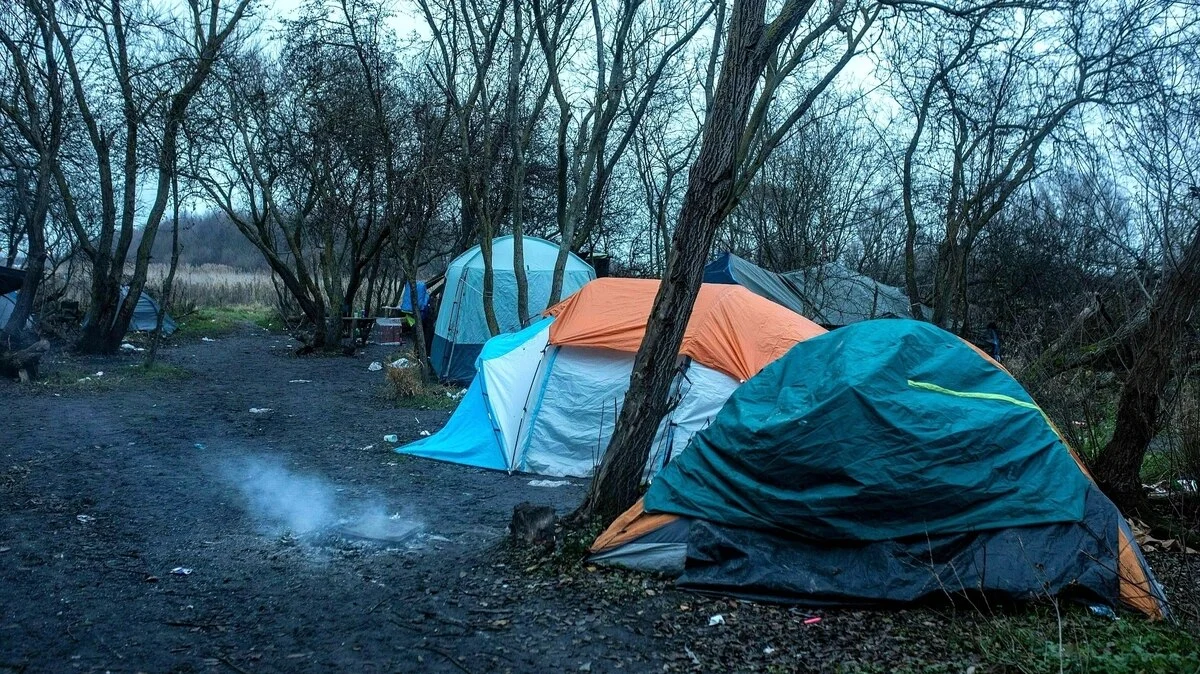
The current epicenter of the crisis has migrated some 30 kilometers east, near Dunkirk. Here, in the no-man’s-land between industrial estates and coastal forests, a new, sprawling camp has taken root. Aid organizations estimate that in September alone, nearly 2,500 people occupied the site.
The infrastructure of this camp mirrors its predecessor: makeshift shops selling snacks and gas canisters, phone-charging stations, and rudimentary "tea houses" where the rhythmic sound of knives on cutting boards replaces the silence of the woods. It is a fully functioning, albeit destitute, micro-society.
Life jackets, once a rarity, are now a primary commodity. Purchased at local sporting goods stores for roughly €30 or traded in the camp’s informal economy, they are the mandatory entry fee for the sea. For those like Jonas, an Eritrean refugee, the reality is stark: "The smugglers took my money—€1,300. I have tried three times, and three times the police destroyed our boat with knives and tear gas." Jonas, like many others, is trapped in a loop of debt, police violence, and the dangerous pursuit of a future across the water.
Supporting Data and the "Calais Group"
The escalation of the border regime has been fueled by hundreds of millions of euros in bilateral funding. Under the 2004 Le Touquet Agreement, the British government has essentially outsourced its border control to French soil.
The financial commitment is staggering: a border-protection deal signed in 2026 alone encompasses €760 million over three years. Since 2021, the "Calais Group"—comprising the UK, France, Belgium, Germany, the Netherlands, the EU Commission, Frontex, and Europol—has coordinated efforts to dismantle smuggling syndicates.

Yet, the statistics are grim. Since 1999, more than 500 people have perished attempting to cross the Channel. In 2025, 41 deaths were recorded; by October 2026, 31 lives had already been lost. As Bruno Retailleau, a former French Interior Minister, admitted in 2024, the "militarization of the border" has had "harmful consequences, including an increase in fatalities."
The shift to "taxi-boats"—larger, overloaded vessels that pick up passengers at various points along the coast—has created a lethal dynamic. In August 2026, one boat was found carrying 230 people, a massive increase from the average of 60 to 70 passengers per boat in previous years.
Official Responses and Local Impacts
For residents like Benoît Landesmann, a primary school teacher in Calais, the "legacy" of the Jungle is the permanent transformation of the landscape into a high-security zone. "Fences, everywhere there are fences, and in the middle of the city, there are boulders," he notes. These large stones are placed by authorities to prevent tents from being pitched in public spaces.
"The children here are used to seeing police everywhere," Landesmann observes. He describes the nightly "bizarre processions" of migrants escorted by police through the streets after being intercepted at the coast. For those who live in the dunes, the sea is no longer a site of recreation; it is a graveyard.
Brigitte Duhen, a volunteer with the NGO Opal’Exile, spends her days on the beaches of Hardelot, observing the desperate departures. She describes the emotional toll of watching people wade into the freezing, white-foaming water. "When I have seen something terrible on the beach, I need days before I can return," she says. "The images of the migrants, the police, the firemen—they never leave you."

Implications: A Failure of Policy
The persistence of the migration crisis at the Channel is not a failure of policing; it is a failure of policy. The assumption that the "Jungle" could be solved by bulldozers ignored the fundamental driver of human movement: the desire for safety and work, and the belief that the United Kingdom offers a better life than the reality of the post-crisis continent.
By pushing migrants further down the coast—from Calais to Equihen-Plage, Hardelot, and even the Normandy beaches—the authorities have merely increased the length of the sea crossing and the associated risks. The "taxi-boat" model, intended to evade the heavy patrols around Calais, has turned the wider Channel coastline into a theater of death.
As the political climate in both the UK and France continues to harden, the strategy remains focused on deterrence. However, history suggests that deterrence has a limit. As long as the "Myth of the UK" persists and the legal pathways for asylum remain obstructed, the cycle of the "Jungle" will continue. The fences will grow taller, the police presence more entrenched, and the tragic cycle of lives lost in the Channel will remain a defining, and shameful, chapter of 21st-century European history.
Ten years after the fall of the original Jungle, the lesson remains unlearned: you cannot demolish a human need for a future. You can only move it to the next beach, into the next boat, and into the next tragedy.