In the quiet, mountain-shadowed landscape of Bolzano, Italy, an unlikely cultural collision is taking place. The Museion, a temple of contemporary art, is currently hosting "Rammellzee: Time:line," the first major European retrospective dedicated to one of the most enigmatic, influential, and paradoxically invisible architects of modern American pop culture.
Rammellzee—born in 1960 and raised in the working-class enclave of Far Rockaway, Queens—was a man who defied categorization. He was a graffiti writer, a hip-hop pioneer, a performance artist, a sculptor of industrial-grade nightmares, and a self-styled philosopher of the "Gothic Futurism" movement. While his name is whispered with reverence in the inner circles of New York’s 1980s avant-garde, he remains a phantom to the general public. This exhibition seeks to exhume his legacy, presenting a life lived at the intersection of extreme creativity and slow-acting self-destruction.
The Architecture of the Void: Main Facts and Artistic Philosophy
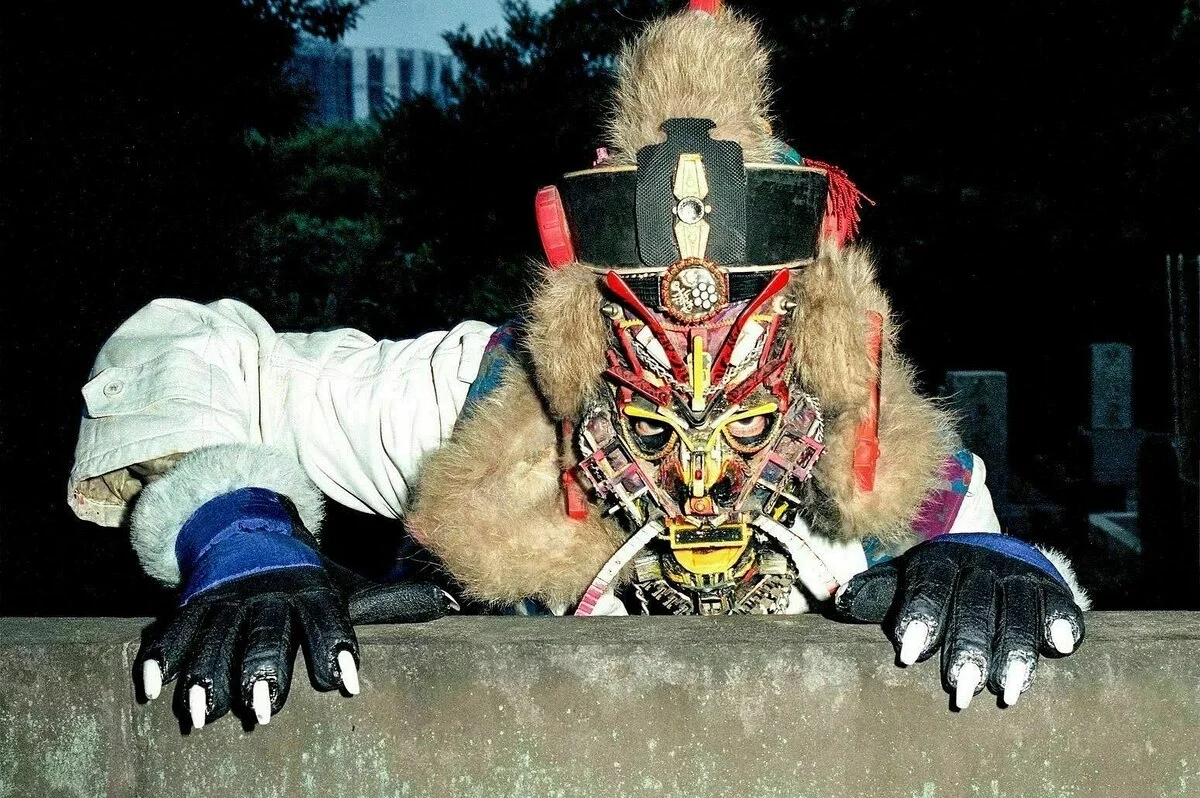
The exhibition opens not with a painting, but with a visceral, mechanical confrontation. A video from 1991 captures a young Rammellzee—often referred to simply as "Ramm"—preparing for an exhibition in the Netherlands. He stands before a towering, heavy-duty exoskeletal suit, a piece of wearable sculpture so dense it weighs nearly as much as the artist himself.
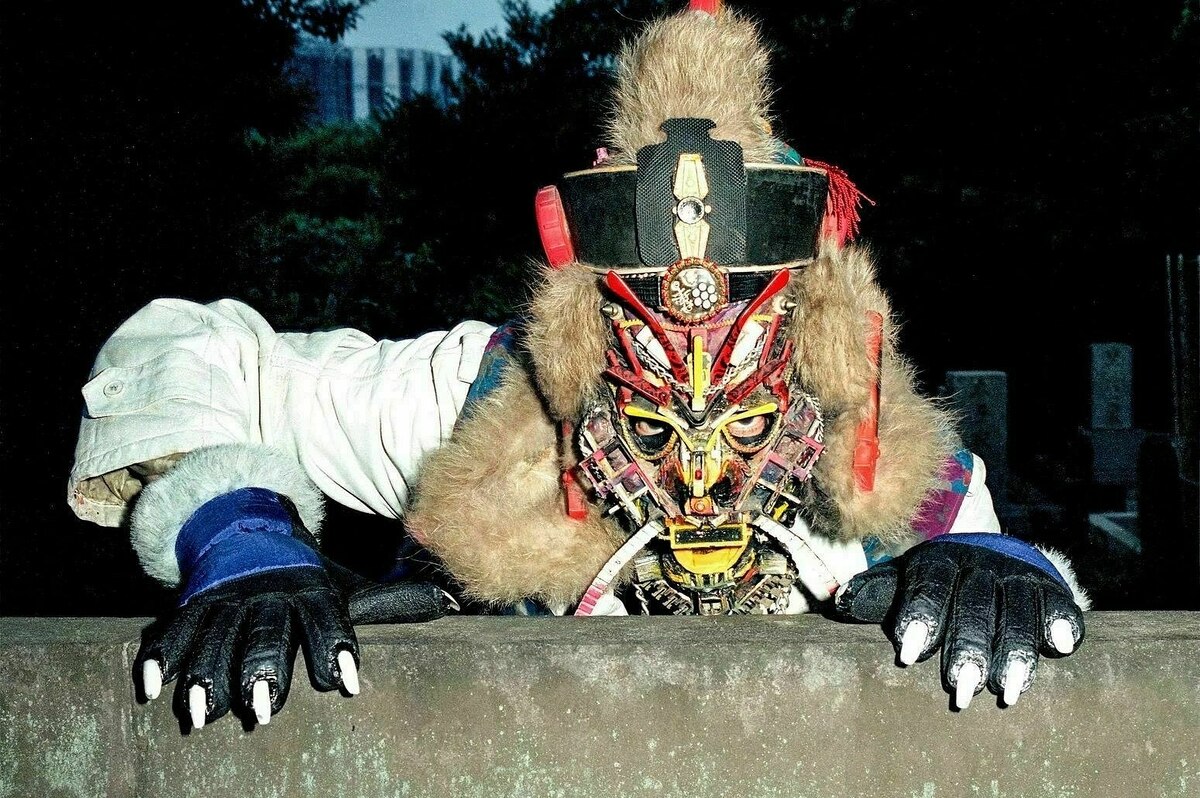
"Producing this thing cost 80,000 dollars and four years of my life," he quips to the camera. "It takes 15 people to help me get into it."
The "thing" is a marvel of DIY ingenuity: a chaotic fusion of plastic, epoxy, and hot glue. When loaded with dry ice, it billows smoke at the press of a button. It is, in essence, a manifestation of a childhood Lego-Technic fantasy, forged with the grit and "street cred" of a man who spent his youth navigating the dangerous, graffiti-streaked arteries of the New York City subway system.
Central to the Museion show is "Gasholear," a rotating, bulletproof sculpture adorned with flamethrowers, strobe lights, and a vocoder. It is a testament to Rammellzee’s obsessive nature; he spent seven years refining this single object, continuously updating its mechanisms. It stands as a physical manifestation of "Ikonoklast Panzerism"—a theory Rammellzee developed, which posited that letters of the alphabet, when weaponized through graffiti, could reclaim space from the oppressive, standardized forces of the city.

A Chronology of Subversion
Born to an African American mother and an Italian father, Rammellzee’s origin story is rooted in the "A-Train" subway line of Queens. In the late 1970s, as a teenager, he began tagging the city’s trains, discarding his birth name to adopt the moniker that would eventually become his entire identity.
His rise in the scene was meteoric. By 1982, his profile was cemented by his appearance in Charlie Ahearn’s seminal film, Wild Style, which introduced the world to the "four pillars" of hip-hop: graffiti, DJing, breaking, and MCing. However, Rammellzee was already operating on a frequency far beyond the standard graffiti writer.
He moved to Manhattan in 1979, where he was quickly absorbed into the downtown arts scene. He became a fixture in a circle that included Fab 5 Freddy, Jean-Michel Basquiat, and Martin Wong. His creative output was staggering in its variety:

- 1980s: Emergence as a visionary graffiti artist, shifting from subway cars to canvases and sculptural installations.
- 1983: Recording the seminal track "Beat Bop" with K-Rob and produced by Basquiat, a foundational moment in the history of experimental hip-hop.
- 1984: Cameo appearance in Jim Jarmusch’s Stranger Than Paradise, solidifying his status as a downtown icon.
- 1990s-2000s: Shift toward "Gothic Futurism," an artistic theory blending Afrofuturism, medieval aestheticism, and high-tech industrial waste.
- 2010: Death at the age of 49.
Supporting Data: The Cost of Creation
The exhibition at the Museion, curated by Hugo Vitrani and Cédric Fauq, does not shy away from the darker aspects of Rammellzee’s practice. His work was a physical manifestation of "oil-turned-art." He utilized toxic epoxy resins, neon paints, and industrial polymers to build his sculptures, often layering them with a reckless disregard for personal health.
The exhibition documents an aborted collaboration between Rammellzee and the prominent New York gallerist Jeffrey Deitch. The deal fell through because Rammellzee insisted on fabricating his resin works on-site at the gallery. Deitch refused to expose his staff to the noxious, highly toxic fumes that Rammellzee treated as a standard byproduct of his creative process.
This detail is pivotal to understanding the artist: his art was not merely something he made; it was an environment he inhabited. The price of this immersion was physical. Rammellzee died in 2010, his body ultimately failing due to years of chemical exposure. Even his final resting place is part of the exhibition: an urn of his own design, a mirrored pyramid that reportedly holds the key to the mathematical formula of his own name.

Museumsinternes Forschungsprojekt: Institutional Perspectives
The Museion’s decision to dedicate such a substantial retrospective to Rammellzee is part of a larger, long-term institutional research project. Following a major exhibition on graffiti last year, the museum is now diving into the "artist’s artist"—individuals who defined a subculture but were often overlooked by the high-art establishment during their lifetime.
Curators Vitrani and Fauq have successfully avoided the trap of making this a dry, archival display. By integrating the works of his peers—including pieces by Basquiat and Francesco Clemente—the exhibition contextualizes Rammellzee not as an isolated eccentric, but as a central node in a vast, interconnected network of 20th-century American counterculture.
The museum’s approach highlights the tension inherent in placing "street" art within white-cube gallery walls. Graffiti was birthed in the dark, in the prohibited, and in the ephemeral. As the artist himself is quoted in the exhibition: "Graffiti was created in the darkness, when you can feel nothing, touch nothing. You can focus on nothing and manipulate nothing."

Implications: The Legacy of Gothic Futurism
Why does Rammellzee matter today? In an era where digital art is increasingly ephemeral and "street art" has become a commodified, institutionalized aesthetic, Rammellzee’s work offers a stark, radioactive counterpoint.
His theories on "Gothic Futurism" remain startlingly relevant. He envisioned a future where the marginalized could find a new, equal humanity in the stars—an Afrofuturist vision that turned the "trash" of urban decay into the building blocks of a new cosmology. His influence can be traced through the evolution of street fashion (notably his collaborations with brands like Supreme), the experimental sounds of hip-hop pioneers like the Beastie Boys and Cypress Hill, and the visual language of contemporary sculpture.
The exhibition at the Museion is more than a trip down memory lane; it is a confrontation with a radical, uncompromising creative spirit. It forces the viewer to reconcile the brilliance of his vision with the destruction of his body. By displaying his masks, his weapons, and his philosophical manifestos, the museum invites us to consider the cost of total artistic commitment.

As the exhibition runs until March 2027, it serves as a long-term monument to a man who lived his life as a self-constructed myth. For those who visit, the takeaway is clear: Rammellzee was not just a participant in the history of pop culture; he was its architect, working in the shadows, fueled by the very toxins that eventually claimed him. His art is a reminder that while the system may try to categorize, sanitize, or ignore, true radical creation—the kind that truly changes the landscape—cannot be manipulated. It remains, like the neon-flecked armor he wore, impenetrable and blindingly bright.