STUTTGART – In a season defined by uncertainty and an unprecedented string of opening-day defeats, Borussia Mönchengladbach finally found their rhythm on a rain-soaked Friday night at the MHP Arena. By securing a hard-fought 3:2 victory over VfB Stuttgart, the “Foals” not only avoided the ignominy of setting a new all-time Bundesliga record for the worst-ever start to a campaign but also injected a vital dose of belief into a squad currently navigating a severe injury crisis.
For head coach Alexander Blessin, who returned to his hometown of Stuttgart, the result was a watershed moment. Facing a roster depleted by eleven absences, Blessin leaned on the resilience of his core and the brilliance of his young prospects to overcome an early deficit and silence a restless home crowd.
The Weight of History: Avoiding the Abyss
Entering this Matchday 7 fixture, the narrative surrounding Gladbach was one of impending historical failure. With six losses in their first six matches, the club sat precariously on the precipice of the record books. Had they succumbed to defeat in Stuttgart, they would have stood alone as the worst starters in the 61-year history of the Bundesliga.
History, however, is rarely written by the statistics alone. While the club’s form has been abysmal, the underlying effort—even in losses—had shown signs of growth. The 3:2 victory was the manifestation of that persistence. It served as a reminder that even a "rumpf-kader" (skeleton crew) can find success when tactical discipline meets individual moments of inspiration.
Chronology of a Comeback: How the Match Unfolded
A Nervous Start
The match began exactly as the Gladbach faithful feared. Only five minutes had elapsed when VfB Stuttgart’s Ermedin Demirovic, eager to prove his worth after a rotation in the starting lineup, unleashed a strike from 22 meters. The ball, hit on the turn, appeared routine, but a critical lapse by goalkeeper Moritz Nicolas saw the ball slip through his hands and into the net.
Stuttgart, coming off a grueling 1:1 Champions League draw against Atletico Madrid, initially looked the sharper side. Dzenan Pejcinovic and Lorenz Assignon peppered the Gladbach goal, and for the first half-hour, it seemed as though the visitors were merely delaying the inevitable.
The Turning Point
The tide shifted in the 38th minute. A botched clearance by Stuttgart’s Maximilian Mittelstädt landed at the feet of Zento Uno, who set up Joe Scally. With a display of technical audacity, Scally flicked the ball home with his heel, catching the Stuttgart defense completely off guard.
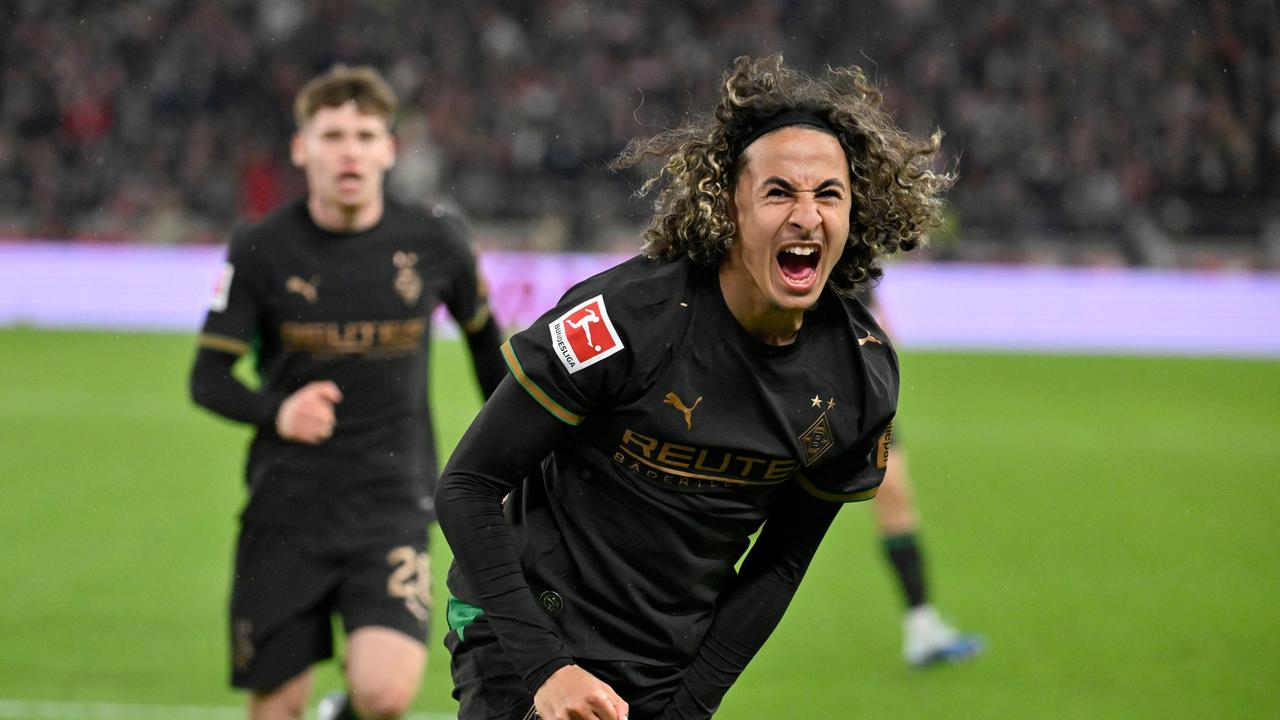
The goal changed the psychological landscape of the match. Suddenly, Gladbach were not just surviving; they were dictating. Before the halftime whistle, the visitors had forced Dennis Seimen into a series of crucial saves, and a thunderous strike from Wael Mohya rattled the woodwork, leaving the hosts feeling fortunate to head into the interval at 1:1.
The Second Half Surge
The momentum carried over into the second half with devastating efficiency. In the 51st minute, the breakthrough arrived: Wael Mohya, operating with the confidence of a veteran, danced past two defenders on the flank before delivering a precise cut-back to Shuto Machino, who hammered the ball into the top corner.
The decisive moment came in the 66th minute, cementing the night as the “Wael Mohya Show.” After a flurry of activity in the penalty area—a shot from Mohya, a line-save by the Stuttgart defense, and two attempts by Scally—the ball found its way back to the 17-year-old talent, who headed it into the net. It was a chaotic, gritty goal, but it represented everything Gladbach had been missing: hunger and presence in the final third.
Despite a late rally from Stuttgart, capped by a second goal from Demirovic in the 84th minute, Gladbach’s defense held firm under intense pressure to secure their first three points of the season.
Supporting Data and Personnel Challenges
The scale of this achievement cannot be understated when looking at the personnel report. Alexander Blessin traveled to Stuttgart without eleven first-team regulars. To fill the gaps, the manager was forced to call upon talents from the club’s Regionalliga side.
This forced integration of youth proved to be the catalyst for the victory. Players like Wael Mohya, who became the face of the match, provided a spark that the more established players had struggled to ignite in previous weeks.
Stuttgart, conversely, rotated six players following their Champions League commitments. While manager Sebastian Hoeneß defended the decision to utilize the depth of his squad, the lack of cohesion was evident. The team’s inability to maintain their early dominance proved fatal, a point of significant concern for the VfB leadership as they look to maintain their status as a European-caliber competitor.
Official Responses: "Too Little, Too Little" vs. "A Boost to Confidence"
The post-match atmosphere in the tunnel reflected the contrasting trajectories of the two clubs.
Alexander Blessin (Gladbach Coach):
"This victory does us a world of good and will provide the team with the necessary self-confidence moving forward," said the visibly relieved coach. "It hasn’t been easy for the boys, but we threw everything we had into this match. We were decimated by injuries, but the players who stepped up today gave us exactly what we needed. It was a well-deserved result."
Sebastian Hoeneß (Stuttgart Coach):
The tone from the home side was significantly darker. Hoeneß did not mince words regarding his team’s performance. "After this game, we are not where we want to be. It was simply not enough. You don’t win Bundesliga games by playing well for only 30 minutes. We lost our way, and that is a problem we must address immediately."
Implications: A New Season Begins
For Borussia Mönchengladbach
While the win does not instantly erase the misery of the opening six matches, it provides a foundation. Historically, teams that have started with six consecutive losses—such as Mainz (2020/21) and Bochum (2022/23)—have gone on to survive the season. Gladbach will look to use this momentum in the upcoming DFB-Pokal match against Karlsruher SC, followed by a "six-pointer" against SC Paderborn in the league. If they can replicate the intensity shown in Stuttgart, the club may yet escape the relegation battle.
For VfB Stuttgart
Stuttgart’s immediate future is equally fraught with challenges. The loss highlights the difficulty of balancing Champions League football with domestic consistency. With a DFB-Pokal fixture against Paderborn looming on Wednesday and a daunting trip to Bayer Leverkusen next Saturday, the pressure is on Hoeneß to quickly re-establish the defensive stability that characterized their success last season.
The Bigger Picture
This match serves as a microcosm of the Bundesliga’s volatile nature. In a league where the gap between the mid-table and the bottom is often razor-thin, a single match can define the narrative of a season. For Gladbach, the "night of the broken streak" will be remembered as the moment the season truly began. For Stuttgart, it stands as a stark warning that in the Bundesliga, no opponent is easy, and no momentum is permanent.
As the league progresses, the victory in Stuttgart will be viewed as the night the "Foals" refused to go quietly into the night, setting the stage for what promises to be a dramatic autumn in German football.