DÜSSELDORF – They are impossible to ignore: gargantuan, vibrant, and unabashedly curvaceous. Known as the "Nanas," the iconic sculptures of Niki de Saint Phalle have become synonymous with joy and liberation. Yet, as a major new exhibition titled Dream Machine opens at the Kunstpalast in Düsseldorf, the public is being invited to look past the primary colors and round forms. The exhibition, running through February 7, 2027, peels back the layers of Saint Phalle’s life, exposing the profound trauma, searing rage, and fierce intellectual rigor that fueled one of the 20th century’s most complex artistic legacies.
The Evolution of an Icon: From Rage to Radiance
To understand Niki de Saint Phalle is to understand a woman who used art as a weapon of self-preservation. Born in 1930 in Neuilly-sur-Seine and raised in a strictly Catholic environment in New York, Saint Phalle’s early life was marked by a crushing adherence to societal norms—specifically the expectation that a woman’s purpose was to marry and serve.
However, the "Nanas"—a term derived from the French slang for a feisty, sexually liberated woman—did not emerge from a place of pure happiness. They were the culmination of a long, painful process of exorcising personal and systemic demons. In the 1960s, before the birth of the colorful, dance-like figures that define her public image, Saint Phalle was a practitioner of "shooting paintings." She would load a rifle and fire at assemblages of plaster, paint, and objects, allowing the colors to bleed down the canvas like wounds.
"Using a rifle is an act traditionally coded as masculine," explains Heike van den Valentyn, curator of the Dream Machine exhibition. "In that act of destruction, she was creating something entirely new. It was an act of catharsis."
Chronology of a Creative Revolution
- 1930: Born in France, raised in New York.
- 1950s: After a nervous breakdown and institutionalization, including electroshock therapy, Saint Phalle turns to art as a "necessity and redemption."
- 1961: The "Tirs" (Shooting Paintings) period. Saint Phalle gains notoriety for her public performances of shooting her own art.
- 1966: Creation of Hon-en katedral (She-a cathedral) in Stockholm. A 29-meter-long, reclining Nana that visitors could enter through the vagina, featuring a milk bar in the breast and a cinema in the womb.
- 1974: The installation of the Nanas at the Leibnizufer in Hannover. Initial public outcry labels them "unformed dumplings" and "disgusting monstrosities."
- 1994: Publication of her autobiography, in which she publicly reveals that she was sexually abused by her father starting at age eleven.
- 2026/27: Dream Machine exhibition at the Kunstpalast, Düsseldorf, re-evaluating her entire body of work.
The Architecture of Femininity: The "Hon" and Beyond
Perhaps the most radical moment in Saint Phalle’s career occurred in 1966 with Hon ("She" in Swedish). Collaborating with her partner, the kinetic artist Jean Tinguely, Saint Phalle built a colossal, reclining female figure in the Moderna Museet in Stockholm.
The sculpture was not merely a statue; it was an environment. Visitors entered the massive, colorful body through the legs. Once inside, they found a space that challenged the traditional male-dominated art world’s view of the female body. It contained a mechanical womb, a love nest, and a milk bar. By turning the female body into a public, traversable space, Saint Phalle forced society to confront the physical realities of womanhood—pregnancy, birth, and motherhood—in a monumental, unapologetic way.
When these sculptures eventually made their way to Hannover in 1974, the reaction was vitriolic. The public, still steeped in conservative gender ideals, viewed the rotund, non-conforming bodies as an affront to femininity. Yet, Saint Phalle welcomed the outrage. She had intended to disrupt, and she had succeeded. Today, those same sculptures are the pride of Hannover, and Saint Phalle remains the city’s only honorary citizen—a testament to how radical ideas can eventually become the pillars of a city’s cultural identity.
Supporting Data: The Psychology of the Work
The Dream Machine exhibition serves as a critical academic reassessment. By juxtaposing her later "joyful" works with the dark, jagged assemblages of her youth, the Kunstpalast provides data on the trajectory of trauma-informed art.
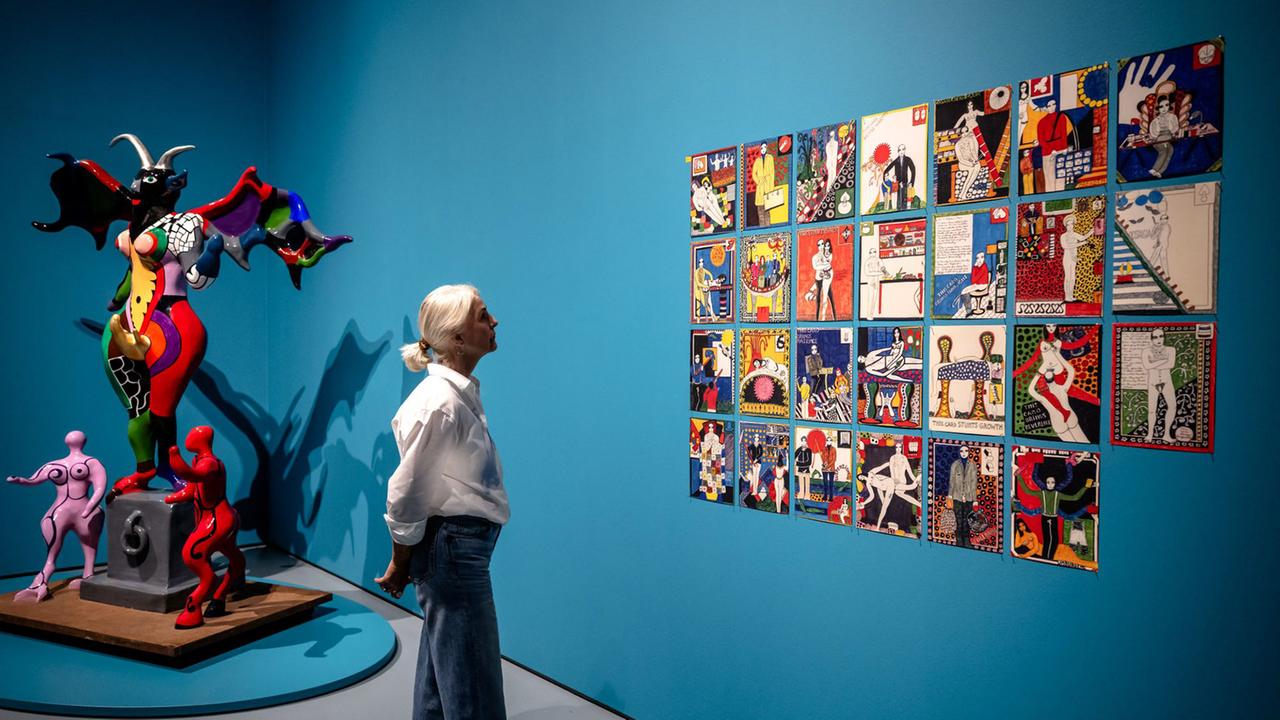
The exhibition highlights that Saint Phalle’s shift toward "joy" was not an abandonment of her politics, but a strategic evolution. She discovered that a positive, colorful, and inclusive aesthetic could be just as subversive as a violent one. By creating sculptures that children could climb on and play with, she democratized art. She moved the conversation about women’s rights and bodily autonomy from the gallery walls into the public square, turning art into a tool for communal healing.
Official Perspectives: The Curator’s View
Heike van den Valentyn emphasizes that the relevance of Saint Phalle’s work has only grown over time. "In her own time, her concerns were often dismissed as secondary or purely aesthetic," van den Valentyn notes. "Today, we recognize the deep political urgency behind her work. She was fighting against a male-dominated art scene that had no language for female rage, female pleasure, or the complex ambivalence of motherhood."
Van den Valentyn points out that Saint Phalle’s work shares a profound kinship with contemporary feminist icons like the late Yayoi Kusama. Both artists utilized repetitive patterns and vibrant colors as a form of armor against deep-seated psychological trauma. "Both women were dealing with profound pain, but they chose to channel it into a visual language that is hyper-visible, bold, and ultimately, empowering," the curator explains.
Implications: A Mirror for Modernity
The implications of the Dream Machine exhibition are significant for the contemporary discourse on gender and art. Saint Phalle’s insistence on "all power to the Nanas" remains a rallying cry for self-determination. Her work forces us to ask: How do we, as a society, process collective and individual trauma?
The exhibition highlights that Saint Phalle’s art was designed to be "used." She famously advocated for art that was tactile and engaging. By bringing the viewer into the work—physically and emotionally—she dismantled the barrier between the creator and the consumer.
As we look at her work today, the themes of bodily autonomy and the right to define one’s own existence are as pertinent as they were in the 1960s. Her work serves as a reminder that the personal is political, and that the act of reclaiming one’s narrative—whether through a rifle, a paintbrush, or a giant, colorful sculpture—is a revolutionary act.
A Legacy of Resilience
The Dream Machine exhibition is not just a retrospective; it is an invitation to engage with the grit behind the glamour. As visitors walk through the halls of the Kunstpalast, they are encouraged to look past the primary colors and see the scars, the rebellion, and the immense, enduring strength of a woman who refused to be defined by her abusers or her critics.
Niki de Saint Phalle transformed her life from a site of victimization into a fountain of creative power. As the exhibition demonstrates, she did not just create art; she created a blueprint for survival, proving that joy, when wielded with intent, is one of the most powerful tools for social and personal change. Whether it is a Nana dancing on the streets of Hannover or a miniature figure in the halls of Düsseldorf, the spirit of Niki de Saint Phalle continues to challenge, provoke, and inspire.