Main Facts: A New Laureate of Complexity
In a literary world often defined by linear narratives and predictable genres, the announcement of Anne Carson as the Nobel Prize laureate in Literature marks a victory for the unconventional. At 76, the Canadian poet, essayist, and classicist has redefined what it means to be a contemporary intellectual. Her work does not merely exist on the page; it operates as an active, often volatile performance that challenges the structural integrity of language itself.
Carson’s writing is a radical synthesis of ancient Greek scholarship and avant-garde experimentation. She is a master of the "unreliable" text, where the visual arrangement of words—often sprawling across the page in defiance of standard formatting—is as significant as the syntax. To read Carson is to engage in an exercise of active questioning, where the reader is invited to dismantle their own certainties alongside the author.
Chronology: From Antiquity to the Avant-Garde
Anne Carson’s trajectory is as fragmented and brilliant as her prose. Born in 1950, her academic roots are firmly planted in the soil of antiquity. She pursued rigorous training as an altphilologist (classicist), a background that continues to inform her work. However, her path was never linear; she famously interrupted her studies multiple times, enrolling in a vast array of disciplines that allowed her to cross-pollinate her interests in philosophy, linguistics, and art.
- Early Career: Carson emerged as a formidable academic voice, publishing scholarly inquiries that bridged the gap between historical analysis and creative interpretation. Her foundational interest in Sappho and the nature of desire—most famously explored in Eros the Bittersweet—established her as a thinker who treats ancient history as a living, breathing laboratory for modern human experience.
- The Breakthrough of "Autobiography of Red": Published in 1998, this novel-in-verse transformed Carson from an academic darling into a literary phenomenon. By re-imagining the myth of Geryon—a monster from the Greek tradition—as a vulnerable, gay adolescent living in the modern world, she proved that the ancient past could be used to illuminate the most pressing anxieties of the present.
- The Prolific Decades: Over the subsequent twenty-five years, Carson has maintained a relentless pace of production, oscillating between essays, experimental plays, and poetry collections like Men in the Off Hours and Float. Her recent recognition with the Nobel Prize is the culmination of a decades-long career defined by an uncompromising refusal to simplify the human condition.
Supporting Data: The Architecture of the "Punk Philosopher"
What sets Carson apart is her refusal to accept the "sanctity" of the text. She treats language as a physical material—something to be stretched, broken, and reassembled.
The Philosophy of the "Doubtful Cogito":
In a recent dialogue with Norwegian novelist Linn Ullmann, Carson offered a masterclass in intellectual deconstruction. When discussing René Descartes’ famous assertion, “Cogito, ergo sum” (I think, therefore I am), Carson noted the fundamental error in our modern reduction of the philosopher’s work. “In reality, the full text reads ‘Dubito, ergo cogito, ergo sum’—I doubt, therefore I think, therefore I am.”
For Carson, this is the cornerstone of her methodology. Doubt is not a failure of knowledge; it is the prerequisite for thought. By centering her work on the "space between" certainties, she creates an environment where the reader is forced to confront the gaps in their own understanding.
The Stesichoros Effect:
Carson often cites the 6th-century BC poet Stesichoros as a personal hero. She credits him with being the first to introduce nuance into language. Before Stesichoros, adjectives were static: Helen was always beautiful, death was always bad. He introduced the possibility of multi-dimensional characterization. Carson adopts this "Stesichorean" approach in her own writing, elevating figures like Herakles or Hektor from mythic archetypes to deeply human, often tragic, subjects.
Official Responses and Academic Reception
The literary community’s response to her Nobel win has been one of reverence mixed with a sense of "about time." Critics have long lauded her as a "Punk Philosopher," a title she embraces with her signature blend of wit and intellectual rigor.
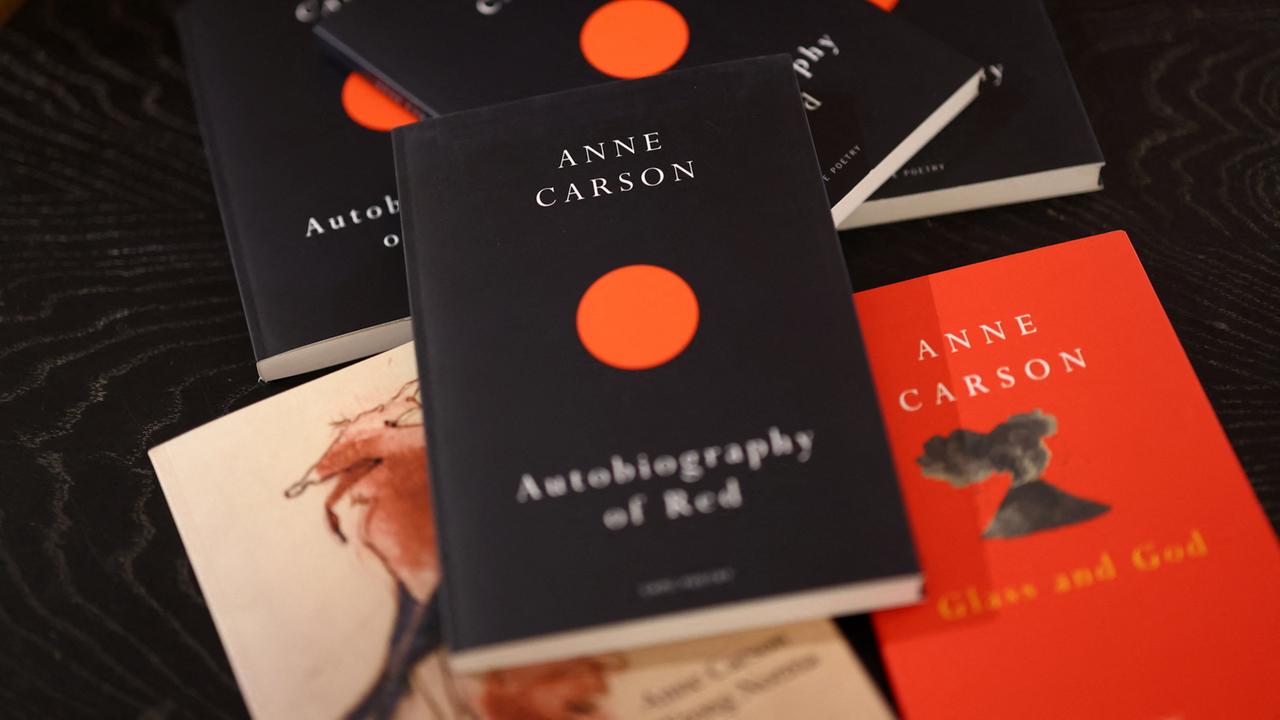
"Anne Carson doesn’t just write; she interrogates the very possibility of communication," says Dr. Elena Vance, a scholar of comparative literature. "Her work on the ‘TV Men’—where she subjects figures like Lazarus or Antigone to modern, almost journalistic, scrutiny—reminds us that our myths are not static icons. They are, and always have been, vulnerable to our own current biases and pains."
Her public appearances, which are increasingly rare but highly sought-after, are described by attendees as "events" rather than readings. Her recent performance in Berlin, which drew 700 people, saw her lecturing on the creation of the universe with the casual expertise of someone discussing a grocery list. She moved effortlessly from the physics of galaxy formation to the existential silence of Samuel Beckett’s Godot, demonstrating an uncanny ability to connect the macrocosm of the universe to the microcosm of human doubt.
Implications: Why Carson Matters Today
The implications of an Anne Carson Nobel Prize extend far beyond the accolade itself. In an era dominated by soundbites, algorithmic content, and the erosion of nuance, Carson’s work serves as a necessary corrective.
1. The Return of Critical Thinking
Carson’s insistence on "the small things"—the minor details in an ancient myth, the specific phrasing of a philosophical line—is an invitation to slow down. She argues that the task of the writer is to pay attention to the details that others discard. By forcing readers to focus on these marginalia, she encourages a level of intellectual engagement that is increasingly rare.
2. Challenging the Binary
Carson’s work is inherently non-binary. She blurs the lines between essay and poem, between the ancient and the modern, and between the objective and the subjective. In Norma Jean Baker of Troy, she juxtaposes the life of Marilyn Monroe with the legend of Helen of Troy, suggesting that the "consumption" of female icons is a trans-historical tragedy. This thematic layering forces the audience to acknowledge that our modern obsession with fame is simply a re-enactment of ancient patterns.
3. The Ethics of Curiosity
Ultimately, Carson’s legacy is one of radical curiosity. She does not offer answers. When she asks, through her poetry, what Lazarus felt upon being ripped from the grave, she does not provide a definitive resolution. She leaves the doubt hanging. For the reader, this is an act of liberation. It signals that it is acceptable—even necessary—to live in a state of unresolved questioning.
As the world continues to grapple with increasing polarization, Anne Carson’s body of work stands as a bastion of complexity. She reminds us that to think is to doubt, and to doubt is the most profoundly human act of all. Her Nobel win is not just an acknowledgment of her past contributions; it is a signal to the next generation of writers that the most important work is that which breaks the mold, challenges the expectation, and celebrates the beautiful, bitter, and endless process of becoming.