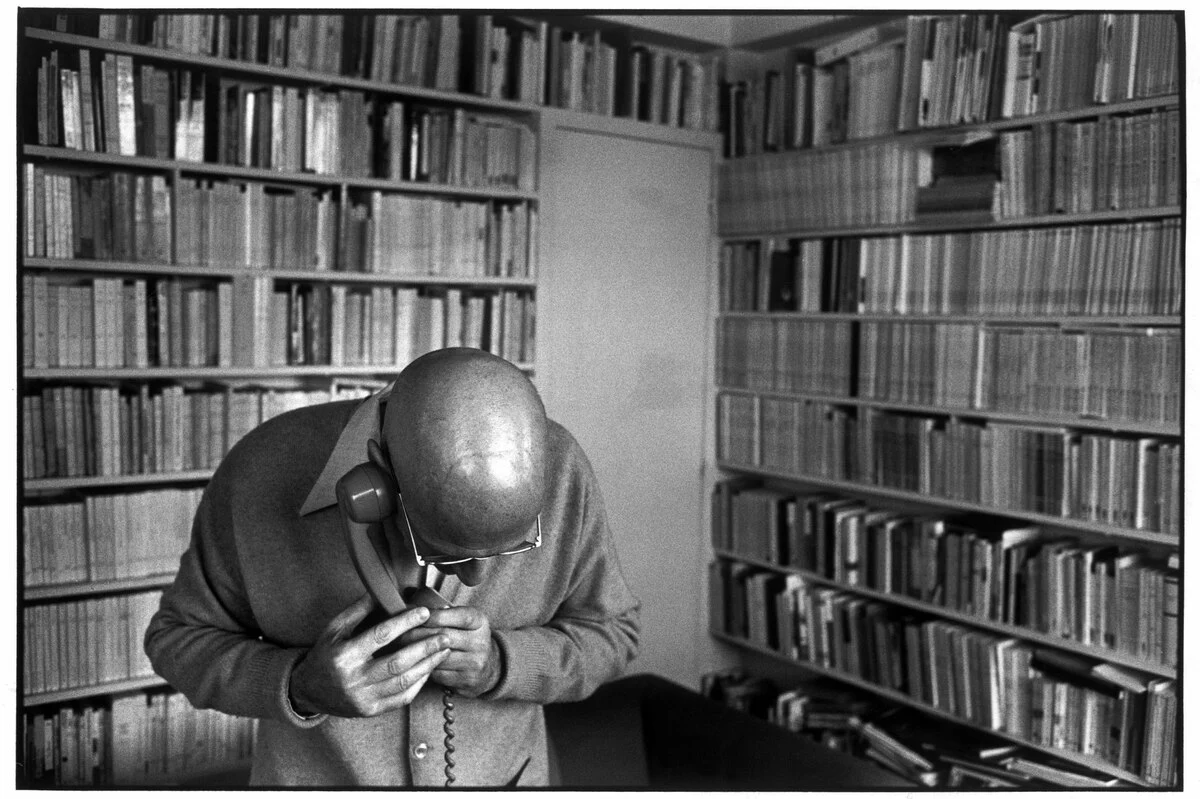
In the late intellectual life of Michel Foucault, a cryptic, poetic aphorism emerged as a silent sentinel on the back covers of his final masterworks. "The history of humanity is the long succession of synonyms for one and the same word. To contradict it is a duty." These lines, penned by the French poet and resistance fighter René Char, serve as more than a mere epigraph; they act as a philosophical anchor for Foucault’s late-stage investigations into the history of sexuality. As we approach the centenary of Foucault’s birth in 2026, the resurgence of this sentiment invites a profound re-examination of how the philosopher engaged with literature, resistance, and the radical potential of a single, unifying signifier.
The Mystery of the Synonymic Imperialism
Can one conceive of a language that does not rely on the differentiation of words to generate meaning? A linguistic system where every utterance sounds identical, and meaning is derived solely from social context, gesture, and the radical empathy of the listener? This is the provocation embedded in René Char’s aphorism.
When Foucault chose to place this sentence on the back covers of the final volumes of The History of Sexuality (Histoire de la sexualité), he was essentially mirroring the rhetorical weight of Marx’s eleventh thesis on Feuerbach: "The philosophers have only interpreted the world, in various ways; the point is to change it." Char’s words possess a similarly apodictic, seductive force. They demand a response not just to their semantics—what do they actually mean?—but to their pragmatics: why, at the conclusion of a lifetime of intellectual labor, did Foucault return to this specific, haunting injunction?
A Chronology of Influence and Exile
To understand the weight of this citation, one must trace the trajectory of Foucault’s relationship with Char. In the early 1950s, Char was Foucault’s most-cited contemporary author. However, this period of intellectual devotion was marked by profound personal struggle. Foucault was suffering under the suffocating weight of institutional homophobia within the Parisian elite academic circles. This environment, which drove him to two suicide attempts between 1948 and 1950, effectively forced him into a form of "exile" across Europe.
During his tenure in Uppsala, Warsaw, and eventually Hamburg (1959–1960), Foucault taught courses on contemporary French literature, with Char’s works—specifically Hypnos—at the center of his curriculum. Hypnos, written during the Nazi occupation, is a collection of fragmented, dry, and often devastatingly beautiful records of life in the Resistance. For Foucault, the urgency of Char’s prose—which documented the horrors of war alongside metaphysical speculation—offered a model of survival.
In Hamburg, the atmosphere proved more hospitable. Foucault’s tenure at the Institut Français coincided with a vibrant, albeit cautious, queer underground. Anecdotes from the era, such as those involving the activist Rolf Italiaander, illustrate a man beginning to shed the trauma of his Parisian years. It was in this "orbit of the Suhrkamp culture" that the seeds of his later philosophical shifts were sown.
Supporting Data: The Puzzle of the Translation
The appearance of the Char quote on Foucault’s books is not merely an editorial footnote; it is a bibliographical mystery. When the German edition of the fourth volume of The History of Sexuality appeared in 2019, the Char quote was present, yet it diverged from established translations of the poet’s work.
Research indicates that a version of this quote appeared in a 1991 Edition Suhrkamp volume, edited by François Ewald and Bernhard Waldenfels. The translator of the quote remains elusive, seemingly circulating within the intellectual orbit of the Suhrkamp publishing house for decades before it finally adorned the back of the Foucault volumes. This suggests a deliberate, almost subterranean transmission of ideas—a "homonymic resistance" that mirrors the very content of the aphorism itself.
Implications: The Search for the "One Word"
What does this mean for Foucault’s late philosophy? The "history of humanity as a long succession of synonyms" implies that our historical progress has been an illusion of linguistic variation. If the history of sexuality is, as Foucault suggests, a series of forced confessions and power-knowledge structures, then to "contradict it" is to reject the dictionary of the state.
The literary theorist Dennis Hollier, analyzing this motto, asks: "Will we oppose this imperialism of synonymy with a homonymic resistance?" This points toward a linguistic utopia—or perhaps a radical performative act. If we replace the endless, divisive vocabulary of power with the "one word," we might find ourselves in the realm of the secret rhyme, the password, or the mantra.
Hollier draws parallels to the repetitive, rhythmic nature of music—from the syncopated beats of Afrobeat and Funk to John Lennon’s fascination with the song that consists of only one tone and one word. In such a framework, meaning is not fixed; it is generated through the groove, the repetition, and the shared experience of the beat. The "word" does not change, but its resonance shifts with the unfolding of the night.
The Return of the Resistance
Foucault’s return to Char in his final years signifies a shift from the structuralist analysis of his middle period back to an existential ethics. If the "repressive hypothesis" of sexuality was the target of his early work, the later work sought a way to live within the "confession-compulsion" that modern society imposes.
Char’s aphorism suggests that history, in its very structure, has always been "wrong." Therefore, the task of the intellectual is not to continue the story, but to break it. By embracing the "homonymic"—the idea that there is only one word—Foucault hints at a form of existence that refuses to be categorized or defined by the state’s taxonomy.
This is where the "Love" of the Beatles, or the simple, devastating clarity of Lennon’s The Word, resonates with Foucault’s project. It is not a call for a return to a pre-linguistic state, but a demand for a language that acknowledges its own limits. To "say the word" is an act of resistance against the infinite, grinding machinery of synonymic history.
Conclusion: A Philosophy of the Present
The resonance of Foucault’s work in the 21st century—especially concerning sexuality, power, and identity—remains unparalleled. By linking his final investigations to the poetic resistance of René Char, we see a Foucault who was less interested in the construction of a grand theory and more interested in the cultivation of a practice.
The eleventh thesis of the "Rubber Soul" era is this: we are trapped in a long, monotonous succession of synonyms, and our duty is to break that chain. Whether through the repetitive grace of a song, the subversion of identity in a drag performance, or the quiet, persistent resistance of a single, honest word, Foucault leaves us with an open-ended challenge. As we look back on his hundred years, we are not asked to interpret his work; we are asked to find our own "one word" and, in doing so, to contradict the history that has been written for us.
In the final assessment, Foucault’s life and work suggest that while the institutions of power seek to divide us through the proliferation of labels, there exists a radical, unifying possibility in the repetition of the essential. To speak that word, whatever it may be for the individual, is the ultimate act of defiance.