The natural world is a theater of constant drama, where the microscopic struggles of insects, the silent grief of giants, and the evolving adaptations of urban wildlife play out far from human observation. Each year, the "Wildlife Photographer of the Year" competition—the most prestigious global showcase of nature photography—serves as a vital archive of these moments. The 2026 collection, a curated selection of which has recently been unveiled, continues this tradition, pushing the boundaries of technical mastery and emotional storytelling.
From the macro-lens intimacy of a predator-prey interaction in a garden to the stark, scientific documentation of ecological shifts in Utah’s Great Salt Lake, this year’s entries provide a profound look at the state of our planet. These images are more than mere aesthetics; they are evidence of a changing world, capturing the intersection of human expansion and the resilience of the animal kingdom.

The Human Impact: A Shifting Ecological Landscape
One of the most striking aspects of the 2026 collection is the blurring line between "wild" and "urban." In Bangkok, photographer Seth Forestson has captured the prehistoric majesty of water monitors—large, formidable lizards that have adapted to the concrete sprawl of the city. Once confined to remote waterways, these reptiles now navigate the urban landscape, resembling the dinosaurs of a bygone era. Forestson’s work highlights a critical contemporary reality: as human habitats expand, wildlife is forced to adapt, often finding unexpected niches within our infrastructure.
Similarly, Alex Visbal’s documentation of the Great Salt Lake in Utah offers a sober reminder of human intervention. By capturing the dramatic, blood-red coloration of the water—a byproduct of specific microbes thriving in hypersaline conditions following the disruption of freshwater supplies—Visbal illustrates the cascading environmental consequences of water management. The image serves as a visual proxy for a broader, more invisible ecological crisis, transforming scientific data into a hauntingly beautiful landscape.

Moments of Raw Survival and Intimacy
The competition is perhaps most famous for its "action" shots, which require not only immense patience but also the ability to anticipate the unpredictable. Alexis Tinker-Tsavalas’s close-up of a flesh fly falling prey to a robber fly is a masterclass in macro photography. The image freezes a millisecond of violence, highlighting the brutal efficiency of the natural world. It is a reminder that even in our own backyards, life and death cycles continue with indifferent precision.
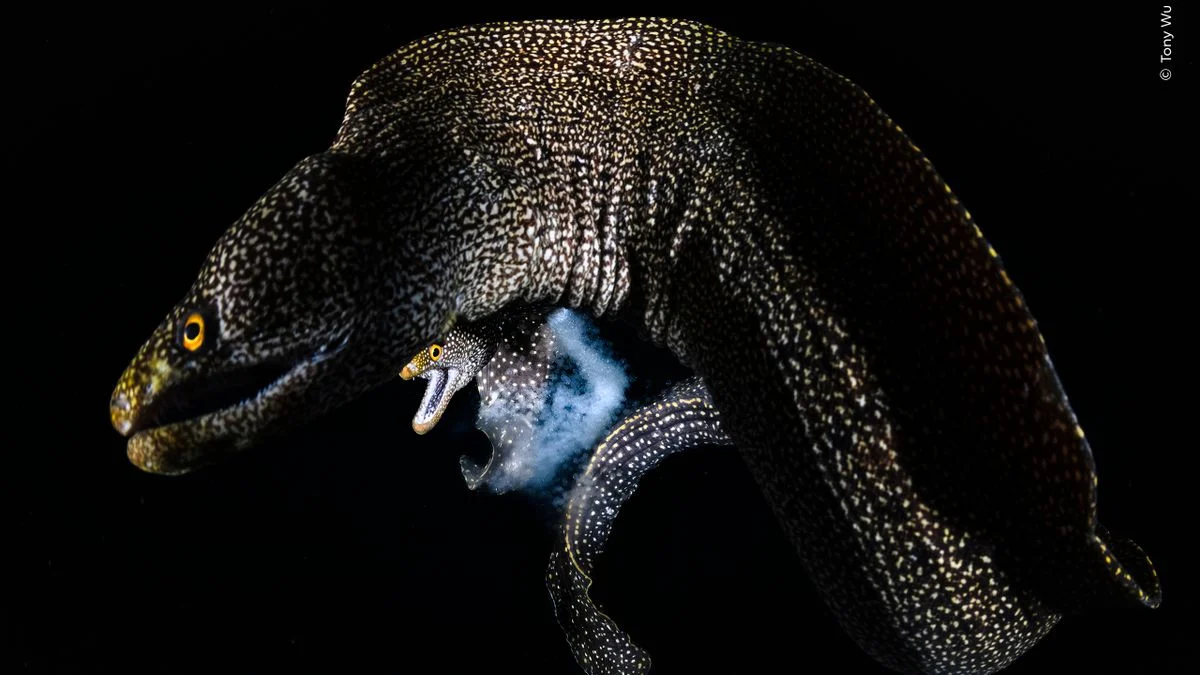
In contrast to the quick, decisive nature of predation, other photographers have focused on the complex social behaviors of animals. Tony Wu’s long-term study of Abbott’s moray eels represents a milestone in marine biology documentation. By observing the male for two years, Wu captured what is believed to be the first-ever photographic record of their courtship ritual. Such images are invaluable to scientists, providing insights into reproductive behaviors that were previously shrouded in mystery.

Empathy and the Science of Grief
Perhaps the most emotionally resonant image in the 2026 selection comes from Federico Veronesi, who documented an elephant mother mourning her deceased calf. The image is stark and deeply moving, challenging the anthropocentric view that complex emotions like grief are exclusive to humans.
Research in ethology has increasingly suggested that large mammals, particularly elephants, possess the cognitive capacity for deep social bonding and, consequently, profound loss. Veronesi’s photograph acts as a catalyst for this ongoing scientific debate. It forces the viewer to confront the possibility that the animals we study may be far more psychologically sophisticated than we have historically been willing to admit.

Supporting Data: The Next Generation of Observers
The inclusion of youth categories is a cornerstone of the Wildlife Photographer of the Year, and this year’s winner, Amelie Davis, exemplifies the importance of this mission. Her winning shot of a bumblebee, captured using nothing more than her father’s smartphone, demonstrates that the barrier to entry for conservation-minded storytelling is falling.
This democratization of photography is essential for the future of environmental advocacy. By encouraging young people to observe and document the wildlife in their own gardens, the competition fosters a sense of stewardship that is vital for long-term ecological preservation. As these young photographers grow, they carry with them a heightened awareness of the biodiversity that exists right on their doorsteps.

Official Perspectives: The Role of the Competition
The jury for the 2026 competition emphasized that their selection process was guided by three core criteria: technical excellence, originality, and the narrative weight of the subject matter. In an era where AI-generated imagery and heavy digital manipulation have become commonplace, the "Wildlife Photographer of the Year" remains a bastion of authenticity.
"These images are not just ‘pretty pictures,’" a spokesperson for the judging panel noted. "They are the front-line reports from the field. Whether it is a whale shark feeding near an Indonesian fishing platform—a phenomenon captured by Alex Lindbloom—or the subtle, rhythmic behavior of nesting shoebills in Uganda observed by Isak Pretorius, each photograph acts as a witness to the state of nature today."

The competition organizers have also highlighted the increased focus on the "Bagan" fishing platforms in Indonesia. These platforms create artificial environments that attract whale sharks, leading to a unique, albeit complicated, interaction between humans and one of the ocean’s largest species. This provides a perfect example of how the competition functions as a research tool: by documenting these interactions, photographers provide scientists with data on population densities, feeding habits, and the long-term effects of human-wildlife proximity.
Implications: Why These Images Matter
The broader implications of the 2026 exhibition are clear: the world is rapidly changing, and our relationship with nature is becoming increasingly entangled. The imagery provided by this year’s winners acts as a mirror to our own actions.

- Urban Adaptation: As species like the water monitor adapt to city life, we must re-evaluate urban planning to accommodate biodiversity, ensuring that the "wild" does not disappear as cities grow.
- Climate and Resource Management: The ecological shifts in places like the Great Salt Lake indicate that we are approaching tipping points in our management of natural resources.
- Animal Cognition: The documentation of grief in elephants demands a shift in how we approach conservation, prioritizing the psychological and social well-being of the animals we protect, not just their physical survival.
- Community Engagement: By celebrating amateur and youth photography, the competition highlights that everyone, regardless of equipment or experience, can contribute to the global understanding of our ecosystem.
Conclusion: A Call to Witness
The 2026 Wildlife Photographer of the Year collection serves as both a celebration of the planet’s beauty and a somber reflection of its fragility. Each photograph is an invitation—a request for the viewer to stop, look, and consider the intricate, often invisible, web of life that sustains us all.
Whether it is the "rasensprenger" (lawn sprinkler) behavior of elephants at a Kenyan water hole, or the early morning song of a common blackbird captured by Konrad Gräter, the exhibition reminds us that nature does not require a trip to the Serengeti to be found. It is present in the rhythm of the seasons, the habits of our garden insects, and the resilience of the wildlife that shares our cities.

As the exhibition travels globally, its impact will undoubtedly ripple through the scientific and public spheres, influencing conservation policies and individual attitudes alike. The 2026 winners have done more than take pictures; they have taken a stand for the natural world, documenting its wonders and its wounds with equal dedication. In doing so, they ensure that even if these species or habitats were to vanish, their stories would remain—a permanent record of a world that we are privileged to share, but currently failing to preserve.