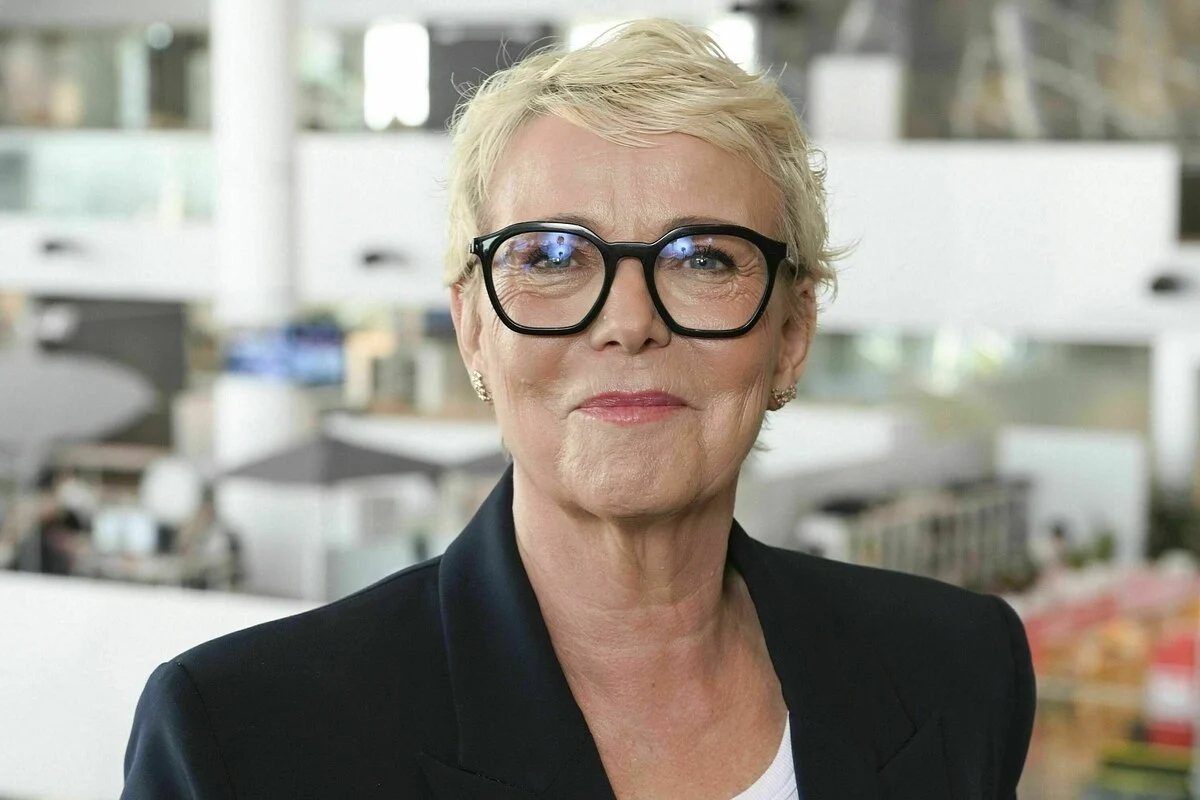
Berlin, Germany – A fleeting moment of apparent defiance against Germany’s far-right Alternative for Germany (AfD) party by Marion Horn, Editor-in-Chief of Germany’s most influential tabloid, Bild, has rapidly dissolved into a public apology and a cascade of contradictions. What began as a bold personal declaration in an authorized interview quickly transformed into a retracted "mistake," sparking widespread debate about journalistic integrity, editorial independence, and the media’s complex relationship with extremist political forces.
The Initial Declaration: A Moment of Apparent Clarity
The controversy ignited following an interview Horn gave to the media industry service Kress Pro. In a discussion frequently revolving around the Axel Springer Verlag’s (owner of Bild) stance on the AfD, Horn offered what seemed to be a definitive personal position. She recounted a vivid anecdote: "In my office hangs a poster. There’s a sports plane pulling an advertisement behind it. It says: ‘Fuck AfD’. That is my attitude." This unequivocal statement, "Fuck AfD," was a stark, almost visceral, rejection of the party.
Horn elaborated further on the internal struggles within the Bild newsroom, acknowledging the pervasive discussions about how to cover the AfD without inadvertently legitimizing it. She revealed a personal dilemma that many journalists face when confronted with extremist politics: "Do I want there to be even one photo of me with Ms. Weidel? No. Is that unjournalistic? Unfortunately, yes." This self-critical reflection underscored the tension between personal conviction and the professional expectation of objective reporting, even while making such a politically charged statement. Her candor offered a rare glimpse into the internal ethical debates within a major news organization grappling with the rise of the far-right.
The revelation from the head of Germany’s most read newspaper that her "attitude" was "Fuck AfD" was, for many, a significant moment. It suggested a clear editorial line, or at least a powerful personal stance, from a figure whose publication often influences public discourse. While the German "media bubble," as the original article noted, remained "surprisingly quiet" immediately after the statement, the declaration resonated with those who had long questioned Bild‘s coverage of the AfD, often perceiving it as inadvertently amplifying the party’s messages.

However, not everyone remained silent. Julian Reichelt, Horn’s ousted predecessor at Bild, reacted with characteristic vehemence. In a post on the platform Nius, he fumed over what he termed an "absolutely fatal, politically propagandistic activist utterance," highlighting the deep ideological fissures within the German media landscape, particularly concerning the AfD. Reichelt’s condemnation underscored the perceived breach of journalistic neutrality, even as it came from a figure whose own tenure was marked by controversy.
Bild’s Complex Relationship with the Far-Right
To fully grasp the magnitude of Horn’s statement and subsequent retraction, one must understand Bild‘s unique position in the German media ecosystem and its historically complex relationship with political movements. As Germany’s best-selling tabloid, Bild has always positioned itself as the voice of "the people," a populist organ that both reflects and shapes public opinion. This role inevitably places it at the intersection of public sentiment and journalistic responsibility.
Axel Springer Verlag, Bild‘s parent company, has long upheld foundational principles enshrined by its founder, Axel Springer, including strong support for democracy, a commitment to a united Europe, and a rejection of political extremism. Yet, Bild‘s content, often characterized by sensationalism and a focus on crime and immigration, frequently aligns with narratives that resonate with the AfD’s core voter base. This creates an inherent "schizophrenia," as the original article put it: while the publisher’s leadership may ideologically oppose the AfD, the newspaper’s daily editorial choices can, intentionally or not, serve the party’s agenda.
This internal conflict is exacerbated by the current political climate in Germany, which has seen a discernible "Rechtsruck" – a shift to the right in public sentiment and electoral preferences. Horn herself alluded to this pressure, stating that "there is no conference anymore where we don’t discuss back and forth and say: ‘This now sounds as if we wanted the AfD in power.’" This highlights the constant tightrope walk Bild editors face: how to report on the issues that concern their readership without appearing to endorse a party that challenges democratic norms.

The relationship between Springer and mainstream politicians is also fraught with tension. Bundeskanzler (Chancellor) Friedrich Merz of the CDU, for instance, reportedly maintains a "legend" that he is being "persecuted by the Axel Springer Verlag." This perception underscores the immense power and influence attributed to Bild and its editorial line, making any public statement from its editor-in-chief highly scrutinized. Horn’s initial "Fuck AfD" declaration, therefore, was not merely a personal opinion but carried the weight of her institutional role, raising questions about whether Bild was signaling a more explicit stance against the far-right.
The Abrupt Retraction: A "Mistake" and a "Provocation"
The moment of apparent clarity, however, was short-lived. Just days after the Kress Pro interview, Marion Horn performed an abrupt and public reversal. On her LinkedIn profile, she posted an apology, retracting her earlier statement and calling it a "mistake." She explained that she had "allowed herself to be provoked" and, crucially, distanced herself from the "stupid slogan that the Antifa has appropriated for itself."
This retraction immediately raised significant questions. The claim of being "provoked" seemed incongruous with the nature of the interview. As the original taz article emphatically highlighted, the Kress Pro interview was "officially authorized" by Horn. This means the text was submitted to her for review and approval before publication. The process of authorization in journalism is designed precisely to prevent misquotes, misunderstandings, or statements made "in the heat of the moment." For an authorized statement to later be dismissed as a "provocation" and a "mistake" by the interviewee, especially one intimately familiar with journalistic practices, is highly unusual and undermines the integrity of both the interview and the interviewee’s subsequent explanation.
The contradictions deepened when Horn admitted that the symbolic "Fuck AfD" poster, which she had so vividly described hanging in her office, did not, in fact, exist. "There is no poster in the newsroom with this sentence," she clarified on LinkedIn, further eroding the credibility of her initial statement. The entire narrative device she used to convey her "attitude" was revealed to be a fabrication. This admission, coupled with the retraction of an authorized statement, left many observers bewildered, questioning the sincerity of both her original declaration and her subsequent apology. The incident began to resemble, as the original article’s co-worker wryly noted, "something made up or like an AI hallucination," a surreal moment of self-contradiction in the media landscape.

Unpacking the "Unjournalistic" Dilemma
Horn’s retraction and the accompanying revelations expose a multifaceted "unjournalistic" dilemma at the heart of Bild‘s operation and, by extension, within the broader German media. The conflict between a personal political conviction and the professional obligation of an editor-in-chief is profound. While journalists are individuals with their own beliefs, the head of a major news organization is expected to maintain a degree of institutional neutrality, or at least consistency, in public statements regarding political parties. Horn’s initial statement, while framed as personal, inevitably reflected on Bild‘s editorial stance.
The pressure to retract such a statement could stem from various sources. It is plausible that Axel Springer Verlag, known for its conservative leanings but also its commitment to a broad readership, intervened to ensure perceived neutrality. Advertisers or powerful political figures might also have expressed concern. Furthermore, Bild‘s populist appeal means it cannot afford to alienate a significant portion of its readership, some of whom may sympathize with the AfD. The "Rechtsruck" that Horn herself acknowledged suggests a commercial imperative to navigate the political landscape carefully, avoiding overtly partisan declarations that could jeopardize market share.
The incident severely impacts journalistic credibility. When an editor-in-chief retracts an authorized statement, dismisses it as a "provocation," and admits to fabricating a key detail of their account, it erodes trust not only in that individual but also in the publication they represent. It raises questions about the transparency of editorial processes and the authenticity of public declarations from media leaders. For a profession that relies heavily on trust and verifiable facts, such inconsistencies are damaging.
Moreover, the episode highlights the ongoing struggle within German media to define its stance on the AfD. Should mainstream outlets maintain strict neutrality, even if it means platforming a party with anti-democratic tendencies? Or do they have a moral obligation to take a clear stand against extremism? Horn’s initial "Fuck AfD" statement represented the latter approach, but her swift retraction indicates the immense pressure to conform to a perceived standard of neutrality, even if that neutrality is itself challenged by the nature of the party in question. Her description of the slogan as "appropriated by Antifa" further complicates matters, attempting to depoliticize her statement by associating it with a specific, often controversial, activist group.

Implications for Trust and Transparency
The Marion Horn affair is more than just a fleeting media blip; it is a microcosm of the profound challenges facing journalism in an increasingly polarized political landscape. It lays bare the tensions between personal conviction and institutional responsibility, commercial pressures and ethical imperatives, and the ever-present demand for transparency.
Was Horn’s initial declaration a genuine moment of candor, a slip of the tongue revealing her true feelings before the weight of her office forced a retraction? Or was it a calculated, albeit poorly executed, attempt to project a certain image before external or internal pressures dictated a strategic retreat? The contradictory explanations – "provoked" yet "authorized," "personal attitude" yet "fabricated poster" – suggest a deeper struggle within Bild and perhaps within Horn herself.
The incident leaves significant questions lingering about the integrity of public statements from powerful media figures and the pressures that shape editorial decisions in Germany’s largest newspaper. It underscores the critical need for unwavering transparency and consistency from journalistic institutions, especially when navigating the treacherous waters of political extremism. In an era where "fake news" and "post-truth" narratives are prevalent, the credibility of established media outlets is paramount. The "Fuck AfD" retraction, with its layers of inconsistency, unfortunately contributes to a sense of cynicism, making it harder for the public to discern genuine commitment from strategic maneuverings. The episode serves as a stark reminder that in journalism, clarity, consistency, and above all, truth, remain the most powerful currency.