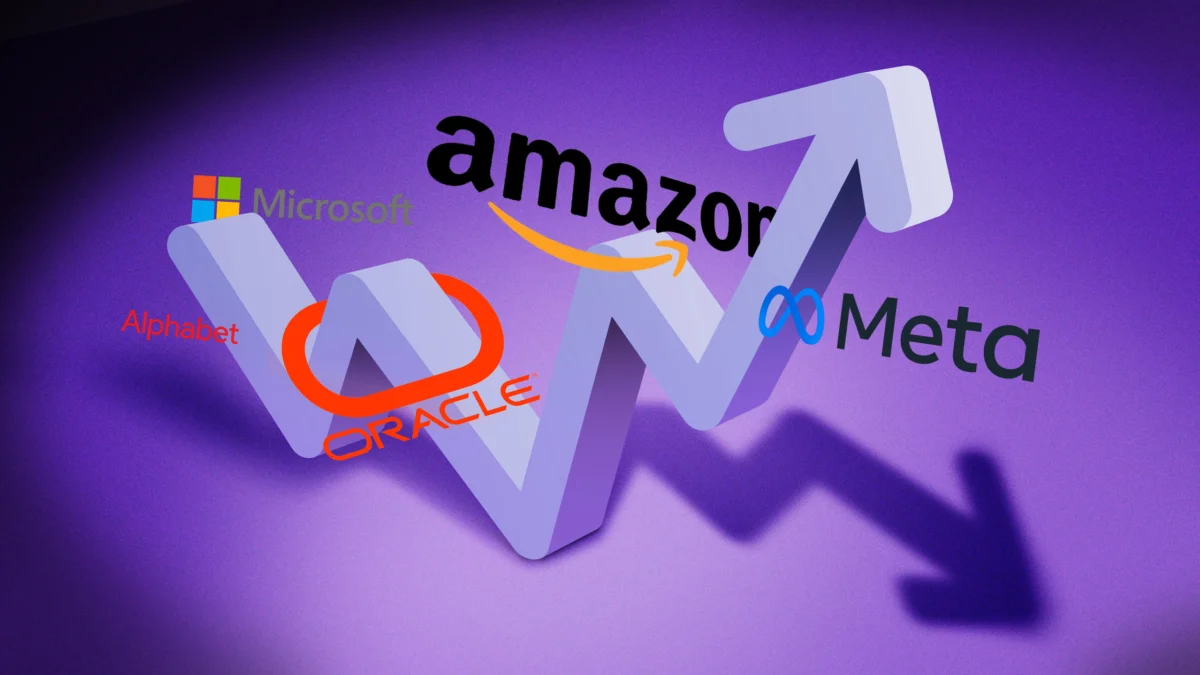
DÜSSELDORF – The race for artificial intelligence supremacy has evolved from a technological arms race into a massive financial restructuring project. According to a landmark study by the Cologne-based Flossbach von Storch Research Institute, the world’s leading technology giants—Microsoft, Meta, Alphabet, Amazon, and Oracle—have embarked on an unprecedented trajectory of capital commitment.
In a span of just five years, these five "Hyperscalers" have ballooned their financial obligations to a staggering $2.7 trillion. This figure, largely comprised of off-balance-sheet commitments, highlights a fundamental shift in the business models of these titans: they are no longer just software providers; they are becoming the primary financiers of the world’s digital infrastructure.
The Scale of the Commitment: From Billions to Trillions
The sheer magnitude of the figures revealed by the analysis is difficult to comprehend. The five corporations have seen their legally binding leasing obligations surge from $68 billion five years ago to a massive $1.1 trillion today. These figures represent long-term commitments for data center capacity, specialized hardware, and the physical infrastructure required to power the next generation of generative AI models.
Beyond leasing, the scope of investment expands further. Commitments related to software development, cloud infrastructure, and the massive energy requirements needed to cool and power server farms have grown from $129 billion to $1.6 trillion.
Combined, these companies have effectively pledged $2.7 trillion toward an AI-driven future. Perhaps most critically, a significant portion of this expenditure is not immediately visible in traditional balance sheets, masking the true extent of the leverage these firms are taking on to win the AI war.
Chronology: The Rapid Acceleration of AI Capital Expenditure
To understand how we arrived at a $2.7 trillion figure, one must look at the timeline of the "AI Gold Rush."
- 2019–2020: The Pre-Generative Era. During this period, capital expenditure was primarily focused on traditional cloud computing expansion. Companies were building out infrastructure to support the shift from on-premise servers to the cloud.
- 2021: The Turning Point. Mid-2021 serves as the benchmark for this study. At this time, the five companies held a combined net cash position of $209 billion. They were the world’s wealthiest entities, funding their expansion through massive free cash flow generated by their core businesses.
- 2022: The ChatGPT Catalyst. Following the release of OpenAI’s ChatGPT, the industry pivoted sharply. Investment mandates were rewritten overnight as CEOs recognized that the future of their market dominance relied on the integration of Large Language Models (LLMs).
- 2023–2024: The Era of "Excessive" Spending. The race intensified, with companies aggressively signing multi-year contracts for energy supplies, Nvidia H100 GPU clusters, and specialized real estate. This phase saw the pivot from net cash positions to the accumulation of debt, marking the end of the "self-funded" era of Big Tech.
A Fundamental Shift in Financial Health
Perhaps the most startling revelation of the Flossbach von Storch analysis is the reversal of the companies’ financial fortitude. In June 2021, the collective group possessed a net liquidity of $209 billion. By the latest reporting cycle, that surplus had evaporated, replaced by $106 billion in adjusted net debt.
The Case of Oracle
Oracle stands out in this data set, accounting for $88 billion of the total net debt. As a legacy enterprise software giant aggressively pivoting to become a cloud-infrastructure powerhouse, Oracle’s strategy is emblematic of the "all-in" approach. By leveraging its balance sheet to fund the massive expansion of its cloud regions, Oracle is betting that the long-term utility of its AI-ready infrastructure will eventually dwarf the interest costs of its current debt burden.
The "Self-Funding" Era Ends
For over a decade, investors viewed Big Tech as an endless fountain of cash. However, as the research institute notes, the liquidity reserves are shrinking. These corporations are no longer able to finance their operations solely through internal cash flow. They have moved from being lenders to the global economy to being significant borrowers, shifting the risk profile of these stocks for institutional investors.
Supporting Data and Methodology
The study draws its conclusions from a granular analysis of filings submitted to the U.S. Securities and Exchange Commission (SEC), supplemented by proprietary data from Bloomberg.
The methodology focuses on "Off-Balance-Sheet Commitments," which are contractual obligations that do not always appear as debt on the balance sheet but represent firm financial liabilities. These include:
- Operating Leases: Long-term contracts for data center space.
- Purchase Obligations: Commitments to buy hardware or energy at set prices.
- Capital Expenditure Commitments: Planned investments in physical infrastructure that the companies are legally obligated to fulfill.
By aggregating these, the researchers have provided a more realistic picture of the "True Debt" load of the tech sector than what is seen on standard quarterly income statements.
The Investor’s Perspective: Implications and Risks
The implications of this shift are profound for the global equity markets. Investors have long prized these companies for their "fortress balance sheets." If those fortresses are now being mortgaged to pay for AI, the volatility profile of these stocks must be reassessed.
1. The Margin Compression Risk
If the AI revolution does not yield immediate, high-margin revenue growth, these companies will be left with massive fixed costs. The "break-even" point for these AI investments is moving further into the future. If demand for AI services plateaus, the depreciation of these massive assets could weigh heavily on future earnings per share.
2. The Energy Bottleneck
A significant portion of the $1.6 trillion in "other obligations" relates to energy. These companies are now effectively energy companies, signing power purchase agreements with nuclear and renewable energy providers. This creates a dependency on utility markets that are increasingly prone to price shocks.
3. Regulatory and Geopolitical Headwinds
With trillions in capital tied up in infrastructure, these companies become "too big to fail" in a digital sense. This invites increased scrutiny from antitrust regulators who may view their dominance over the infrastructure of the internet as a barrier to competition.
Official Responses and Industry Sentiment
While the companies themselves—Microsoft, Meta, Alphabet, Amazon, and Oracle—generally maintain that their capital expenditures are "prudent and necessary" to capture the AI market, they have increasingly used their earnings calls to address investor concerns.
Executives have consistently argued that these are not merely costs, but investments in the next decade of productivity. Microsoft’s leadership, for instance, has repeatedly emphasized that the Azure cloud platform requires this scale to maintain its competitive edge against AWS and Google Cloud. However, the tone in recent earnings calls has shifted slightly, with a greater emphasis on "operational efficiency" and "ROI tracking" for AI initiatives.
Conclusion: A High-Stakes Transformation
The findings from the Flossbach von Storch Research Institute serve as a sobering reminder: the AI boom is not a cost-free transition. It is an industrial revolution occurring at breakneck speed, funded by the most aggressive capital deployment in corporate history.
For shareholders, the next three to five years will be the "proof of concept" phase. The $2.7 trillion invested will either be remembered as the greatest capital allocation strategy of the 21st century—cementing these companies as the foundation of the modern global economy—or as a period of historic over-extension. As liquidity tightens and debt levels rise, the margin for error for these tech giants has never been thinner. The market, which has thus far cheered every dollar of AI spending, may soon begin to demand a more rigorous accounting of the returns on this unprecedented gamble.