The night sky over Florida was recently transformed into a celestial stage, not by a natural meteor shower or an aurora, but by the precise, industrial mechanics of a SpaceX Falcon 9 rocket. On October 13, at 6:33 a.m. local time, the mission designated CRS-35 ignited the horizon at the Cape Canaveral Space Force Station. While the primary mission—delivering vital supplies, scientific hardware, and experimental payloads to the International Space Station (ISS)—was a textbook success, it was the unintended visual byproduct of the launch that captured the global imagination.
Minutes after liftoff, a breathtaking, ethereal structure dubbed the "Space Jellyfish" unfurled against the pre-dawn darkness. The luminous, blue-tinged plume, characterized by its pulsating, tentacle-like expansion, left observers across the region wondering if they were witnessing a launch anomaly or a glitch in the simulation of reality. In an age where digital manipulation is rampant, this organic light show was entirely authentic, serving as a reminder of the complex interactions between human technology and the upper atmosphere.
The Anatomy of a Celestial Spectacle
To the casual observer, the appearance of a glowing, translucent organism hovering in the vacuum of space is jarring. However, the "Space Jellyfish" is a well-documented optical phenomenon rooted in the physics of high-altitude fluid dynamics and solar geometry.
The phenomenon occurs when a rocket launch takes place during the "twilight window"—typically during the early dawn or late dusk. At the time of the CRS-35 launch, the sun had not yet risen for observers on the ground, leaving the horizon shrouded in deep shadows. However, at the extreme altitude where the Falcon 9 was performing its second-stage burn, the sun was already visible.
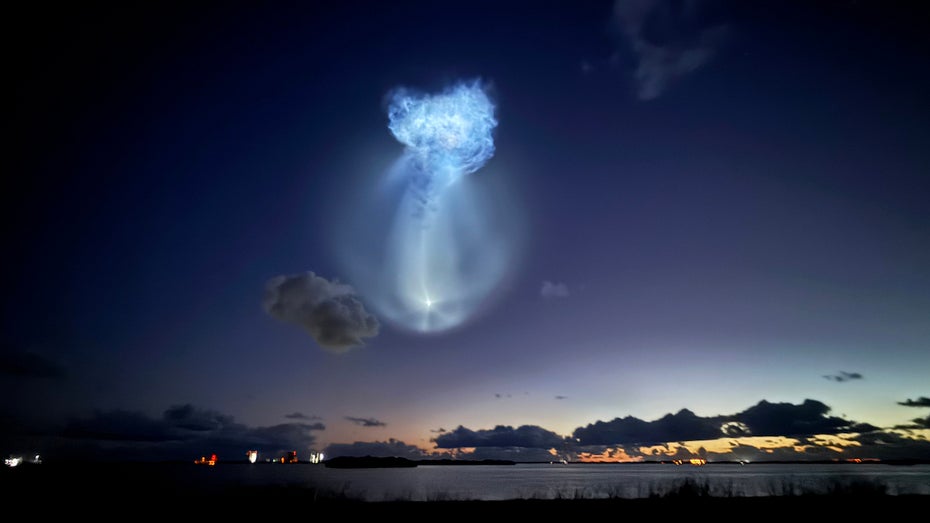
As the rocket’s exhaust plume expanded into the thinning atmosphere, the sunlight hit the expelled gases and ice crystals at just the right angle. This backlighting effect causes the plume to glow with an iridescent, spectral blue hue. The "jellyfish" shape itself is a result of the pressure differential in the upper atmosphere. As the rocket climbs, the exhaust gases expand rapidly, creating a mushroom-like cloud. The "tentacles" are formed by the interplay between the rocket’s engine thrust and the ambient atmospheric pressure, which shapes the exhaust trail into trailing, flowing streamers that persist for several minutes before dispersing into the thin air.
A Chronology of the CRS-35 Mission
The road to the CRS-35 launch was marked by logistical hurdles that underscored the fragile, high-stakes nature of modern space logistics. Originally slated for a November 2026 launch window, the mission faced significant scheduling volatility.
- Initial Planning: The mission was designed to bolster the ISS’s inventory, carrying essential life-support components and new research modules for long-term orbital experiments.
- The Launch Delay: The mission was initially pulled forward to August 2026. This acceleration was a reactionary measure following reported damage to a Russian launch pad, which threatened to delay the rotation of supplies to the station. International space agencies, including NASA, acted to ensure that the ISS crew would not face a resource shortfall.
- The Adjustment: Once the Russian infrastructure was repaired faster than initial projections, the CRS-35 schedule was recalibrated. The shift back to October provided the necessary flexibility for the mission to proceed, ultimately placing the launch in the early morning twilight hours that facilitated the spectacular visual display.
- The Launch: At 6:33 a.m. on October 13, the Falcon 9 cleared the pad, executing a perfect ascent profile that resulted in the now-viral "Space Jellyfish" display.
Historical Context: From UFO Panic to Scientific Curiosity
The "Space Jellyfish" is by no means a new occurrence, though its notoriety has grown alongside the frequency of commercial rocket launches. Throughout the 1970s and 80s, when launch trajectories and schedules were less transparent to the public, such sightings were frequently reported as Unidentified Flying Objects (UFOs).
In the pre-social media era, these plumes were sometimes mistaken for signs of military conflict, nuclear testing, or, more sensationally, extraterrestrial visitation. A notable instance occurred in December 2017, when a SpaceX launch over the West Coast triggered a massive wave of panic. Local emergency services were flooded with calls, and news outlets initially struggled to categorize the event. Since then, organizations like NASA and SpaceX have become more proactive in issuing pre-launch warnings, which has helped transform the public perception of these events from "UFO sightings" to "spectacular science."

The Science of Atmospheric Interaction
The "Space Jellyfish" is a testament to the sheer scale of the energy released during a rocket launch. When the Falcon 9 enters the mesosphere and lower thermosphere, the exhaust is essentially composed of water vapor and carbon dioxide. In these layers, the air is so thin that the plume can expand to a diameter of several kilometers.
The colors observed—ranging from soft blues to pale violets—are a result of Rayleigh scattering, the same principle that makes the sky blue. When the high-altitude plume is illuminated by the sun, the shorter, blue wavelengths of light are scattered more efficiently, creating the characteristic "Jellyfish" shimmer. Scientists have studied these plumes to better understand high-altitude wind patterns and the chemical composition of the mesosphere, turning a PR spectacle into a secondary source of atmospheric data.
Official Responses and Strategic Implications
For SpaceX, the "Space Jellyfish" has become an unintended branding asset. While the primary objective of CRS-35 is the delivery of cargo, the viral nature of the launch photos provides significant public visibility for the company.
NASA, which oversees the logistics of the ISS resupply missions, remains focused on the payload rather than the aesthetic impact. However, the agency acknowledges that the high visibility of these launches fosters public interest in space exploration. By maintaining a schedule that prioritizes scientific mission requirements, NASA and SpaceX have largely accepted the "Space Jellyfish" as a pleasant, albeit predictable, consequence of orbital mechanics.
There is, however, an ongoing discussion regarding the long-term impact of rocket exhaust on the upper atmosphere. While the "Jellyfish" disappears in minutes, the cumulative effect of a rising frequency of orbital launches is being monitored by environmental scientists. The introduction of soot and water vapor into the stratosphere and mesosphere could potentially alter local chemical balances, though current models suggest that the impact remains negligible compared to other industrial sources.
The Future of Night-Launch Optics
As space tourism and private satellite constellations increase the cadence of launches, the "Space Jellyfish" will likely become a common sight for residents near major launch sites like Cape Canaveral and Vandenberg Space Force Base.
This evolution of the night sky highlights the intersection of human ambition and the natural world. The "Space Jellyfish" is more than just a beautiful photo opportunity; it is a physical manifestation of the thrust required to break the bonds of Earth’s gravity. As we look toward the future of lunar gateways and Mars missions, the sight of these artificial nebulas will continue to serve as a beacon, signaling our persistent,, and increasingly frequent, expansion into the final frontier.
The CRS-35 mission stands as a hallmark of this era—a perfect synergy of logistics, engineering, and the occasional, awe-inspiring display of light that reminds us of the profound scale of our efforts to reach the stars. Whether viewed through the lens of a smartphone or the data-hungry sensors of a research satellite, the "Space Jellyfish" remains a singular reminder that even the most industrial of human endeavors can, under the right light, become art.