Executive Summary: A Night of Redemption
In a turn of events that feels lifted directly from the pages of a sporting fable, Jonas Hofmann has emerged as the unlikely hero of Bayer Leverkusen’s European campaign. Only days removed from being completely omitted from the club’s international roster, the midfielder was thrust into the starting lineup against OFI Crete following a severe injury to Martin Terrier. His response? A clinical brace within a three-minute span that secured a 2-0 victory for the "Werkself," maintaining their perfect record in the Europa League.
As of October 22, 2026, Leverkusen sits at the pinnacle of their European group with nine points from three matches and a flawless goal difference of 8-0. Under the tactical guidance of manager Carles Martínez, the team is currently riding a wave of momentum, boasting six consecutive victories across all competitions.
The "Hofmann Miracle": A Procedural Triumph
The narrative surrounding this match is anchored in the administrative dexterity shown by the Leverkusen management. Under UEFA regulations, teams are permitted to register a replacement player for a long-term injury victim up until the sixth matchday of the group stage. With Martin Terrier sidelined, Leverkusen acted swiftly to bring Hofmann into the fold.
"I simply did what I was asked to do," Hofmann stated in a post-match interview with RTL. "I was nominated, I traveled with the team, and I performed my job. You cannot ask for more than an opportunity, and I am grateful for the trust shown by the staff."
Chronology of the Match: From Tentative Start to Dominance
The Opening Stanza: Defensive Resiliency
The atmosphere at the stadium in Crete was electric, and the hosts initially threatened to disrupt Leverkusen’s rhythm. Just ten minutes into the match, Bayer goalkeeper Janis Blaswich was forced into an acrobatic save to deny a dangerous effort from Thiago Nuss. The early pressure from OFI Crete highlighted the potential for an upset, as the home side sought to exploit the unfamiliarity of the Leverkusen defensive line.
Leverkusen took time to find their footing. It was not until the 20th minute that the visitors began to exert control. Jonas Hofmann, eager to justify his late selection, forced a sprawling save from Crete goalkeeper Klidman Lilo. Moments later, Patrik Schick narrowly missed the target with a curling shot that sailed just wide of the post.
The Decisive Three Minutes
The turning point occurred in the 35th minute. Leverkusen’s sustained pressure finally dismantled the Cretan resistance. Following a scramble in the penalty area, the ball fell kindly to Hofmann, who pounced to bury the rebound.
Barely had the celebrations subsided when, in the 37th minute, Hofmann struck again. This time, it was a precise long-range effort that left Lilo helpless, effectively putting the game out of reach before the halftime whistle. The efficiency of this two-goal burst underscored the clinical edge that has defined Leverkusen’s season thus far.
Second Half: Managing the Lead
The second half saw Leverkusen adopt a more methodical approach. While Hofmann came agonizingly close to securing a hat-trick—only to be denied by another stellar save from Lilo—the focus shifted toward defensive stability.
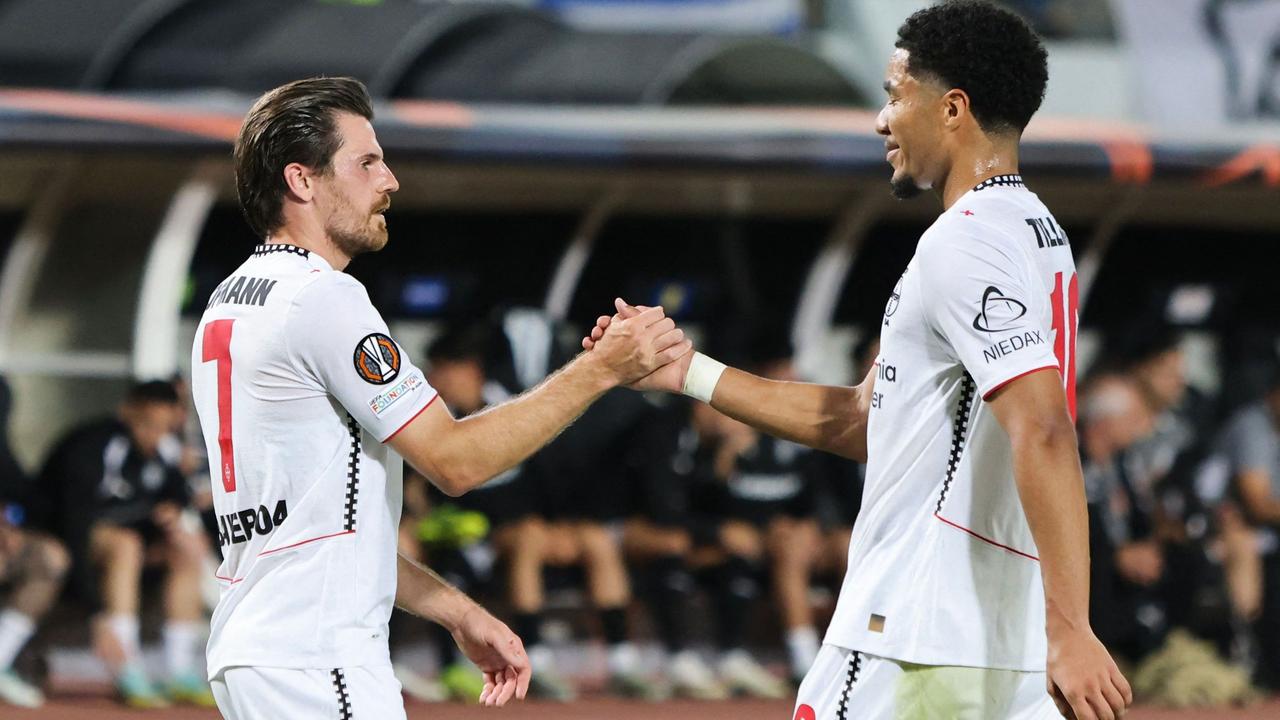
OFI Crete attempted to mount a comeback, with Konstantinos Kostoulas testing the visitors with a long-range strike, but Leverkusen’s defensive unit, marshaled by their experienced backline, remained unruffled. Manager Carles Martínez utilized the final 30 minutes to manage his squad’s fatigue, introducing Nathan Tella, Ibrahim Maza, and Miguel Gutiérrez. Despite a late deflected effort from substitute Taxiarchis Fountas that landed on the roof of the net, Leverkusen never appeared truly threatened.
Tactical Breakdown: The Martínez Philosophy
Manager Carles Martínez has instilled a brand of football characterized by high-intensity pressing and fluid movement. The integration of Hofmann into the XI served as a masterstroke, as his movement between the lines created consistent pockets of space that the Cretan defense struggled to close down.
Leverkusen’s ability to transition from a controlled build-up to a vertical attack was on full display. The partnership between Patrik Schick and the midfield trio allowed the team to rotate positions, making them unpredictable. Defensively, the team’s compact structure ensured that even when possession was lost, the transition to defense was immediate and suffocating, limiting the hosts to sporadic long-range attempts rather than high-percentage scoring opportunities.
Supporting Data: The Numbers Behind the Run
- European Standings: Bayer Leverkusen maintains a 100% win record (3/3), keeping them in the top tier of the Europa League table.
- Goal Differential: With 8 goals scored and 0 conceded, Leverkusen boasts one of the most balanced profiles in the competition.
- Winning Streak: The club has extended its current winning streak to six matches across all competitions, including Bundesliga play.
- Squad Depth: The fact that a late-added player like Hofmann can step into the starting lineup and produce a brace is a testament to the high training standards and squad depth cultivated by the coaching staff.
Official Responses and Post-Match Analysis
The sentiment in the dressing room following the final whistle was one of professional satisfaction. Manager Carles Martínez praised his team’s adaptability, noting that "matches in Europe are never easy, especially on the road. The atmosphere here was challenging, but the players showed the maturity required to manage the game effectively."
The media spotlight, however, remained fixed on Jonas Hofmann. Analysts have pointed out that his performance was not just a statistical anomaly but a reflection of his tactical intelligence. "Hofmann knows where the space is," remarked one football pundit during the post-game analysis. "His ability to read the rebound for the first goal and his confidence to pull the trigger from distance for the second shows a player who is mentally prepared for the highest level of European competition."
Future Implications: Looking Ahead
The victory in Crete serves as a vital springboard for Leverkusen’s upcoming schedule. The "Europa-Duell" against TSG Hoffenheim on October 25, 2026, is now the primary focus. Currently sitting fourth in the Bundesliga with 13 points, Leverkusen is just one point behind league leaders Bayern Munich.
The implications of this win are twofold:
- Confidence: The team has proven it can handle the physical and mental demands of midweek European travel followed by high-stakes domestic fixtures.
- Rotation: With the DFB-Pokal clash against 1. FC Nürnberg looming in the following week, the successful integration of players like Tella and Maza provides Martínez with the necessary options to rotate his squad without a drop-off in performance quality.
As the season enters this intensive phase, Leverkusen’s ability to remain "without fault and blemish" (as the German press has noted) will be tested. However, if the performance in Crete is any indication, the Werkself are well-equipped to handle the challenges of a busy autumn calendar.
Conclusion: A New Standard
Bayer Leverkusen’s European campaign is unfolding with the precision of a championship-caliber side. While the individual brilliance of Jonas Hofmann provided the fireworks in Crete, the win was a collective triumph. By securing three points and maintaining a clean sheet, Leverkusen has sent a clear message to the rest of the Europa League: they are not just participants; they are contenders. As the club pivots back to domestic duties, the momentum from this "small football fairy tale" will undoubtedly serve as a catalyst for their ambitions both at home and abroad.