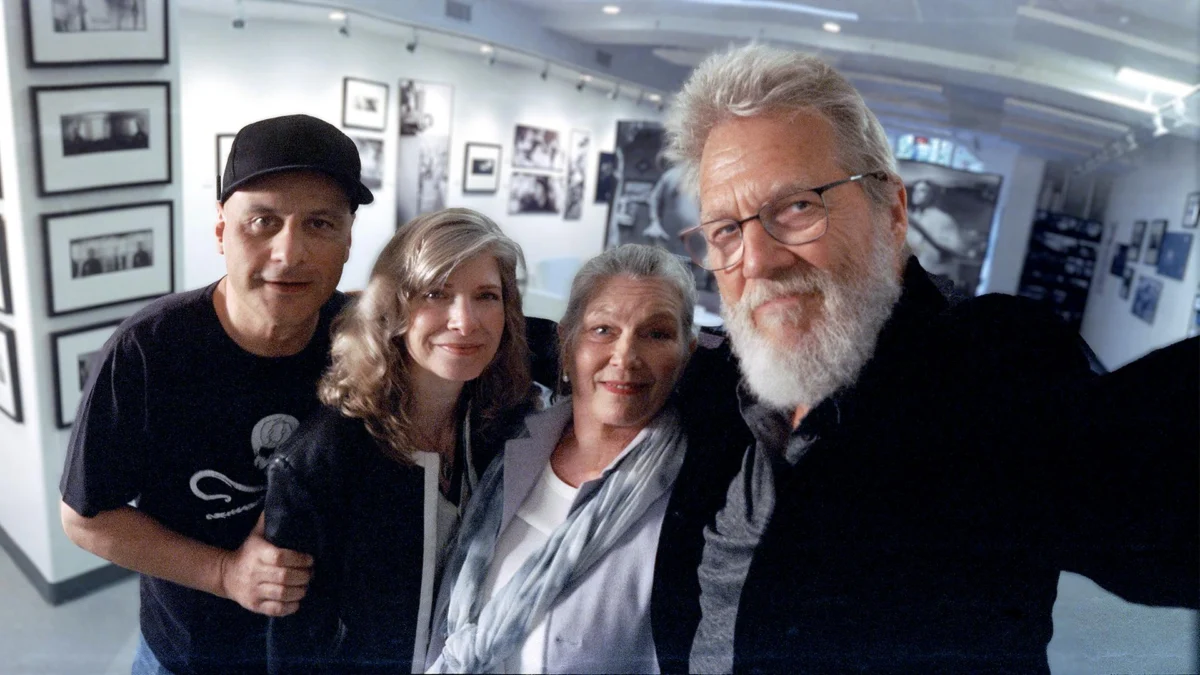
It sounds like the setup for a surreal Hollywood script: A world-famous Oscar winner, a global icon of cool, reaches out to a small-town couple in the heart of Hesse, Germany. Their mission? To resurrect a piece of analog history that the world had effectively discarded. This is not a scene from The Big Lebowski, but the real-life story of Jeff Bridges, his wife Susan Geston, and a pair of photography enthusiasts from Bad Nauheim, Charys Schuler and Marwan El-Mozayen.
The journey of the "WideluxX"—the modern reincarnation of a legendary swing-lens camera—is a testament to passion, technical obsession, and the enduring power of analog craftsmanship in an era dominated by digital convenience.
The Main Facts: An Unlikely Alliance
Jeff Bridges, best known for his iconic role as "The Dude," is more than just a face on the silver screen; he is a dedicated photographer with a specific, singular aesthetic. Since the late 1970s, he has relied almost exclusively on the Widelux, a Japanese-made swing-lens panoramic camera. The device is renowned for its ability to capture wide, often surreal images that bend the rules of perspective.
However, the Widelux suffered a catastrophic fate. When the original manufacturer’s factory burned down in the late 2000s, it took with it the blueprints, the specialized machinery, and the institutional knowledge required to produce the cameras. The Widelux became an "extinct" species, leaving its remaining users—including Bridges—at the mercy of aging parts and dwindling repair services.

The solution emerged from the unlikely hub of Bad Nauheim, where Schuler and El-Mozayen edit a prestigious magazine dedicated to analog photography. When Bridges approached them via a Zoom call with the desperate plea, "Maybe you could help me save this camera," the couple did not hesitate, despite having never built a camera from scratch.
A Chronology of a Six-Year Obsession
The saga of the WideluxX is a grueling six-year odyssey that transformed from a simple repair inquiry into a full-scale industrial revival.
- 1977: Susan Geston Bridges gifts Jeff a Widelux for their wedding, sparking a lifelong artistic obsession that would define his personal photography career.
- Late 2000s: The Japanese factory fire effectively ends the production of the Widelux, turning the camera into a "white whale" for analog collectors.
- The Outreach: Jeff and Susan Bridges seek out experts to keep the spirit of the camera alive. Their search leads them to the German magazine editors in Bad Nauheim.
- The "Klinken Putzen" Phase (2018–2020): Schuler and El-Mozayen purchase a donor Widelux, strip it down to its 292 individual parts, and begin traveling across Germany to find manufacturers willing to take on the project. They face constant rejection, as the complexity of the design—which famously contains no screws or washers—daunts even the most seasoned engineers.
- The Breakthrough: Wolfgang Walberer, a retired mechanical engineer from the Wetterau region, joins the team. His technical expertise provides the missing link.
- 2021–2024: The development of the "WideluxX" begins in earnest, involving a network of specialized workshops around Wetzlar, a region with a deep-rooted history in precision optics.
- October 2026: The documentary Jeff Bridges’ Analog Adventure premieres, chronicling the journey from a broken dream to a finished, handcrafted masterpiece.
The Engineering Challenge: 292 Parts of Precision
To understand why the Widelux is so difficult to revive, one must look at the anatomy of the machine. The original Widelux is a marvel of mid-century mechanical design. Unlike a standard camera, it uses a rotating lens that "swings" across the film plane, exposing the negative in a continuous sweep.
The internal mechanism is a labyrinth of precision components. With 292 individual parts—none of which are held together by conventional screws or standardized fasteners—the camera is essentially a Swiss watch that takes pictures. For the team in Germany, the challenge was not just to "copy" the camera, but to re-engineer it for the 21st century without sacrificing the unique, slightly distorted, and deeply organic look that Bridges fell in love with.

"You have to want this project," Marwan El-Mozayen noted during the development phase. The team focused on creating a camera that wasn’t just a nostalgic toy, but a professional-grade instrument intended to last for generations.
Official Perspectives and Behind-the-Scenes Insights
The collaborative process bridged the gap between the glitz of Santa Barbara and the industrial precision of Wetzlar. According to Charys Schuler, the experience was profoundly human. "I always tried to treat Jeff like a normal person, because in the end, he is a normal person," she reflects in the ARD documentary.
For Bridges, the camera is an extension of his creative soul. In the film, he explains the camera’s charm: "If you run fast enough, you can be in the same picture twice." This playfulness is what he sought to preserve. By adding the ‘X’ to the name—becoming the WideluxX—the team signaled that this was not merely a repair, but an evolution.
Wolfgang Walberer, the engineer who rescued the project, recalls the moment of realization: "The project naturally excited me as a mechanical engineer. When you see a mechanism that is so elegant yet so misunderstood by modern mass production, you feel a duty to keep it alive."

Implications: The Future of Analog Photography
The revival of the WideluxX is a microcosm of a larger cultural trend: the "analog renaissance." In a world where high-resolution digital images are ubiquitous and instantly discardable, there is a growing, affluent market for objects that possess "soul" and longevity.
Economic and Practical Impact:
- Manufacturing Resilience: The project has proven that decentralized, artisanal manufacturing can successfully revive complex, "extinct" technologies if the passion and expertise are aligned.
- Market Demand: Despite a price tag of over €5,000, the demand for the WideluxX is immense. The current production schedule is fully booked with a waiting list stretching until the end of 2027.
- The "Slow Tech" Movement: The success of this camera highlights a shift in consumer behavior. Users are no longer looking for the fastest or most efficient tool; they are looking for a tool that requires them to slow down, compose, and engage with the mechanical process of creation.
The Documentary as a Catalyst:
The ARD documentary, Jeff Bridges’ Analog Adventure, serves as more than just a promotional tool. It acts as an archive of the knowledge that was nearly lost. By documenting the assembly, the frustrations, and the technical problem-solving, the film preserves the "know-how" for future generations of camera builders.
The documentary is available via the ARD Mediathek as of October 24, 2026, with a broadcast on hr-television scheduled for November 3, 2026, at 10:00 PM.
Conclusion
The story of Jeff Bridges and his German partners is a heartwarming reminder that history does not have to stay in the past. Through the sheer force of will, a 292-part mechanical puzzle was saved from the ashes of a Japanese factory and reborn in the workshops of Hesse. The WideluxX is more than a camera; it is a symbol of a bridge between the analog past and a sustainable, craftsmanship-focused future. For "The Dude," the dream continues—and for the rest of us, it is a reminder that some things are truly worth fighting for.