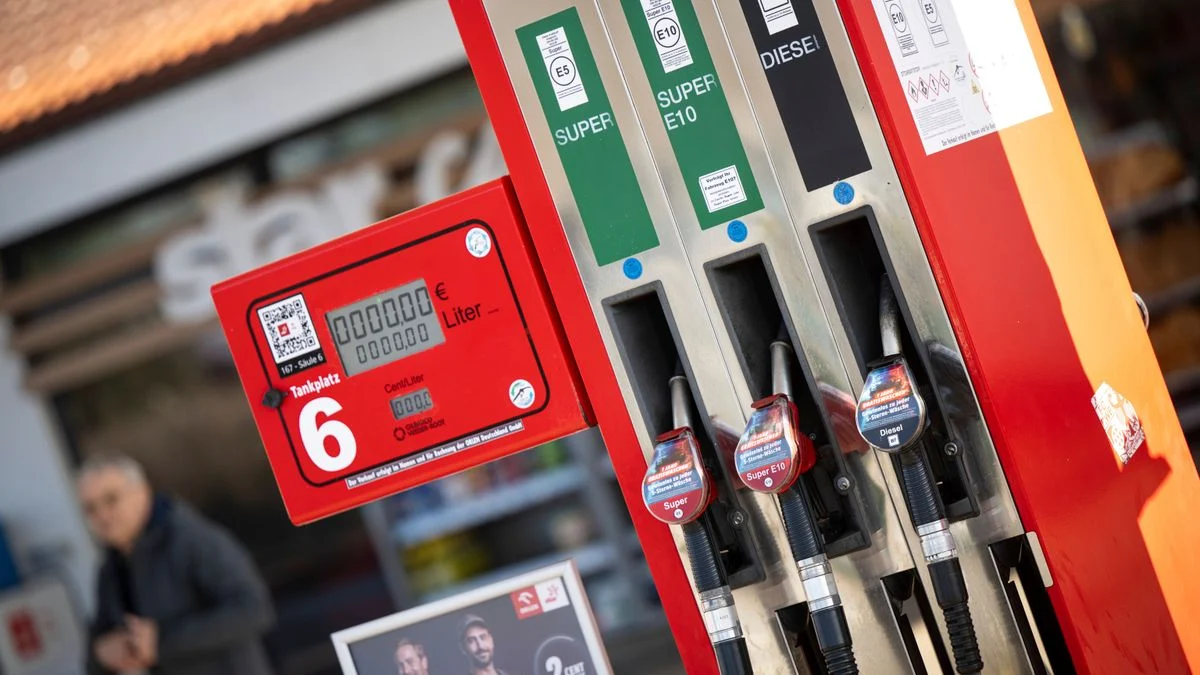
In the complex ecosystem of the German fuel market, the ritual of visiting the gas station has transformed from a mundane chore into a tactical exercise. Recent data provided by the ADAC—Germany’s largest automobile club—reveals that the "Zwölf-Uhr-Regel" (the noon rule), initially implemented to curb market volatility, has inadvertently created a hyper-dynamic environment where timing is everything. For the average motorist, the difference between a savvy refueling stop and an expensive impulse purchase can now exceed nine euros per tank, highlighting a systemic shift in how oil companies manage price fluctuations.
Main Facts: The High Cost of Timing
The latest analysis by the ADAC, which meticulously tracked pricing data across more than 14,000 gas stations, paints a stark picture of volatility. The data shows that price disparities within a single day have reached unprecedented levels. For Super E10, the record for the largest daily price swing was set in May 2025, reaching a staggering 12.5 cents per liter. For diesel, the historical record is even more pronounced, hitting a 16.7-cent gap in May 2022.
These figures are not merely statistical anomalies; they represent a significant financial burden on the German consumer. The current market structure dictates that the most advantageous window for refueling is shortly before noon. Once the clock strikes 12:00 PM, the industry-standard price hike typically occurs, leaving those who refuel in the afternoon at a distinct disadvantage. According to ADAC calculations, a driver filling a 50-liter tank with Super E10 can save an average of 7.30 euros by timing their visit correctly. For diesel drivers, the potential savings are even higher, averaging 9.20 euros per tank.
Chronology: The Evolution of the Noon Rule
To understand the current market dynamics, one must look back at the legislative response to geopolitical instability. The "Zwölf-Uhr-Regel" was not a spontaneous invention of the market but a deliberate intervention by the German federal government. Inspired by the Austrian model, the regulation was introduced following a period of extreme price volatility in March, spurred by the geopolitical fallout of the conflict in Iran.
The logic behind the regulation was straightforward: by limiting price increases to a single daily adjustment at noon, the government hoped to prevent the "yo-yo effect," where gas stations would change prices multiple times throughout the day, leaving consumers confused and unable to make informed decisions. Under this regime, gas stations are permitted to lower their prices at any time—a mechanism intended to encourage competition—but are strictly forbidden from raising prices more than once per day, specifically at the midday mark.
However, the reality of the market has diverged from the original intent. Rather than stabilizing prices, the rule has turned the midday hour into a focal point for coordinated pricing strategies, effectively creating a "price floor" that resets every 24 hours.
Supporting Data: Analyzing the Volatility
The ADAC’s comprehensive evaluation of 14,000 stations offers a granular view of how oil companies have navigated this regulatory landscape. The data suggests that the market has adapted by front-loading price hikes to ensure that any potential downward pressure is mitigated by a sharp increase the following day.
The Mathematics of the Pump
When analyzing the price spreads, it becomes clear that the "volatility gap" is widening. The 16.7-cent peak for diesel and the 12.5-cent peak for E10 indicate that companies are utilizing the full legal bandwidth permitted by the noon rule.
- Pre-Noon Advantage: Prices are consistently at their nadir in the late morning hours, as stations compete for the early-day commuter traffic.
- The Noon Surge: As the clock approaches 12:00 PM, algorithms across the industry trigger a simultaneous, often aggressive upward correction.
- The Afternoon Plateau: Prices remain elevated for the remainder of the day, with only marginal downward adjustments until the cycle resets the next morning.
This cyclical behavior suggests that the market has evolved to prioritize "risk hedging." By raising prices significantly at midday, oil companies protect themselves against potential volatility in the global crude oil market, ensuring that they maintain margins even if wholesale prices shift slightly in the afternoon.
Official Responses and Economic Critique
The government’s stance remains one of cautious observation, yet the ADAC and independent economic analysts have been increasingly vocal in their criticism. The core of the critique is that the "Zwölf-Uhr-Regel" has created a false sense of security while failing to address the underlying upward trend in fuel costs.
The ADAC has explicitly characterized the significant price jumps at noon as largely unjustified by crude oil price movements. While fuel prices are indeed influenced by the global cost of a barrel of oil, the intensity of the midday spikes often exceeds what would be expected from standard supply-and-demand fluctuations. The club argues that mineral oil companies are applying "risk surcharges" that go beyond the actual costs of procurement, effectively leveraging the government’s own regulation to maximize profits.
Furthermore, economic analysts point out that the policy has inadvertently discouraged "dynamic competition." In a truly free market, companies might lower prices during slow afternoon periods to attract customers. Under the current rule, there is little incentive to do so because the "noon reset" guarantees a price increase regardless of daily market activity, reducing the pressure on companies to engage in aggressive, consumer-friendly price wars.
Implications: The Long-Term Impact on the Consumer
The implications of this regulatory framework are twofold: psychological and economic.
The Psychological Burden
The "noon rule" has fundamentally changed the consumer experience. Drivers are now forced to become amateur market analysts, checking apps and monitoring historical price charts before deciding when to visit the station. This creates a state of constant, low-level anxiety regarding fuel costs. For households with tight budgets, the difference of 9.20 euros is not trivial; it represents the difference between a full tank and a partial one, or a significant portion of a weekly food budget.
The Economic Reality
Unterm Strich—at the end of the day—the data shows a clear upward trend in the overall price level. Despite the theoretical ability for companies to lower prices at any time, the net effect of the daily resets has been a gradual, systematic increase in the average price paid by consumers. The regulation, which was meant to be a protective measure for the public, has essentially provided a predictable framework for oil companies to manage their price-setting algorithms with greater precision.
As the energy transition continues and Germany moves toward a greater reliance on electric vehicles, the volatility of the combustion engine fuel market remains a critical point of political tension. The ADAC’s findings suggest that until the fundamental mechanisms of the fuel market are addressed—potentially through more rigorous oversight of pricing algorithms—the "noon rule" will continue to serve as a beacon for price hikes rather than a shield against them.
Conclusion: A Call for Regulatory Evolution
The German fuel market serves as a cautionary tale of how well-intentioned regulation can be subverted by market participants. By attempting to mandate price stability, the government inadvertently handed the industry a blueprint for optimizing price surges.
For the average motorist, the advice remains clear: if you must refuel, do so in the morning. However, the broader societal question remains whether a market that requires such intense consumer vigilance to avoid being overcharged is functioning correctly. As the data from the ADAC continues to highlight these extreme spreads, the pressure on policymakers to revisit the "Zwölf-Uhr-Regel" will likely grow. Whether through stricter caps on how high these midday jumps can be or a move toward more flexible, truly competitive pricing, the current system is proving to be a costly lesson in the unintended consequences of market intervention.
In the final analysis, the "Zwölf-Uhr-Regel" has not ended the volatility; it has merely scheduled it. And as long as that schedule remains in place, the German driver will continue to pay the price for the market’s calculated response to the midday clock.