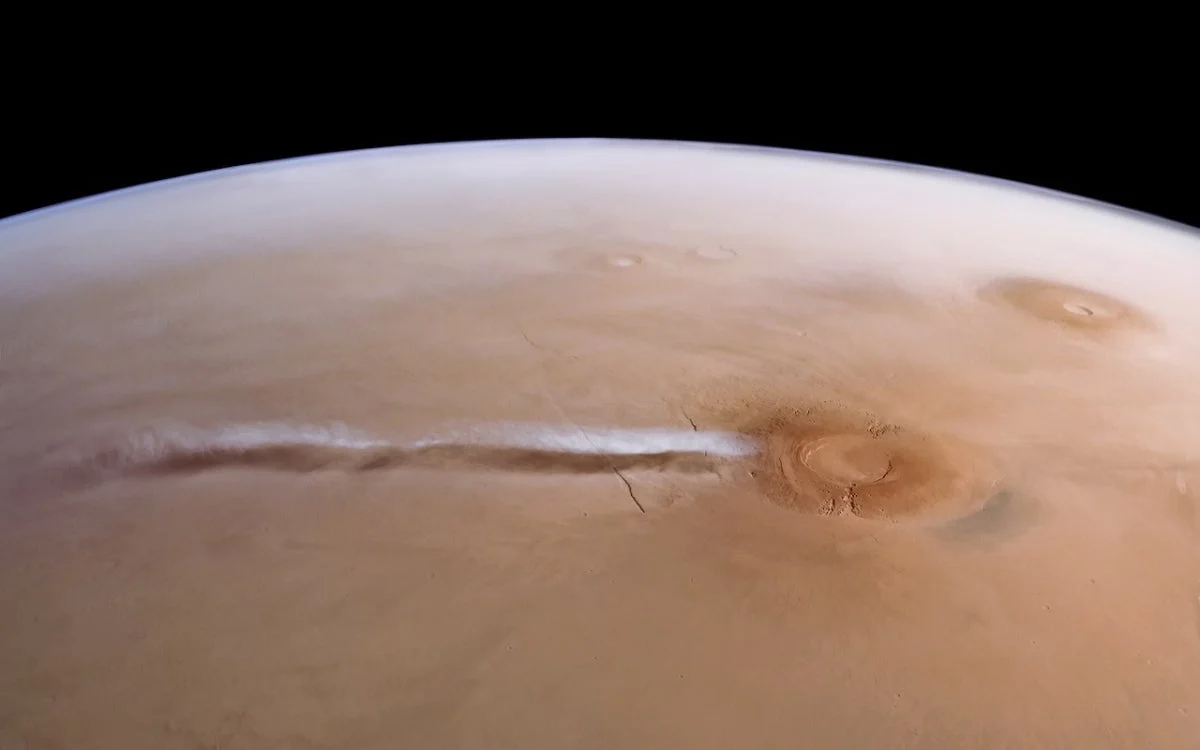
In the vast, arid expanse of the Martian landscape, where dust storms routinely shroud the planet in a crimson haze, a peculiar atmospheric phenomenon has long defied conventional meteorological wisdom. For years, astronomers observing the Arsia Mons volcano—a colossal peak standing 20 kilometers high—have been puzzled by a persistent, elongated cloud that manifests with clockwork regularity. New data provided by the European Space Agency’s (ESA) Mars Express orbiter, combined with groundbreaking research published in the journal Nature, has finally shed light on this mystery. The findings reveal a mechanism previously unseen in planetary atmospheres: "homogeneous nucleation," a process that challenges the very foundations of how clouds are formed.
The Breaking of a Meteorological Paradigm
For decades, the study of cloud formation on both Earth and Mars has been anchored to a single, non-negotiable rule: condensation requires a "seed." In the terrestrial atmosphere, water vapor must latch onto microscopic particles—dust, sea salt, or soot—to transition from a gas to a liquid or solid state. Because the Martian atmosphere is notoriously saturated with fine, abrasive dust, scientists had long assumed that this dust-dependent condensation was the universal standard for all cloud formation on the Red Planet.
However, the latest computer simulations conducted by a research team led by Jorge Hernández-Bernal and Franck Forget of the Sorbonne University in Paris have effectively dismantled this long-standing assumption. By focusing on the "Arsia Mons Elongated Cloud" (AMEC), the team discovered that the traditional model for cloud creation simply does not apply to this specific structure. Instead, the cloud thrives on a process that was once relegated to the realm of theoretical physics: the direct, spontaneous freezing of water vapor without any solid nucleus to act as an anchor.
Chronology of a Discovery
The journey to understanding this phenomenon began with the Mars Express mission, which has been orbiting the Red Planet since 2003. Equipped with advanced monitoring systems, the orbiter has provided a unique vantage point, specifically due to its highly elliptical orbit. This trajectory allows the probe to capture imagery during the early morning hours, the critical window when the AMEC begins its rapid daily expansion.
For years, Mars Express captured the evolution of the cloud, documenting its growth from a small wisp to an elongated structure stretching hundreds of kilometers in mere hours. These visual records provided the "raw material" for the researchers. By feeding this data into high-resolution climate models, the team at Sorbonne University attempted to recreate the cloud’s life cycle. Initially, their simulations failed to match reality. It was only when they introduced the concept of "homogeneous nucleation"—a phase transition occurring in a pure substance without the assistance of foreign particles—that the digital model finally mirrored the satellite imagery with remarkable accuracy.
The Engine of the Sky: How Arsia Mons Accelerates Weather
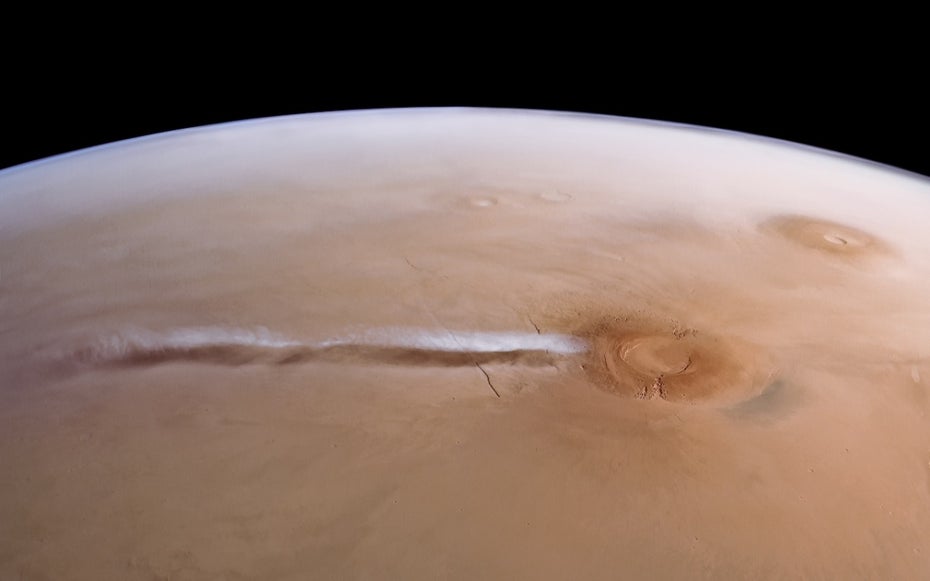
To understand why this cloud forms, one must look at the geography of the planet itself. The Arsia Mons volcano acts as a monumental topographic barrier, forcing Martian wind currents upward. As these winds collide with the 20-kilometer-high mass, they are pushed skyward, transforming into high-speed atmospheric waves.
As these air masses rise, the ambient air pressure drops with staggering speed. This sudden decompression triggers an extreme, rapid cooling effect. In a matter of just ten minutes, the temperature within these air currents plummets by 30 degrees Celsius. This "flash-freeze" environment leads to a state of massive supersaturation. According to the research, the moisture levels in this localized area soar to values 100,000 times higher than the average conditions found on Earth.
Under such extreme physical constraints, the thermodynamic drive to form ice crystals becomes so overwhelming that the water vapor does not wait for a dust particle to serve as a catalyst. Instead, it undergoes a phase transition spontaneously. It is a violent, efficient, and direct process, turning gas into ice instantly—a phenomenon rarely, if ever, observed in natural conditions on Earth due to the ubiquity of aerosol particles in our atmosphere.
Supporting Data and the Limits of Simulation
While the team’s breakthrough confirms that homogeneous nucleation is a natural phenomenon on Mars, it also highlights the limitations of current atmospheric modeling. When the researchers compared their simulation outputs to the high-resolution satellite imagery from Mars Express, they noted discrepancies. The simulated cloud appeared slightly narrower than the real one, and the timing of its onset was consistently delayed.
These gaps in the data provide a roadmap for future climate modeling. The sensitivity of the software is perhaps the most striking finding: the model’s accuracy depends on the most minute variables, such as the surface tension of the microscopic ice crystals. Adjusting these values by even a fraction results in drastic changes to the cloud’s final shape and scale. This sensitivity underscores a critical lesson for planetary science: macro-scale weather events are inextricably linked to microscopic physical interactions. The "big picture" of a planet’s climate is only as accurate as our understanding of the smallest molecular interactions occurring within its atmosphere.
Official Perspectives and Expert Insight
Project scientist Colin Wilson of the European Space Agency has emphasized the importance of the Mars Express data in this discovery. "The ability to track the evolution of the cloud over just a few hours is a testament to the longevity and precision of our mission," Wilson noted. By bridging the gap between historical observations and modern computational power, the mission has allowed scientists to move from mere observation to active interpretation.
For lead author Jorge Hernández-Bernal, the implications go beyond just the Martian landscape. "What we have proven is that a process once confined to textbooks as a purely theoretical concept is, in fact, an active driver of weather in our solar system," he stated. The team argues that the findings validate the necessity of including unconventional physical processes in planetary climate models, as standard ird-centric assumptions often fall short when applied to alien environments.
Implications for Exoplanetary Science
The significance of these findings extends far beyond the dusty plains of Mars. As humanity looks toward the stars and begins to characterize the atmospheres of distant exoplanets, the "Arsia Mons Model" serves as a vital tool. Many exoplanets possess environments vastly different from Earth, where the density of suspended particles, the chemical composition of the atmosphere, and the scale of geological features create conditions that defy our conventional meteorological training.
If clouds on other worlds can form through homogeneous nucleation, our current methods for detecting water vapor and analyzing the habitability of distant worlds may need to be recalibrated. Scientists now have a new variable to consider when studying the light signatures of exoplanets: the possibility that their clouds are not just products of dust-based condensation, but the result of sudden, extreme, and spontaneous atmospheric shifts.
Conclusion: A New Frontier in Meteorology
The discovery that the "oddest cloud" on Mars forms through a mechanism previously considered purely theoretical is a milestone in planetary science. It serves as a humbling reminder that the universe rarely conforms to the rules derived from a single planetary experience. By pushing the boundaries of climate modeling and leveraging the enduring gaze of the Mars Express orbiter, researchers have not only decoded a Martian mystery but have also expanded the toolkit for understanding the complex, often chaotic, weather systems of the cosmos. As we continue to study Arsia Mons, we are not just looking at a volcano; we are watching a laboratory of extreme physics that informs our understanding of weather across the galaxy.