

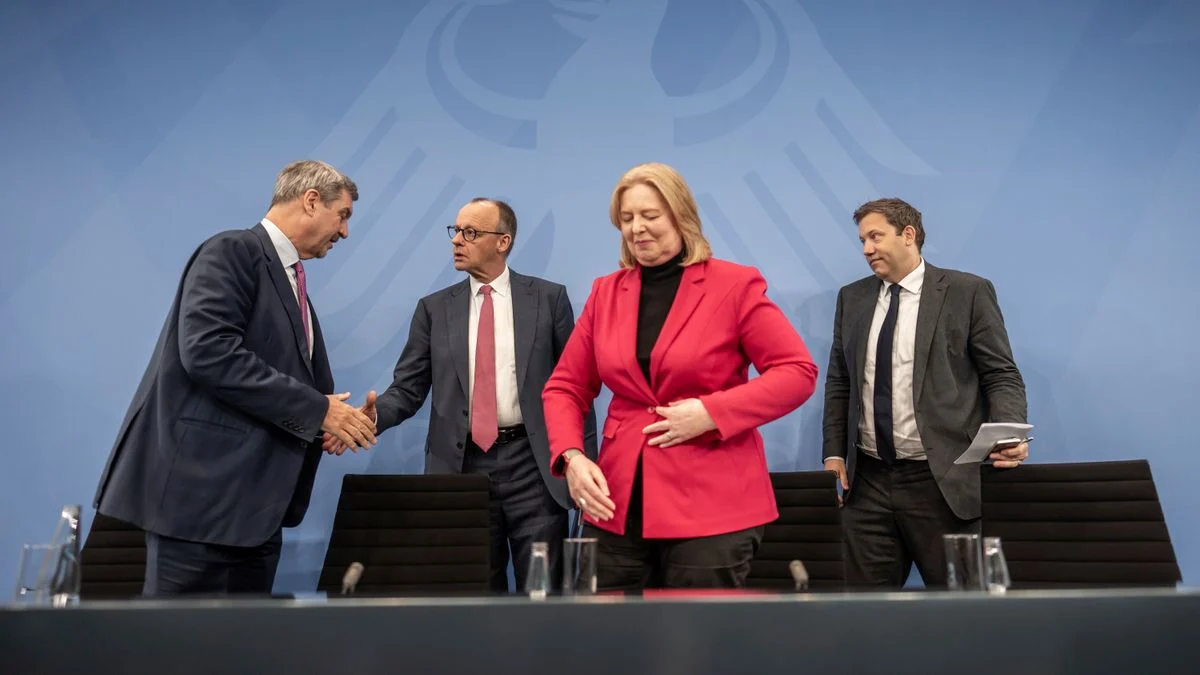
The German government, currently led by an uneasy "black-red" coalition, finds itself in the midst of a significant political and economic crisis. As soaring energy prices—exacerbated by the ongoing conflict in Iran—continue to squeeze the purchasing power of average households, the federal government’s primary strategy for financial relief has collapsed. With the Bundesrat recently blocking a landmark 1,000-euro relief package, Chancellor Friedrich Merz and his cabinet face a period of intense scrutiny and mounting pressure to formulate a viable "Plan B."
The Core Facts: A Failed Legislative Attempt
The centerpiece of the coalition’s response to the cost-of-living crisis was a direct relief payment of up to 1,000 euros, designed to provide a financial cushion for citizens struggling with the inflationary impact of the energy crisis. However, the proposal hit a fatal roadblock this past Friday. In a decisive vote, the Bundesrat—the legislative body representing Germany’s 16 federal states—voted overwhelmingly against the measure. Only four of the 16 states supported the government’s proposal, leaving the initiative dead in the water.
This failure is not merely a bureaucratic hurdle; it is a profound political embarrassment for the Chancellor. While the government has attempted to implement measures like the "tank rebate" (a subsidy for fuel costs), even Chancellor Merz has admitted the policy is only working "passably." With the failure of the 1,000-euro premium, the government’s toolkit for addressing the crisis has been significantly depleted, leaving millions of Germans wondering if, and when, meaningful support will arrive.
Chronology of the Stalemate
To understand the current impasse, one must look at the timeline of the government’s internal discord:
- April: The Promise of Solidarity: During a high-stakes government retreat at Villa Borsig, the coalition partners reached a consensus on the 1,000-euro relief premium. At this gathering, the mood was one of unity, with key opposition leaders and state representatives, including Bavaria’s Minister-President Markus Söder (CSU), signaling their buy-in to the relief strategy.
- May: The Drift: As the geopolitical situation in Iran continued to drive global energy prices higher, the economic pressure on German households intensified. Simultaneously, the political alliance began to fray, with coalition partners openly questioning the efficacy and fairness of the proposed payout structure.
- Early June: The Legislative Showdown: As the proposal moved toward the Bundesrat, skepticism grew. States voiced concerns over the funding mechanisms and the distribution logic of the relief payments.
- Last Friday: The Rejection: The Bundesrat formally struck down the bill. The defeat was crushing, with only a quarter of the states backing the federal initiative.
- This Tuesday: Following the defeat, the leaders of the coalition parties were scheduled to meet at the Kanzleramt to salvage the legislative agenda and address the growing public frustration.
Supporting Data: Why the Pressure is Mounting
The economic data underlying the crisis is stark. Since the escalation of the conflict in Iran, energy costs in Germany have surged to record levels. Household electricity and heating bills have increased by an average of 25–40% compared to the previous year. For low- and middle-income families, this represents a structural shift in disposable income, forcing many to choose between essential services and basic necessities.
The "tank rebate" was intended to mitigate the secondary effects of these costs by reducing the price of fuel at the pump. However, analysts suggest that the rebate has been unevenly distributed, with fuel companies capturing much of the margin rather than passing the full savings to the consumer. The failed 1,000-euro premium was meant to be the "direct" solution, bypassing market intermediaries and placing cash directly into the hands of citizens. Its rejection effectively signals a lack of confidence in the government’s ability to manage large-scale fiscal transfers under the current fiscal rules.
The Blame Game: Official Responses
The atmosphere within the coalition is increasingly toxic. The SPD (Social Democratic Party) has launched a stinging critique of the Union (CDU/CSU) leadership, accusing them of double-dealing. The central point of contention is the role of Markus Söder, the CSU leader and Bavarian Minister-President.
SPD officials have pointed out that Söder was a participant in the April discussions at Villa Borsig, where the relief package was initially drafted. By opposing the measure in the Bundesrat just weeks later, Söder has been accused of prioritizing political optics over the welfare of the citizenry. The argument from the SPD is that the Union is playing a "double game"—participating in the drafting of unpopular or complex legislation, only to distance themselves from it once the political winds shift.
For his part, Söder and the CSU leadership have defended their position, arguing that the federal government’s original proposal was fundamentally flawed and lacked the necessary financial safeguards to prevent long-term debt accumulation in the federal states. They argue that the failure of the bill is not a failure of the state governments, but a failure of the Chancellor’s office to adequately consult and refine the policy before bringing it to a vote.
Economic and Social Implications
The implications of this standoff extend far beyond the immediate disappointment of the failed payment.
1. Erosion of Public Trust
Perhaps the most significant long-term consequence is the damage to public trust. In a time of acute crisis, citizens look to the government for stability and decisive action. When the executive branch publicly commits to a massive financial aid program, only to have it blocked by its own allies in the legislature, it creates an impression of incompetence and internal disarray.
2. Fiscal Policy Constraints
The failure of the 1,000-euro premium highlights the constraints of Germany’s "debt brake" (Schuldenbremse). The government is under constant pressure to provide aid without violating constitutional spending limits. As the coalition searches for alternatives, they are limited by a narrow fiscal window. They must now determine if they can re-package the aid in a way that satisfies the Bundesrat without significantly ballooning the federal budget deficit.
3. The Future of the Coalition
The "black-red" coalition, already viewed as a marriage of convenience, is now under severe strain. The internal animosity between the SPD and the Union is reaching a boiling point. If the leaders cannot reach a resolution at the Tuesday evening summit, the coalition faces a potential existential crisis. A collapse of the government would likely lead to early elections, a scenario that most parties currently view as disastrous given the volatile economic climate.
4. Need for Structural Reform
Experts suggest that the current focus on "one-off" payments is a temporary band-aid on a structural wound. The crisis has exposed Germany’s over-reliance on volatile energy imports and its lack of agility in crisis management. The debate is now shifting toward long-term structural reforms, such as energy subsidies for industry, tax relief for low-earners, and a re-evaluation of the state-federal fiscal relationship.
Conclusion: What Happens Now?
As the coalition leaders gather at the Kanzleramt, the list of options is thin. They can attempt to amend the failed bill and re-introduce it, though this would require significant concessions to the states. Alternatively, they could look for smaller, more targeted measures that might pass the Bundesrat more easily.
Whatever the outcome, the events of the past week have fundamentally altered the landscape of German politics. Chancellor Merz must now prove that his leadership can transcend the narrow interests of his coalition partners, or he risks leading a government that is not only paralyzed but increasingly irrelevant to the daily struggles of the people it serves. The coming weeks will be a litmus test for the coalition’s longevity and, ultimately, for the stability of the German economy in the face of an uncertain global future.





















Leave a Reply