In a high-octane encounter at the Allianz Arena, Bayern Munich and Arsenal played out a gripping 2-2 draw, leaving both sides with questions to answer after a night defined by clinical counter-attacking and defensive vulnerability.
On a crisp Wednesday evening in Bavaria, the Champions League delivered yet another spectacle as two European heavyweights locked horns in a clash that lived up to its billing. For Bayern Munich, the result—a 2-2 stalemate—felt like a missed opportunity to assert dominance on home soil, while Arsenal left Germany with their unbeaten momentum intact, demonstrating the maturity to recover from a deficit in a hostile environment.
The Main Facts: A Game of Fine Margins
The narrative of the evening was dictated by two distinct tactical approaches. Bayern, under the guidance of Vincent Kompany, looked to exploit space behind Arsenal’s high defensive line, while Mikel Arteta’s Gunners sought to control the tempo through possession and precise ball progression.
The scoring was opened by Eberechi Eze in the 25th minute, who capped off a masterful Arsenal move. Bayern responded through Alphonso Davies ten minutes later, and Harry Kane looked to have secured the win with a clinical penalty in the 61st minute. However, Declan Rice struck late in the 82nd minute to level the scores, ensuring the points were shared. With this draw, Bayern sits in the mid-table pack with five points from three games, while Arsenal remains firmly on track with seven.
Chronology: A Rollercoaster in Munich
The match began with an immediate blow for the visitors. Bukayo Saka, the creative heartbeat of Arsenal, was forced off the pitch within the first ten minutes due to a non-contact injury. His premature departure prompted a tactical shift, with Eberechi Eze entering the fray earlier than expected.
Arsenal dictated the opening exchanges, holding nearly 70% possession and targeting the defensive flank occupied by Josip Stanisic. Bayern, however, looked dangerous on the break. In the 21st minute, a lightning-fast transition saw Serge Gnabry force a brilliant point-blank save from Arsenal’s David Raya. It was a warning sign for the visitors, but one they ignored as they continued to push forward.
The breakthrough arrived in the 25th minute. Martin Ødegaard, orchestrating from deep, delivered a perfectly weighted long ball to the left. Stanisic’s positioning narrowly failed to trap Eze in an offside position, and the Arsenal substitute fired a clinical finish into the far corner, silencing the Allianz Arena.
Bayern’s response was swift and surgical. Ten minutes later, Harry Kane mirrored Ødegaard’s vision, threading a laser-focused pass to Alphonso Davies. The Canadian wing-back outpaced his marker, controlled the ball with composure, and slotted it past Raya to restore parity. The half ended with tempers flaring, as a heavy challenge by Ezri Konsa on Kane drew a yellow card, underlining the intensity of the tie.
The second half began as a chaotic, end-to-end affair. Within five minutes of the restart, Manuel Neuer produced a world-class reflex save to deny a Bruno Guimarães header, while at the other end, Raya scrambled to push a Dayot Upamecano header wide. The deadlock was finally broken in the 61st minute when Jurrien Timber blocked a Kane strike with his arm inside the box. Kane, ever the marksman, stepped up to convert the spot-kick, handing Bayern the advantage.
However, Arsenal refused to buckle. As the game entered the final stages, Arteta introduced fresh legs, including Viktor Gyökeres. The tactical gamble paid off in the 82nd minute. Gyökeres, battling with Jonathan Tah, managed to hold the ball up and flick it into the path of a surging Declan Rice. Rice, showing remarkable composure, finished with power to secure a hard-earned point for the Gunners.
Tactical Analysis: The Chess Match Behind the Goals
The match was a masterclass in modern transition football. Both teams proved vulnerable when caught out of possession, a reality Kompany and Arteta will surely address in the coming days.
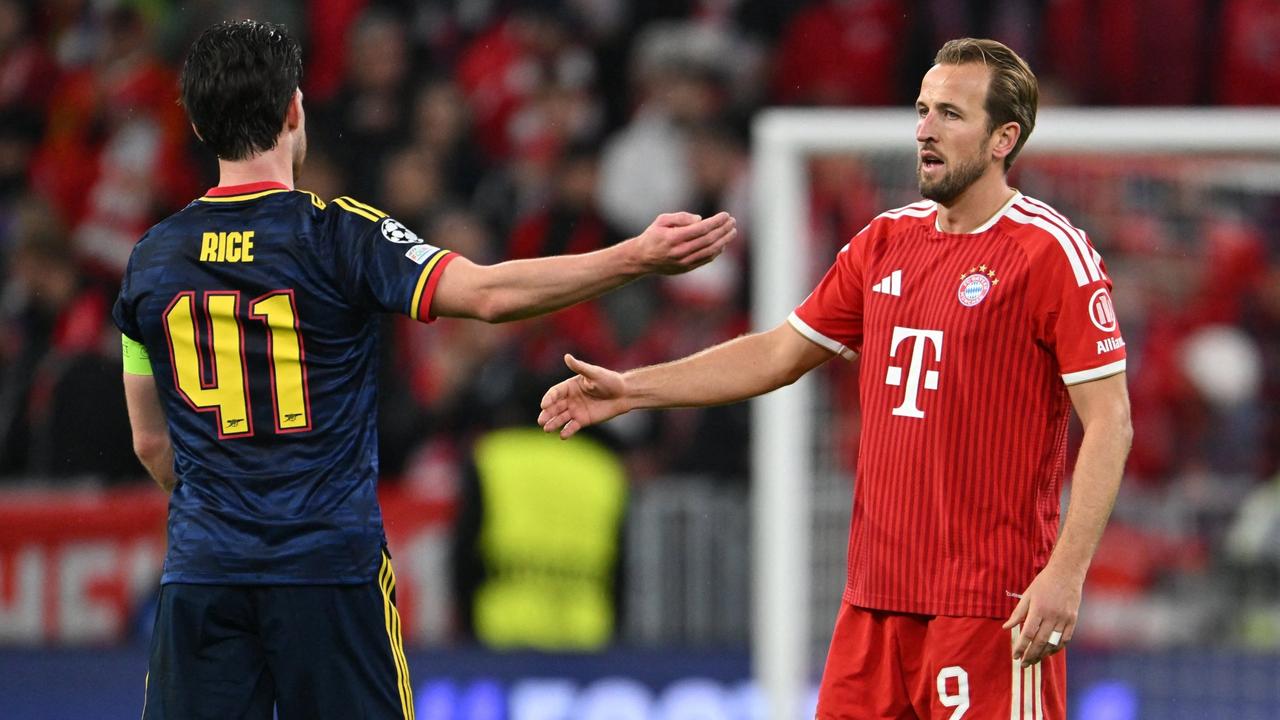
Bayern’s reliance on long, diagonal balls to exploit the space behind Arsenal’s full-backs—specifically the Davies-Kane connection—highlighted a clear strategic focus on punishing the Gunners’ aggressive press. Defensively, however, Bayern struggled with the fluidity of Arsenal’s front line. The absence of Joshua Kimmich, combined with the suspension of Michael Olise, forced Kompany into a reshuffled setup, which occasionally lacked the structural integrity required to contain a side as technically gifted as Arsenal.
Arsenal’s reliance on Ødegaard’s vision remains their greatest asset. The Norwegian midfielder’s ability to manipulate the game’s geometry allowed Arsenal to retain control even when Bayern looked dangerous on the counter. The introduction of Gyökeres in the final quarter proved to be the decisive tactical pivot; his physical presence provided the focal point Arsenal needed to bypass Bayern’s deep-sitting block in the dying embers of the match.
Official Responses: Reflections on a Hard-Fought Draw
Following the final whistle, the mood in the Bayern dressing room was one of frustration rather than relief. Harry Kane, speaking to DAZN, was brutally honest about his side’s performance.
"Overall, it is probably a fair result," Kane admitted. "I think we should have been more clinical, especially in the final third. Every small detail counts at this level. We simply didn’t do enough right in those decisive moments to fully justify a win."
Kane also highlighted the shift in momentum during the final 20 minutes. "We had the momentum, and the opponent looked tired, but then we stopped controlling the game. We found it hard to get out of our half, we didn’t hold the ball well enough, and we allowed them back into the game."
On the Arsenal side, there was a palpable sense of pride. Despite the injury to Saka, the team demonstrated the resilience that has characterized their campaign under Mikel Arteta. The ability to equalize under immense pressure away from home is a hallmark of a side maturing into a genuine European contender.
Implications: The Road Ahead
This draw leaves the standings in the Champions League group stage intriguingly poised. For Arsenal, the seven-point haul suggests they are firmly on track for the knockout phases. The resilience shown in Munich will provide a significant psychological boost as they look toward the later stages of the tournament.
For Bayern Munich, the five-point total is a reminder that they are still a work in progress under Kompany. While the offensive firepower is evident, the lack of defensive stability against top-tier opposition remains a concern. The team will look to integrate their returning players—including a healthy Manuel Neuer, who showed his enduring class tonight—to solidify their standing.
The match also highlighted the thin margins of the Champions League. A single injury, a mistimed tackle, or a split-second hesitation in the final third determined the outcome of a game that could easily have swung in either direction. As both teams look toward their next domestic and European fixtures, the lessons learned in Munich—specifically regarding game management and defensive concentration—will be vital.
In conclusion, the 2-2 draw between Bayern Munich and Arsenal was a testament to the quality of European football. It was a game where tactical brilliance met raw intensity, and where the outcome, while unsatisfying for those seeking a winner, provided a compelling look at two teams determined to conquer the continent. As the group stage progresses, both these clubs remain significant threats, provided they can refine the defensive frailties that defined this gripping night at the Allianz Arena.