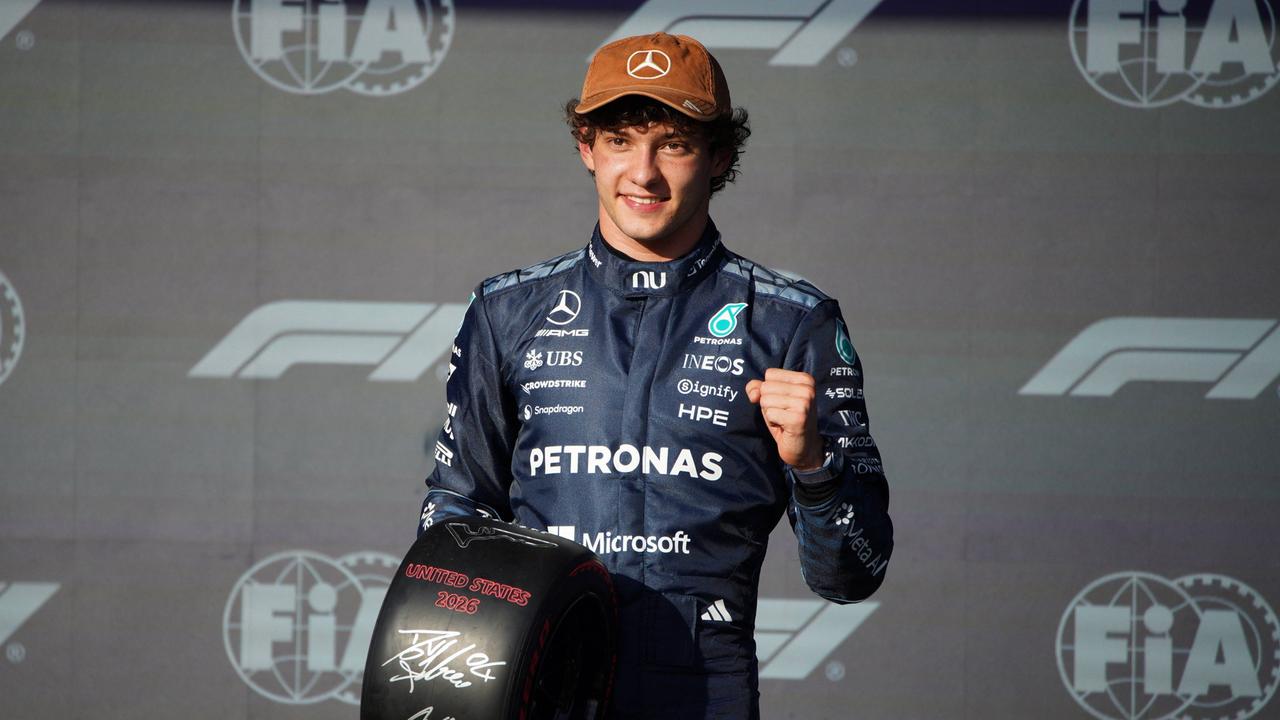
AUSTIN, TEXAS – In a display of tactical precision and raw speed, Formula 1 championship leader Kimi Antonelli has firmly planted his flag in the soil of the Circuit of the Americas (COTA). Securing pole position for the United States Grand Prix, the 20-year-old Italian sensation has set the stage for a potential coronation that would see him etched into the history books as the youngest World Champion in the sport’s storied history.
As the paddock buzzes with anticipation ahead of the 18th round of the 2026 season, Antonelli’s performance in qualifying provided a masterclass in handling pressure. Clocking a blistering 1:34.035, he neutralized the threat posed by his closest rivals and signaled that he is ready to claim the sport’s ultimate prize.
A Masterclass in High-Stakes Qualifying
The qualifying session at the Austin circuit was always destined to be a defining moment of the 2026 campaign. With the sun setting over the Texan landscape, the track surface cooled, creating a narrow window of peak performance that rewarded only the most surgical of drivers.
Antonelli, who has already secured pole position seven times this season, approached the session with the composure of a veteran. Throughout the Q1 and Q2 segments, he carefully managed his tire temperatures—a critical weakness identified by Mercedes earlier in the day—to ensure he had the necessary grip for the final, decisive Q3 run.
When the clock hit zero, the scoreboard confirmed his dominance: 1:34.035. The lap was a work of art, threading the needle through the undulating esses of the first sector and maintaining composure through the high-speed complex of the final corners.
"That feels good!" Antonelli radioed to his pit wall, his voice remarkably calm given the magnitude of the weekend. "The car was exactly where we needed it to be."
His performance relegated the resurgent Max Verstappen to second place. The Dutchman, buoyed by recent victories in Malaysia and Singapore, fought hard but finished just under two-tenths of a second behind. The second row of the grid will be occupied by Verstappen’s Red Bull teammate, Isack Hadjar, who continues to prove his worth as a formidable asset for the Milton Keynes-based squad.
The Ferrari Disappointment and Mid-Field Maneuvers
While the front of the grid was dominated by the familiar names of the 2026 season, there was significant disappointment further back. Ferrari, having shown immense promise during the practice sessions, failed to convert that pace into grid position. Charles Leclerc, despite his best efforts, could only manage fourth place, narrowly beating the veteran Lewis Hamilton, who continues to grapple with the consistency of his challenger.
George Russell, the second Mercedes pilot, endured a difficult session, qualifying in sixth. For Russell, who remains mathematically in the title hunt, the result represents a significant hurdle. His ability to challenge for the podium on Sunday will be crucial if he is to delay Antonelli’s championship celebration.
Further down the order, the Audi team attempted a clever, albeit ultimately unsuccessful, tactical play. Realizing that Gabriel Bortoleto would be starting from the back of the pack due to a power unit penalty, the team utilized him to provide a tow for teammate Nico Hülkenberg. Despite the aerodynamic assistance, Hülkenberg could only manage 11th place, leaving the German outside the points-paying positions for the start of the race.
Mercedes’ Technical Turnaround: From Overheating to Pole
The success of the evening was particularly sweet for the Mercedes garage, which had spent the morning in a state of mild panic. Motorsport boss Toto Wolff had been vocal about the team’s struggles during free practice, specifically citing "ruinous" handling in specific technical sectors.
"We have one or two corners that are simply destroying our lap time," Wolff noted during a mid-day interview. "The tires are overheating in the technical sections, and we simply couldn’t find a solution for the front wing balance. We were not on the right track."
The turnaround between the final practice session and the qualifying hour is a testament to the engineering depth at Mercedes. By adjusting the suspension geometry and refining the brake duct cooling, the team managed to stabilize the car’s temperature window. This allowed Antonelli to push the car to its absolute limits without the risk of thermal degradation in the final sector, proving once again that the Silver Arrows remain the benchmark for mid-weekend development.
The Road to the The Mathematical Reality
As the dust settles in Austin, the focus shifts entirely to the Grand Prix. Kimi Antonelli enters the race with 340 points, holding a commanding lead over his teammates and rivals. With only six races remaining in the season, the maximum available points—including sprint races and fastest laps—are rapidly dwindling.
The current standings are as follows:
- Kimi Antonelli: 340 points
- George Russell: 238 points (102-point deficit)
- Lewis Hamilton: 229 points (111-point deficit)
For the championship to be decided in Texas, the stars must align perfectly for the young Italian. To secure the title on Sunday, Antonelli must win the Grand Prix, while his primary challenger, George Russell, must finish no higher than ninth. Simultaneously, Lewis Hamilton must finish no higher than fifth.
While the mathematical probability of a title-clinching victory this weekend remains slim, the psychological momentum is entirely with the leader. Antonelli has navigated the pressure of his debut season with a level of maturity that has stunned the racing world, and should he emerge victorious on Sunday, he will be crowned the youngest champion in F1 history—a feat that would eclipse the records held by legends like Sebastian Vettel and Lewis Hamilton.
Implications for the Future of Formula 1
Beyond the immediate championship drama, this weekend in Austin signals a definitive changing of the guard. Antonelli’s rise to the top of the sport mirrors the shifting dynamics of the 2026 regulation era. The dominance of the younger generation—Hadjar, Bortoleto, and now Antonelli—suggests that the next decade of Formula 1 will be defined by a new class of drivers who grew up in the simulator era, possessing an uncanny ability to adapt to complex technical changes.
For Mercedes, the success of the weekend underscores the importance of the team’s long-term investment in its junior academy. Critics who questioned the wisdom of promoting a rookie into such a high-pressure environment have been silenced by a performance record that is nothing short of historic.
As the team prepares for the race, the atmosphere in the garage is one of controlled intensity. There are no celebrations yet, no talk of champagne or ceremonies. The objective is singular: to manage the race, protect the lead, and ensure that when the checkered flag drops, the trophy is coming home to Brackley.
For the fans at COTA, Sunday promises to be an emotional affair. They are witnessing the potential birth of a new era. Whether the title is clinched in Texas or postponed to the streets of Mexico City, one thing is certain: the era of Kimi Antonelli has arrived, and it is here to stay.
The United States Grand Prix is scheduled for Sunday, October 26, with lights out at 21:00 CET. All eyes will be on the front row, where a 20-year-old will attempt to write the most significant chapter of his life to date.