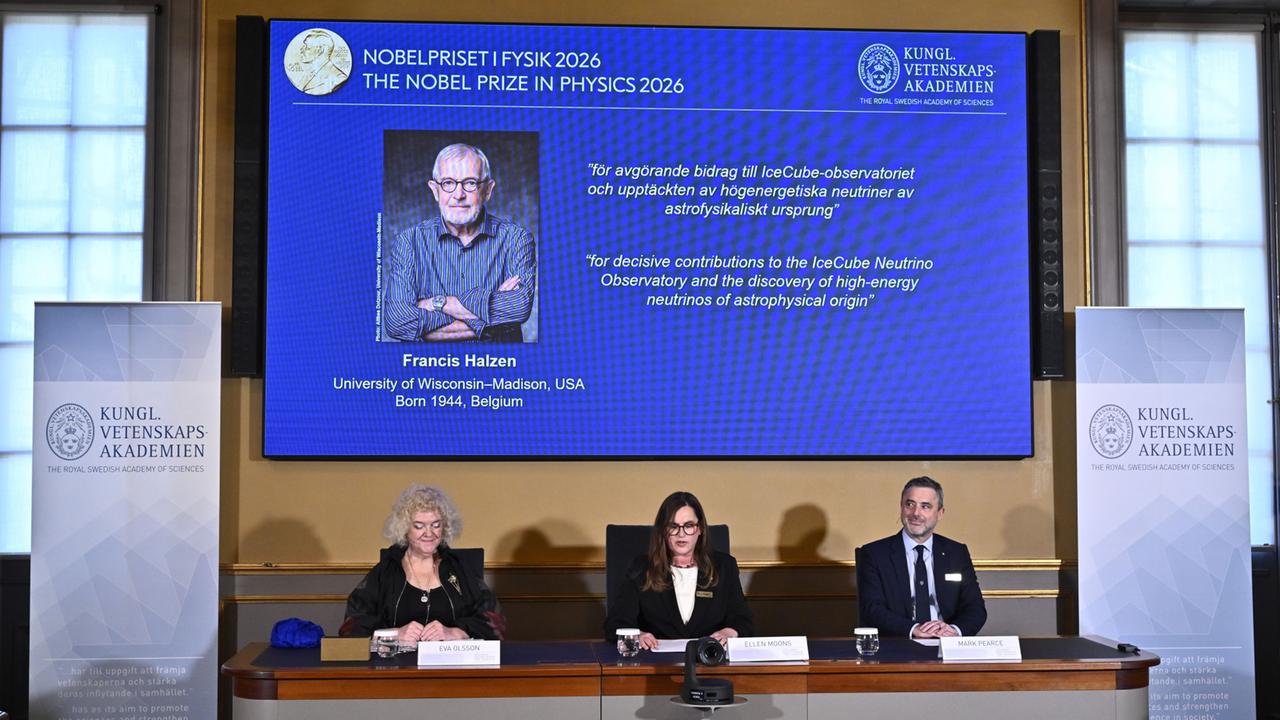
Stockholm, Sweden – October 6, 2026 – In a landmark announcement from the Royal Swedish Academy of Sciences, the Nobel Prize in Physics has been awarded to Francis Halzen, the distinguished Belgian-American physicist, for his groundbreaking contributions to the burgeoning field of neutrino astronomy. The 82-year-old scientist, based at the University of Wisconsin-Madison, is recognized for his pivotal role in the discovery of high-energy neutrinos of astrophysical origin, a feat achieved through his leadership of the monumental IceCube Neutrino Observatory at the South Pole. This accolade heralds a new era in our understanding of the universe, offering an unprecedented window into the most extreme cosmic phenomena.
The Nobel Committee cited Halzen’s "decisive contributions to the discovery of high-energy neutrinos of astrophysical origin," underscoring his visionary leadership and relentless perseverance in developing an entirely new form of astronomy. His work has transformed our ability to probe the universe’s most violent events, from supermassive black holes to exploding stars, by detecting elusive subatomic particles known as neutrinos. This discovery represents not just a scientific triumph but also a testament to decades of international collaboration and technological innovation under Halzen’s guidance.
A Visionary Honored
Francis Halzen, born in Belgium, has dedicated his career to unraveling the mysteries of fundamental particles. His journey to the Nobel stage has been marked by an unwavering commitment to a bold idea: that neutrinos, often dubbed "ghost particles" due to their elusive nature, could serve as cosmic messengers, carrying information from distant corners of the universe untouched by light or other forms of electromagnetic radiation.
At the heart of Halzen’s achievement is the IceCube Neutrino Observatory, an extraordinary scientific instrument embedded deep within the glacial ice of the South Pole. Under his leadership, an international team of scientists and engineers meticulously constructed this colossal detector, transforming a desolate polar landscape into the world’s largest neutrino telescope. Mark Pearce, Chairman of the Nobel Committee for Physics, lauded Halzen’s efforts, stating, "His persistence and scientific vision have paved the way for a new type of astronomy." This "new type of astronomy" promises to revolutionize our understanding of cosmic accelerators and the origins of the highest-energy particles in the universe. Halzen’s award not only celebrates a profound scientific discovery but also acknowledges the immense logistical and intellectual challenges overcome in bringing the IceCube project to fruition.
A Journey into the Cosmic Depths: The Science of Neutrinos
The Nobel Prize for Halzen is a testament to the profound significance of neutrinos in astrophysics. These fundamental particles, created in nuclear reactions within stars and other high-energy cosmic events, are notoriously difficult to detect. Unlike photons (light particles), neutrinos rarely interact with matter, allowing them to travel vast distances across the cosmos, unimpeded by stellar dust, gas, or magnetic fields. This makes them ideal candidates for carrying pristine information about their sources.
The Elusive "Ghost Particles": What are Neutrinos?
Neutrinos are elementary particles, nearly massless, with no electric charge, and interact only through the weak nuclear force and gravity. Billions of neutrinos pass through every square centimeter of our bodies every second, largely unnoticed. Most of these originate from the Sun, but a small fraction, far more energetic, come from much more distant and powerful cosmic sources. Scientists had long theorized about the existence of these high-energy cosmic neutrinos, but their detection remained an immense challenge due to their weak interaction with matter. Capturing even a handful of these elusive particles requires detectors of monumental scale and sensitivity, shielded from terrestrial interference.
IceCube: An Observatory at the Bottom of the World
The solution to this detection challenge was IceCube, conceived and brought to life under Halzen’s leadership. Located at the geographic South Pole, IceCube is not a traditional telescope that collects light. Instead, it is a vast array of 5,160 optical sensors, called Digital Optical Modules (DOMs), frozen into a cubic kilometer of clear Antarctic ice. These sensors are deployed on 86 strings, reaching depths of 1,450 to 2,450 meters (nearly a mile and a half).
When a high-energy neutrino rarely interacts with an atomic nucleus within the ice, it produces a cascade of charged particles. These charged particles move faster than the speed of light in ice, generating a faint blue glow known as Cherenkov radiation. The DOMs detect this light, and by analyzing the timing and intensity of the light signals across the entire array, scientists can reconstruct the neutrino’s trajectory and estimate its energy. The South Pole’s extreme environment provides the perfect natural shield, as the deep, clear ice acts as both the detection medium and an insulator against background cosmic rays, allowing for unparalleled sensitivity. The construction itself was an engineering marvel, requiring specialized hot-water drills to melt boreholes deep into the ice, a process that took nearly a decade to complete.
Unlocking Astrophysical Secrets
The successful detection of high-energy neutrinos of astrophysical origin by IceCube marked a paradigm shift. Before IceCube, astronomy relied primarily on electromagnetic radiation (radio waves, visible light, X-rays, gamma rays) and, more recently, gravitational waves. Each of these "messengers" provides a different perspective on the universe. However, electromagnetic radiation can be absorbed or scattered by interstellar dust and gas, obscuring the true nature of distant sources. Neutrinos, by contrast, travel unimpeded from their points of origin, carrying direct information from the heart of cosmic accelerators.
IceCube’s findings have provided the first direct evidence of cosmic ray accelerators beyond our Milky Way galaxy. These accelerators, such as active galactic nuclei (AGN) powered by supermassive black holes or powerful gamma-ray bursts, are thought to be the sources of the highest-energy particles in the universe, known as cosmic rays. By tracing the paths of high-energy neutrinos back to their celestial origins, scientists can pinpoint these cosmic engines, which were previously hidden from view. This capability has opened up the entirely new field of "neutrino astronomy," complementing traditional photon-based astronomy and offering a more complete, multi-messenger view of the cosmos. It allows scientists to peer into phenomena like supernovae, gamma-ray bursts, and the hearts of galaxies in ways previously impossible.
Halzen’s Enduring Legacy
Francis Halzen’s path to this Nobel recognition is not merely one of scientific insight but also of profound leadership. He conceived the vision for IceCube in the mid-1990s, at a time when the technological challenges seemed insurmountable. For decades, he championed the project, secured international funding, and orchestrated the collaborative efforts of hundreds of scientists and engineers from over a dozen countries. His unwavering belief in the potential of neutrino astronomy, coupled with his ability to inspire and manage a vast international team, was instrumental in transforming IceCube from a daring concept into a fully operational, world-leading scientific facility. The award acknowledges not just a discovery but the monumental effort required to build the instrument that made it possible, cementing Halzen’s legacy as a true pioneer in experimental particle astrophysics.
Official Acclaim and Scientific Community Response
The announcement of Francis Halzen as the sole recipient of the Physics Nobel Prize has been met with widespread acclaim, not only from the Nobel Committee but also from the global scientific community. The decision highlights the profound impact of his work on fundamental physics and astronomy.
Praises from Stockholm
During the official announcement in Stockholm, Mark Pearce, the Chairman of the Nobel Committee for Physics, emphasized the transformative nature of Halzen’s work. "Professor Halzen’s dedication to the IceCube project, from its conceptualization to its successful operation, exemplifies the highest ideals of scientific inquiry," Pearce stated. "His profound understanding of particle physics, coupled with an extraordinary vision for experimental design, has not only led to the detection of these elusive cosmic neutrinos but has also established a completely new observational window to the universe. We are now able to ask and answer questions about the cosmos that were unimaginable just a few decades ago." The Royal Swedish Academy of Sciences underscored that Halzen’s "maβgebliche Beiträge zur Entdeckung hochenergetischer Neutrinos astrophysikalischen Ursprungs" (decisive contributions to the discovery of high-energy neutrinos of astrophysical origin) have irrevocably altered the landscape of astrophysics.
Broader Scientific Impact
Across the international scientific community, the news of Halzen’s Nobel Prize has been met with enthusiastic approval. Leading physicists and astrophysicists have hailed the decision as a well-deserved recognition for a scientist whose tenacity and foresight pushed the boundaries of human knowledge. Many have noted that the IceCube collaboration, under Halzen’s guidance, has become a model for large-scale international scientific endeavors, demonstrating how collective intelligence and shared resources can tackle the grandest challenges in science.
"This is a fantastic day for astrophysics and for everyone who believes in the power of fundamental research," commented a prominent astrophysicist from CERN, who requested anonymity before the official statement from their institution. "Francis Halzen didn’t just build a detector; he built a new way to see the universe. His work with IceCube has opened up a whole new spectrum of cosmic phenomena that we can now study, allowing us to triangulate observations from different messengers – light, gravitational waves, and now neutrinos – to gain a truly holistic understanding of the most energetic processes in the universe." The sentiment widely shared is that the Nobel Prize acknowledges not only a singular discovery but also the establishment of an entirely new branch of observational astronomy.
Broader Context of the Nobel Season
The announcement of the Physics Nobel Prize for Francis Halzen is the second in a week-long series of prestigious awards, continuing a tradition that celebrates humanity’s most significant intellectual achievements.
Following the Quantum Leap: Last Year’s Physics Laureates
Last year, in 2025, the Nobel Prize in Physics was jointly awarded to three scientists for their groundbreaking work in quantum mechanics. Their research focused on entangled photons, Bell test experiments, and quantum information science. These discoveries had profound implications, not only for our fundamental understanding of quantum reality but also for practical applications. Their insights laid the groundwork for hochempfindliche Messungen mit MRT-Geräten (highly sensitive measurements with MRI devices) and also formed the basis for better mobile phones and faster computers. This demonstrates the Nobel Committee’s commitment to recognizing both fundamental breakthroughs and those with tangible technological impacts.
The Inaugural Prize: Medicine’s Optogenetic Breakthrough
The 2026 Nobel season commenced earlier this week with the announcement of the Nobel Prize in Physiology or Medicine. This year’s prize honored three scientists for their pioneering work in optogenetics. This revolutionary technique involves using light to control the activity of cells in living tissue, particularly neurons in the brain. By genetically modifying specific cells to express light-sensitive proteins, researchers can precisely turn these cells "on" or "off" with flashes of light. This method has provided an unprecedented tool for neuroscience, allowing scientists to decipher the complex workings of the brain, investigate neural circuits associated with diseases like Parkinson’s and Alzheimer’s, and gain deeper insights into perception, memory, and behavior. The award underscored the transformative power of interdisciplinary research at the intersection of biology, genetics, and optics.
The Nobel Legacy and Financial Recognition
The Nobel Prizes, established by the will of Swedish inventor Alfred Nobel, are among the most revered accolades in the world. Each laureate receives a gold medal, a diploma, and a monetary award. This year, the prize money for each full Nobel Prize is 12 million Swedish Kronor, which translates to approximately 1.06 million Euros (or about 1.15 million USD, depending on exchange rates). When there are multiple laureates for a single prize, the sum is typically divided among them. This substantial financial reward aims to allow recipients the freedom to continue their research without immediate financial constraints, further contributing to scientific advancement. The Nobel Prizes continue to serve as a beacon, highlighting discoveries that have profoundly benefited humanity and expanded the frontiers of knowledge.
Implications for the Future of Astronomy
Francis Halzen’s Nobel Prize marks a watershed moment, not just for him personally, but for the entire field of astrophysics. His work has profound implications for how we will explore and understand the universe in the coming decades.
The Dawn of Neutrino Astronomy
The award definitively solidifies neutrino astronomy as a distinct and vital field, standing alongside traditional electromagnetic (photon) astronomy and the recently established gravitational-wave astronomy. This multi-messenger approach to astrophysics is perhaps the most significant implication. By combining observations from different cosmic messengers – light, gravitational waves, and now neutrinos – scientists can piece together a far more comprehensive and nuanced picture of the universe’s most violent and mysterious events. Where photons might be absorbed or scattered, neutrinos pass through, offering an unobstructed view. Where gravitational waves signal massive cosmic collisions, neutrinos might pinpoint the engines driving particle acceleration. This synergy promises to unlock secrets that no single form of astronomy could reveal alone. We are entering an era where astronomers will routinely combine data from telescopes, gravitational wave detectors, and neutrino observatories to observe the universe’s most extreme phenomena in unprecedented detail.
Paving the Way for New Discoveries
The success of IceCube, spearheaded by Halzen, has ignited further ambitions within the scientific community. Plans are already underway for next-generation neutrino observatories, even larger and more sensitive than IceCube, capable of detecting even higher-energy neutrinos from further reaches of the cosmos. Projects like IceCube-Gen2, also proposed for the South Pole, aim to expand the current detector by a factor of ten, promising an even deeper dive into the universe’s most powerful accelerators. Other proposed detectors in different locations, such as under the Mediterranean Sea, also aim to contribute to a global neutrino telescope network. These future facilities will allow scientists to map the neutrino sky with greater precision, potentially identifying individual sources of cosmic neutrinos and correlating them with known astronomical objects. This could lead to a definitive understanding of the origin of cosmic rays, one of the longest-standing mysteries in astrophysics. Furthermore, it could reveal completely new types of cosmic sources or even unexpected physics beyond the Standard Model of particle physics.
Inspiration for Global Collaboration
Finally, Halzen’s Nobel Prize serves as a powerful testament to the effectiveness and necessity of large-scale international collaboration in modern science. The IceCube Neutrino Observatory is a prime example of how diverse expertise, shared resources, and collective vision from institutions across the globe can overcome monumental challenges to achieve groundbreaking discoveries. The sheer scale and complexity of such projects demand a global effort, transcending national borders and fostering a spirit of shared scientific endeavor. This collaborative model, successfully championed by Halzen, will undoubtedly inspire future generations of scientists to unite their efforts in tackling the next grand challenges in physics, astronomy, and beyond, ensuring that humanity continues to expand its understanding of the universe for centuries to come.