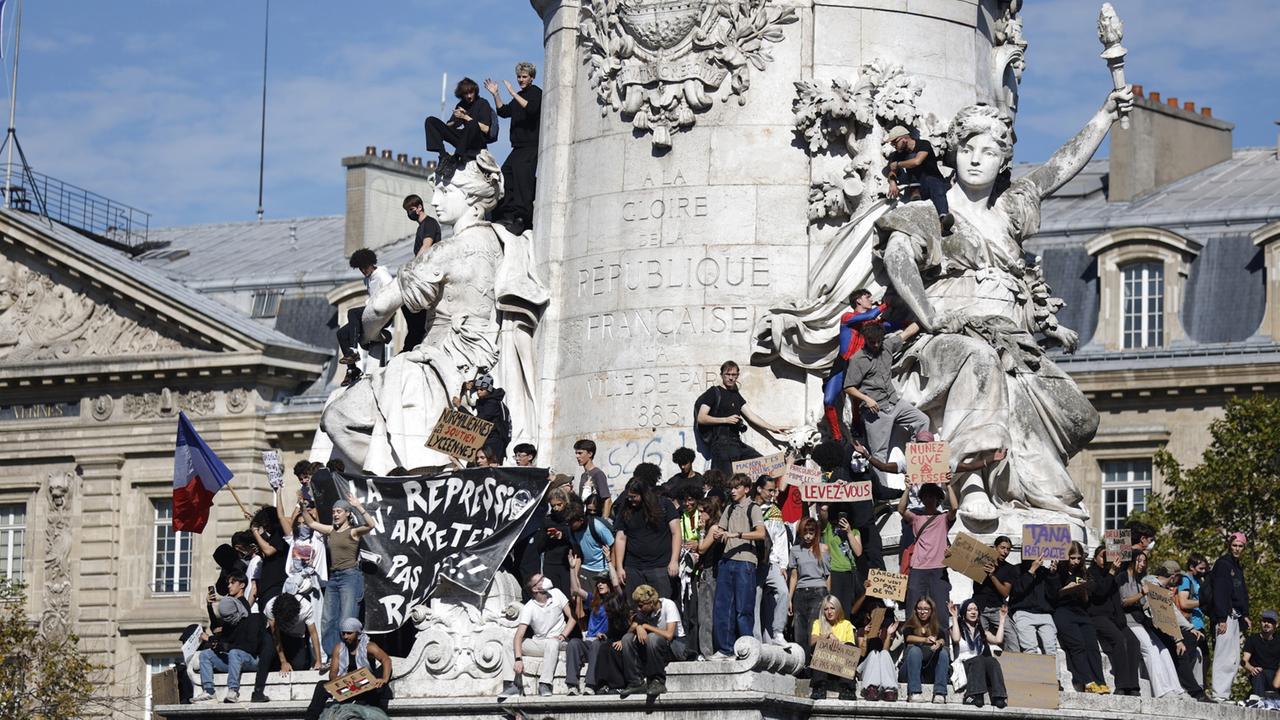
Paris, France – October 6, 2026 – France is currently experiencing an unparalleled surge in youth discontent, as student protests, initially sparked by grievances over deteriorating learning conditions, have escalated into a nationwide movement. Today, a week after the first stirrings of unrest, the demonstrations reached a critical juncture, drawing in powerful teachers’ unions and parents, and pitting tens of thousands of young people against a heavily deployed police force. The widespread mobilization has seen high schools and universities blocked across the country, while major cities from Paris to Marseille became stages for mass rallies characterized by both fervent demands for reform and tense confrontations with law enforcement.
The protests, initially localized to the Greater Paris area, have rapidly become a defining challenge for the French government, coming just seven months before a pivotal presidential election. With demonstrators decrying inadequate resources, dilapidated infrastructure, and perceived police brutality, the crisis threatens to metastasize into broader social unrest, fueled by underlying anxieties over economic hardship and the rising cost of living.
Nationwide Mobilization Escalates
The day’s events underscored the burgeoning scale of the movement. By midday, the high school union USL reported a staggering 1,800 high schools either blocked or preventively closed nationwide, with an estimated 90% of universities also experiencing blockades. While the Ministry of Education offered a slightly lower figure, confirming that classes were fully or partially suspended in 891 high schools, the impact on the national education system was undeniable.
In the capital, a massive protest march that commenced in the early afternoon was anticipated to draw between 20,000 and 40,000 participants, according to BFMTV, citing figures from the Interior Ministry. Across the country, an estimated 150,000 to 200,000 demonstrators were expected to take to the streets in major urban centers including Lyon, Lille, Marseille, Toulouse, Bordeaux, Rennes, and Strasbourg. The sheer numbers reflect a profound and widespread dissatisfaction that has resonated far beyond the initial student demographic.
For the first time since the protests began, teachers’ unions officially joined the ranks of the demonstrators, lending significant institutional weight to the youth movement. Parents also turned out in solidarity, often positioning themselves protectively between their children and the formidable police presence, signaling a broader societal concern for the students’ welfare and the issues they champion.
Chronology of Discontent: A Week of Mounting Frustration
The seeds of this widespread protest were sown approximately a week ago in high schools within the Greater Paris metropolitan area. What began as localized actions by students, primarily expressing frustration over long-standing systemic issues within the education system, quickly gained traction. Initial blockades and sit-ins evolved into larger, more coordinated demonstrations as social media amplified student voices and grievances.
By early October, the movement had begun to spread beyond the capital’s immediate environs, with reports of student actions emerging from other regional academic hubs. The grievances articulated by these early protestors were consistent: a pervasive sense of neglect within the public education system, characterized by a lack of resources, overcrowded classrooms, and a perceived disregard for their future.
The crucial turning point came today, October 6, 2026, when the movement transcended its student-only origins. The official endorsement and active participation of powerful teachers’ unions, coupled with the visible presence of supportive parents, transformed isolated pockets of protest into a unified, national front. This broader coalition signals a deeper crisis of confidence in the government’s handling of public services and its responsiveness to the concerns of its citizens, particularly its youth. The coordinated nature of today’s demonstrations, with simultaneous rallies and blockades across dozens of cities, demonstrated a strategic escalation designed to exert maximum pressure on the government.
Supporting Data: A System Under Strain
The figures cited by both student unions and government ministries paint a stark picture of an education system under immense strain and a society grappling with significant unrest:
- Institutional Blockades: The USL high school union reported 1,800 high schools blocked or closed nationwide, alongside 90% of universities facing similar disruptions. The Ministry of Education, while presenting a more conservative count, acknowledged that 891 high schools experienced full or partial class cancellations. These numbers illustrate a profound paralysis within the French education sector.
- Mass Mobilization: Estimates from the Interior Ministry, conveyed by BFMTV, projected between 150,000 and 200,000 demonstrators nationally. Paris alone was expected to see a turnout of 20,000 to 40,000 participants. Such large-scale participation underscores the depth of public anger and the broad appeal of the students’ demands.
- Police Deployment: The government’s mobilization of a "Großaufgebot" (large contingent) of police, equipped with riot gear, water cannons, and tear gas, indicates the perceived severity of the situation by authorities. This robust police response has, however, become a significant flashpoint within the protests.
- Clashes and Injuries: Reports from various cities detail confrontations where officers were reportedly pelted with objects and fireworks, leading to injuries. While specific numbers for France were not immediately available, the scale of police intervention suggests numerous minor injuries on both sides. In Belgium, a parallel protest saw 22 police officers lightly injured in Liège.
- Arrests: The article mentions that in Belgium, "numerous individuals have been arrested, including 17 minors," highlighting the vulnerability of many participants and the legal ramifications they face. Similar arrests are likely occurring in France, though not explicitly detailed in the provided text.
These statistics collectively point to a society in flux, where a generation of students feels compelled to disrupt their own education to demand a better future.
Allegations of Police Brutality Fuel Outrage
A central and increasingly contentious aspect of the ongoing protests is the frequent and often aggressive deployment of police forces. Demonstrators in many cities reported facing officers in heavy riot gear, who employed water cannons and tear gas against largely youthful crowds. This strong-arm approach has ignited widespread condemnation and fueled accusations of police brutality.
Placards held aloft by protestors vividly expressed their outrage. In Marseille, one sign starkly read: "Use tear gas against rapists, not against minors." Such slogans highlight the perception among many young people that the state’s response is disproportionate and misdirected, treating them as criminals rather than citizens exercising their right to protest.
The General Inspectorate of the National Police (IGPN), the internal affairs body responsible for investigating police misconduct, has reportedly launched inquiries into incidents where demonstrators were injured by officers. These investigations are crucial for maintaining public trust and accountability, but their outcomes are often slow and do not immediately quell public anger. The presence of parents and teachers aiming to shield students from police action underscores the community’s deep concern over these tactics.
Interior Minister Defends Force
Despite the mounting criticism, Interior Minister Laurent Nuñez staunchly defended the police’s actions in an interview with France Inter. He justified the use of grenades (likely referring to tear gas grenades and possibly stun grenades) and rubber bullets (LBDs, or "Lanceur de Balle de Défense" – defensive bullet launchers, a controversial non-lethal weapon) during demonstrations. Nuñez argued that when unrest and violence occur, the use of these weapons is "proportional." He emphatically denied that the situation could be characterized as "police repression."
This defense, however, is unlikely to satisfy the protestors or their supporters. The deployment of such equipment, particularly against minors, remains a highly sensitive issue in France, where memories of past heavy-handed policing tactics during social movements often resurface. The government’s insistence on the proportionality of force clashes directly with the lived experience and emotional outcry of the young demonstrators and their allies.
The Roots of Student Frustration: A System in Crisis
At the heart of the student uprising are deep-seated grievances concerning the quality and equity of the French education system. For years, students have complained about a multitude of systemic failures that they argue impede their ability to learn effectively and prepare for their futures.
Dilapidated Infrastructure and Teacher Shortages
Among the most pressing concerns are the physical conditions of school buildings. Many facilities are described as "dilapidated," suffering from a lack of maintenance and investment. This translates into uncomfortable, unsafe, and often unsanitary learning environments, particularly in older schools and those located in less affluent areas. Students frequently report issues such as broken heating systems, leaky roofs, outdated equipment, and insufficient space.
Compounding the problem of infrastructure is a severe shortage of qualified teaching staff and a high rate of class cancellations. Students lament that "far too many classes are cancelled," often due to a lack of substitute teachers. This leads to interrupted learning, inconsistent curricula, and a feeling that their education is not being taken seriously. The burden of finding replacements or managing oversized classes falls on already overworked educators, contributing to a cycle of burnout and declining morale.
Feeling Ignored: A Two-Tiered System
A recurring theme among the protestors, particularly those from disadvantaged neighborhoods, is a profound sense of being "second-class citizens" and feeling that their concerns are not "taken seriously." This sentiment speaks to a perceived two-tiered education system, where students in more privileged areas benefit from better resources, more stable teaching staff, and superior facilities, while those in less fortunate regions are left to cope with chronic underfunding and neglect. This disparity fuels a sense of injustice and alienation, driving many young people to the streets as a last resort to make their voices heard. The feeling of being ignored by authorities contributes significantly to the intensity and longevity of the protests.
Government Scrambles for a Response
Faced with a rapidly escalating crisis, the French government has begun to articulate responses, though these have so far failed to appease the protestors. The timing of the unrest, seven months before a presidential election, places immense pressure on the administration to de-escalate the situation and demonstrate a credible path forward.
On Sunday evening, Prime Minister Sébastien Lecornu issued a directive calling on relevant ministries to initiate "concrete improvements" in the nation’s schools and to "heed the legitimate concerns of students." While a step towards acknowledging the problem, this broad statement lacked specific details or immediate actions.
Education Minister Édouard Geffray followed up on Monday by launching an online platform designed to allow students to articulate their demands and problems. However, this initiative was met with skepticism and rejection by many young people, who view it as a superficial gesture rather than a genuine commitment to systemic change. As students Iris and Louane told a reporter from Le Monde in Rennes, "We can’t understand this repression… We are pacifists. We just want to make our demands heard. The scale of this demonstration will help us show how widely these demands are shared." Their words encapsulate the sentiment that an online portal is an insufficient response to physical clashes and deeply felt grievances.
Political Implications Ahead of Elections
The massive protests have caught the French government largely unprepared, especially as it grapples with a contentious austerity budget. The administration’s immediate concern is to prevent a "Flächenbrand" (wildfire) – a widespread social conflagration that could see the protests expand beyond the education sector. There is a palpable fear that the student movement, if unchecked, could ignite broader discontent, drawing in other segments of society affected by high fuel prices and the spiraling cost of living.
For President Emmanuel Macron and his government, the timing is particularly precarious. With a presidential election looming, the ability to manage this crisis effectively will be a crucial test of leadership. A perceived failure to address the youth’s legitimate concerns, or a continuation of confrontational policing, could severely damage the government’s standing and influence the electoral landscape. The current unrest highlights the delicate balance the government must strike between maintaining public order and responding to the democratic demands of its citizens.
Spillover into Belgium: Shared Grievances, Similar Clashes
The wave of youth protests has not remained confined to French borders, with similar demonstrations erupting in neighboring Belgium. On Monday, protests against the school system in Liège resulted in clashes and several injuries, mirroring the volatile situation in France.
Similar Grievances, Similar Clashes
According to the Belgian news agency Belga, 22 police officers sustained minor injuries in Liège as demonstrators reportedly threw stones and fireworks at law enforcement. This aggressive interaction reflects a similar dynamic to that observed in France, where confrontations between protestors and police have become a hallmark of the movement. Reports also detailed street blockades, small fires, and smashed windows, indicating a level of destructive behavior that escalated the tension. In response, police deployed water cannons and tear gas against the protestors.
Over 1,000 demonstrators reportedly gathered in Liège, signaling a significant mobilization of young people expressing their dissatisfaction with the education system. Since the start of these particular protests last Thursday, numerous individuals have been arrested, including 17 minors, raising similar concerns about the treatment of young protestors as seen in France.
While the specific structural issues within the Belgian education system may differ in detail from those in France, the underlying sentiments of neglect, inadequate resources, and a desire for improved learning conditions appear to resonate across the border. This cross-national solidarity among young people underscores a broader European context of youth disillusionment with established systems and a growing willingness to engage in direct action to demand change.
What Lies Ahead?
As the protests continue to unfold, the trajectory of this youth uprising remains uncertain. The government faces a complex challenge: how to genuinely address the deep-seated grievances of students and their allies without appearing weak or yielding to disruption, all while navigating a sensitive pre-election period.
The students and unions, emboldened by their growing numbers and cross-generational support, are unlikely to be satisfied with mere online platforms or vague promises. They are demanding concrete, tangible improvements to their learning conditions and a cessation of what they perceive as unwarranted police aggression.
The risk of further escalation, particularly if the government fails to offer substantive concessions, is high. The confluence of educational grievances with broader socio-economic anxieties, such as high fuel prices and the cost of living, could yet transform this student movement into a wider social protest, posing an even greater challenge to the French government and potentially reshaping the political landscape ahead of the upcoming presidential election. The eyes of France, and indeed Europe, will remain fixed on its streets as this critical struggle for the future of its youth continues.