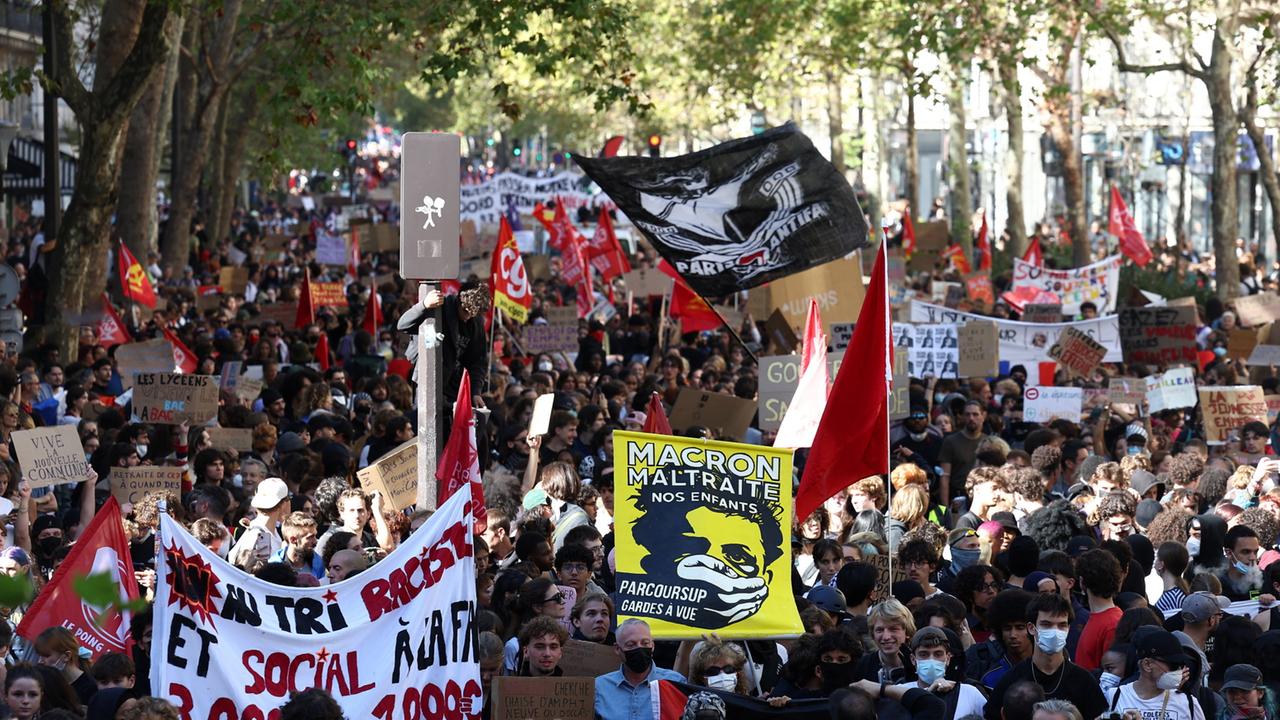
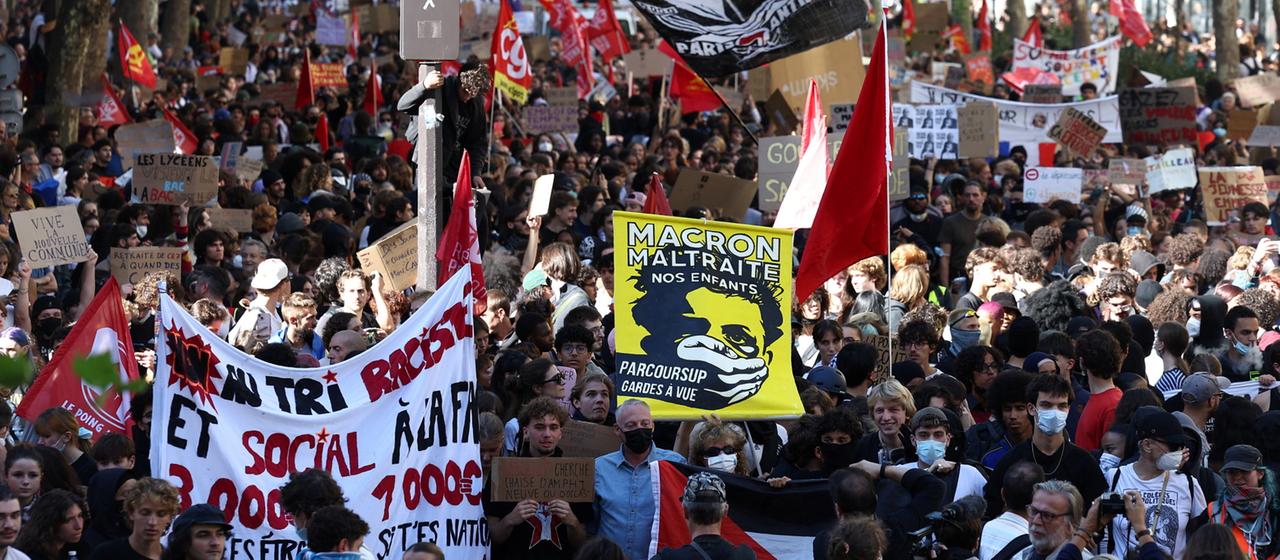
Paris, France – October 6, 2026 – A formidable wave of student protests, advocating for desperately needed improvements in France’s educational system, culminated today in one of the largest demonstrations seen in years. According to the Interior Ministry, an estimated 256,000 individuals participated in nationwide rallies, with a staggering 56,000 converging on the streets of Paris alone. This widespread mobilization underscores a deep-seated frustration among young people, teachers, and parents alike, signaling a critical moment for the Macron government as it grapples with a burgeoning social crisis.
A Wave of Discontent Swells Across France
The iconic Place de la République, a historical crucible of French protest, was once again transformed into a sea of determined faces. Before the main procession even began its march through the capital, demonstrators collectively broke into a defiant rendition of the French national anthem, La Marseillaise, reimagined with lyrics pertinent to their cause: "Aux armes, lycéens!" – "To arms, high school students!" This martial call, however, belied the predominantly peaceful, yet resolutely firm, atmosphere that permeated the gathering.
The sheer scale of today’s protests marks a significant escalation in a movement that has been steadily gaining momentum. Organizers, including student unions and various educational federations, had anticipated a strong turnout, but the final numbers, particularly in Paris, exceeded many expectations. This outpouring of public sentiment highlights a growing chasm between the government’s perceived inaction and the tangible struggles faced daily within the nation’s schools.
Students like Khalil and Esperanza, who traveled from Massy, a commune south of Paris, articulated the core demands resonating across the country. Their primary focus: a substantial increase in funding for the public education system. "I came to protest against teacher job cuts," Khalil stated, his voice firm amidst the chants. "They say these cuts are due to demographic reasons, fewer students in the future. But it’s just a way to save money. The result is classrooms with up to 35 students. These are not conditions conducive to learning."
Esperanza echoed his sentiment, drawing a stark comparison. "It’s scandalous that money is being diverted to less important areas like the military," she asserted passionately. "It is education that saves the nation." Their words encapsulate the widespread belief that the government’s priorities are misplaced, sacrificing the future of its youth for other budgetary considerations.
From Seine-Saint-Denis to the Streets of Paris: A Chronology of Grievances
The current wave of student activism, though now a national phenomenon, has its roots firmly planted in the socio-economically challenged département of Seine-Saint-Denis, located just north of Paris. It was here, in mid-September, that the initial sparks of discontent ignited. For years, this region, characterized by a diverse population and significant social inequalities, has been a symbol of systemic underinvestment in public services, particularly education.
Teachers, parents, and local elected officials in Seine-Saint-Denis have been vocal critics of their abysmal learning conditions for an extended period. Toni Tremblay, a mathematics teacher in Seine-Saint-Denis and a representative of the SNES-FSU union, revealed the depth of this long-standing struggle. "We have been protesting for three years," Tremblay recounted. "Teachers, deputies, and parents have been demanding an emergency plan for the département for three years. And all we get in response is the government’s contempt and the police. We do not consider this an appropriate response. We want educational policy answers."
This historical context is crucial to understanding the current nationwide mobilization. The solidarity expressed by students like Esperanza, Khalil, and their friend Nassim with their peers in Seine-Saint-Denis is not merely symbolic; it represents a recognition that the systemic issues plaguing one region are indicative of broader failures across the national education system. The protests escalated from localized actions and school blockades in Seine-Saint-Denis, gradually gaining traction through social media and traditional media coverage, drawing in other regions and culminating in today’s massive national demonstration. The memory of the 2023 pension reform protests, which saw widespread public dissent, also lingers, providing a blueprint for large-scale mobilization against government policies.
Deep-Rooted Issues: The Data Behind the Demonstrations
The grievances voiced by the students are not merely anecdotal; they are supported by a wealth of data and a lived reality for millions.
Classroom Crisis: Overcrowding and Teacher Shortages
The issue of overcrowded classrooms is a central pillar of the protests. While the government might cite demographic shifts as a rationale for teacher job cuts, the reality on the ground, as described by Khalil, paints a different picture. Many high schools, especially in urban and suburban areas, are struggling with a teacher-to-student ratio that makes individualized attention and effective pedagogy nearly impossible. Reports from teacher unions frequently highlight a shortage of qualified educators in critical subjects, leading to unfilled positions, reliance on less experienced contract teachers, and a heavy workload for existing staff. This translates directly into cancelled classes, less comprehensive curricula, and a diminished learning experience for students. The notion of 35 students in a single classroom is not an anomaly but a growing norm, far exceeding recommended educational standards.
The Neglected Periphery: The Plight of Seine-Saint-Denis
The département of Seine-Saint-Denis serves as a poignant microcosm of the wider issues. It is one of France’s poorest regions, with a high proportion of immigrant families and significant socio-economic challenges. Decades of underfunding have left its schools in a state of disrepair: crumbling infrastructure, inadequate heating, outdated equipment, and a persistent lack of resources. Teachers in Seine-Saint-Denis often face unique challenges, including high rates of student turnover, linguistic diversity, and a greater need for social and psychological support services, all while operating with fewer resources than their counterparts in more affluent areas. The "emergency plan" demanded by local educators and parents for three years underscores the dire state of affairs, demonstrating a systemic failure to address the specific needs of a vulnerable population. The government’s consistent failure to implement such a plan has fueled a profound sense of neglect and injustice.
Funding Priorities: Education vs. Other Sectors
Esperanza’s point about money being diverted to "less important areas like the military" touches upon a deeply contentious debate regarding national budget allocation. While defense spending is a government priority, critics argue that such investments come at the expense of crucial social sectors like education and healthcare. Protesters believe that a robust, well-funded education system is not merely a social service but a foundational investment in the nation’s future economic competitiveness, social cohesion, and democratic health. The perception that the government prioritizes other sectors over the well-being and intellectual development of its youth has ignited widespread public anger.
The Silent Struggle: Teachers and Parents Join the Fray
Today’s demonstration saw an unusually strong presence of not just students, but also their teachers and parents. Toni Tremblay’s testimony about teachers protesting for three years highlights the chronic nature of the problem from an educator’s perspective. Teachers are often on the front lines, witnessing daily the impact of underfunding and overcrowding on their students and their own ability to teach effectively. Their participation underscores the severity of the crisis and their frustration with unresponsive authorities.
Equally significant was the presence of many parents, who joined the march explicitly "for protection." This detail speaks volumes about the tense relationship between protesters and authorities in France, particularly in the wake of previous social movements. Parents, concerned for their children’s safety and future, are stepping up not just as advocates but as guardians, reflecting a societal distrust that the state will ensure a safe environment for peaceful protest. Trade unions and left-wing political parties also deployed their own security services, known as services d’ordre, to help maintain peace within the demonstration, a clear indication of collective efforts to prevent any potential escalation of violence.
Government’s Stance: "Contempt" and Confrontation?
The government’s response to the escalating education crisis has been a significant point of contention. Prior to today’s peak, the Macron administration had largely been perceived as dismissive of the specific demands emanating from Seine-Saint-Denis and other struggling regions. Initial reactions often involved acknowledging "challenges" but refraining from committing to the scale of investment demanded by educators and unions. Promises of "dialogue" have, according to protesters, rarely materialized into concrete, meaningful action.
Instead, the response has frequently been characterized by a heavy police presence at school blockades and earlier demonstrations, a strategy that many, including teacher Toni Tremblay, view as "contempt." "All we get in response is the government’s contempt and the police," Tremblay stated, highlighting a feeling that their pleas for policy solutions are being met with force rather than engagement. This approach mirrors criticisms leveled during the Yellow Vest movement and the pension reform protests, where the government’s perceived authoritarian stance and reliance on policing rather than negotiation fueled further public anger.
As of today’s massive turnout, an immediate, comprehensive official response from the government has yet to fully emerge beyond the Interior Ministry’s crowd estimates. The challenge for the Macron administration now is to move beyond mere acknowledgment of the numbers and address the deep-seated grievances articulated by a quarter of a million people. Failure to do so risks further entrenching the perception of a government out of touch with its citizens, particularly its youth.
Beyond the Barricades: Broader Implications for French Society
The student protests, while focused on education, are increasingly seen as a symptom of a broader malaise within French society, carrying significant political, social, and cultural implications.
Political Pressure on the Macron Administration
The sheer scale and sustained nature of these demonstrations place immense pressure on President Macron and his government. Having already navigated the turbulent waters of the pension reforms, the administration now faces another formidable challenge to its authority and legitimacy. Public opinion polls often indicate a decline in trust in government institutions, and a failure to adequately address the concerns of students, teachers, and parents could further erode this trust. With future elections on the horizon, the government’s handling of this crisis could have lasting political repercussions, potentially mobilizing a new generation of politically engaged, yet disillusioned, voters.
The Media Narrative and the Perception of Protest
A recurring theme among the student protesters, articulated powerfully by Esperanza, is the perceived misrepresentation of their movement by the media. "The violence is overrepresented," she lamented. "Of course, fireworks fly, we cannot deny that." While acknowledging isolated incidents, Esperanza stressed that these were perpetrated by a "vanishingly small part" of the demonstrating crowd. "In the media, it’s mostly about the violence and little about what we are demanding. That’s why we are protesting. We are not listened to enough; we are always just mocked."
This sentiment highlights a critical challenge for social movements in the age of 24/7 news cycles: the battle for narrative control. A media focus on sensationalist images of confrontation can obscure the legitimate, deeply felt grievances that motivate the vast majority of peaceful protesters. This distortion further alienates demonstrators, reinforcing their belief that their voices are not being heard, and their demands are being deliberately sidelined.
A Generation’s Disillusionment and the Future of Education
At its heart, this movement represents the disillusionment of a generation. These students are not merely protesting for better textbooks or newer buildings; they are fighting for their future. They understand that a quality education is the bedrock of opportunity, social mobility, and personal development. The systemic failures they highlight – overcrowded classrooms, teacher shortages, dilapidated infrastructure – directly threaten their ability to succeed in an increasingly competitive world. This deep-seated anxiety about their prospects, coupled with a feeling of being ignored by those in power, could have profound long-term social consequences, potentially fostering widespread cynicism and disengagement from democratic processes. The future of French education, once a source of national pride, is now at a critical crossroads.
Echoes of Past Movements: A Nation on Edge
The question posed on one protester’s placard – "Are the students the new Yellow Vests?" – encapsulates the broader societal tension felt across France. While Esperanza might not go "that far," the parallels are undeniable. Both movements emerged from a sense of deep social injustice, a feeling of being unheard by a distant elite, and a frustration with a government perceived as unresponsive to the needs of ordinary citizens. Like the Yellow Vests, the student movement is broad-based, encompassing diverse grievances, and has quickly tapped into a wider current of discontent. The consistent reliance on street protests as a primary means of expressing dissent reflects a growing distrust in traditional political channels.
The current wave of student protests is more than just a call for better schools; it is a profound cry for recognition, for investment in the nation’s youth, and for a re-evaluation of national priorities. As the sun sets on a day of massive mobilization, the stakes for the French government and society at large could not be higher. The youth have found their voice, and they are determined to be heard, signaling that they will continue to fight "until all their demands are met – or at least they come as close as possible." The question now remains: will the government finally listen, or will France brace itself for another prolonged period of social unrest?