By Scientific Correspondent
For centuries, the vast, mysterious depths of our oceans have guarded the secrets of whale behavior. While the complex social structures of toothed whales, such as orcas and dolphins, have long been documented, the emotional lives of baleen whales—the giants of the deep—have remained largely a matter of conjecture. However, a landmark observation off the Australian Gold Coast in July 2025 has provided what researchers are calling the first definitive evidence of grief-like behavior in humpback whales.
This unprecedented incident, captured by the Whales & Climate Research Program, challenges our understanding of mammalian consciousness and forces a re-evaluation of the emotional capacity of one of the planet’s most iconic marine species.
The Incident: A Mother’s Vigil
On July 17, 2025, the serene waters off the Australian Gold Coast became the stage for a poignant display of maternal devotion that would soon captivate the global scientific community. Researchers from the Griffith University, led by Dr. Olaf Meynecke, were monitoring humpback whale migration patterns when they encountered a scene that would shift the paradigm of cetacean study.
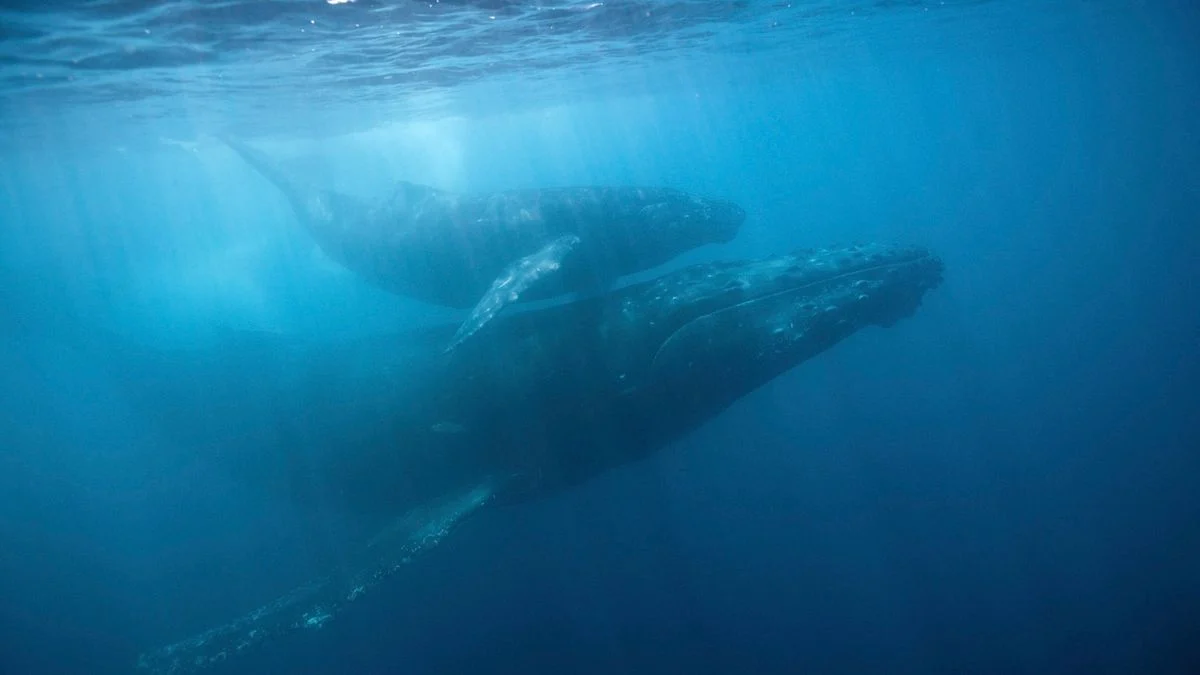
A female humpback whale was observed lingering in the vicinity of a motionless calf resting on the sandy ocean floor. What began as a routine observation quickly turned into a profound behavioral study. Over the course of two hours, the researchers watched as the mother repeatedly dived to the sea floor, physically interacting with the deceased calf. She nudged the body with her rostrum (head) and pectoral fins, attempting to lift or reposition the small carcass.
Most strikingly, the mother would remain motionless beside the calf for intervals of at least one minute at a time—a rare behavior for a species that must constantly surface to breathe and maintain buoyancy. This cycle of diving, touching, and silent vigil continued uninterrupted, painting a picture of profound loss that seemed to transcend the instinctual drive for survival.
Chronology of a Sorrowful Encounter
The documentation of this event provides a rare, minute-by-minute look at how these massive creatures process death.
- July 17, 2025: Initial contact. Researchers identify a female humpback whale exhibiting atypical diving patterns. Upon closer inspection, a deceased calf is located on the seabed. The mother remains in the area for a documented two-hour window, performing repetitive contact behaviors that suggest an inability to process or accept the calf’s demise.
- July 18–19, 2025: The mystery deepens. Following the initial observation, two adult humpback whales were spotted circling the exact same coordinates off the Gold Coast for several hours. While researchers could not definitively confirm if these were the same individuals from the previous day, the proximity and the sustained focus on the area suggest a collective response to the mortality of a member of their population.
This timeline suggests that the reaction was not a fleeting impulse, but a sustained, multi-day engagement with the site of the tragedy, hinting at a social awareness that extends beyond the immediate mother-offspring dyad.
The Science of Cetacean Emotion
In a report published in the prestigious journal Discover Animals, Dr. Olaf Meynecke posits that these behaviors are consistent with "care-giving or training actions" typically observed in highly social mammals after the death of a peer.
"The observed behaviors align with attentive reactions documented in socially complex mammals," Dr. Meynecke writes. "They indicate an innate, powerful maternal bond to the calf, which, in this context, strongly manifests as an expression of grief."
Why Now? The Mystery of the "Sinking Calf"
A central question remains: If whales feel grief, why have we not seen this behavior more often? The answer, according to marine biologists, lies in the unique biology of baleen whale calves. Unlike toothed whales, whose carcasses often remain buoyant for longer periods due to different physiological compositions, the calves of many baleen species have a relatively low body fat percentage.
Upon death, these calves often sink rapidly to the ocean floor. Because the majority of human observation occurs at the surface, the "funerary" behaviors occurring at depths of 20 to 50 meters or more have historically been hidden from view. The Gold Coast incident was only captured because the water clarity and the specific location of the calf allowed researchers to witness a behavior that may, in fact, be common but entirely invisible to science.
Implications for Marine Biology and Conservation
The confirmation of this behavior has far-reaching implications for how we view the "intellectual" and "emotional" architecture of whales.
1. Re-evaluating Social Complexity
For years, the scientific community categorized the social lives of baleen whales as "simple" compared to the highly coordinated packs of orcas. The Gold Coast observation provides a corrective to this view. It suggests that humpback whales possess a sophisticated social framework that includes deep emotional attachment, mourning, and perhaps even a form of communal response to loss.
2. Anthropomorphism vs. Biological Fact
While scientists are careful to avoid the trap of "anthropomorphism"—the tendency to project human emotions onto animals—the line between human and cetacean grief is becoming increasingly blurred. If the behavioral indicators of grief (physical contact, prolonged presence, and social distress) are present, researchers argue that we must accept the biological reality of that emotion, regardless of what we choose to call it.
3. Conservation Concerns
Understanding that these animals possess high emotional intelligence changes the stakes for conservation efforts. If the death of a calf causes significant, multi-day distress to a mother and potentially her social group, then anthropogenic factors that lead to calf mortality—such as ship strikes, entanglement in fishing gear, or acoustic pollution that disrupts communication—are not just ecological losses; they are causes of profound psychological trauma to the survivors.
Official Responses and Peer Review
The publication of the report in Discover Animals has ignited a flurry of academic discourse. Dr. Elena Vance, a specialist in marine mammal cognition who was not involved in the study, noted that the data provided by the Griffith University team is "compelling and difficult to interpret as anything other than a high-level social response."
"We are moving past the era where we viewed whales as mere ‘swimming machines,’" Dr. Vance said. "This study forces us to treat them as individuals with complex, internal lives. When a mother whale stays with her dead calf, she isn’t just acting on instinct; she is engaged in a cognitive process of loss. That requires us to be much more sensitive in our interactions with these populations."
The scientific community is now calling for a global database of such sightings. By pooling data from independent researchers and citizen scientists worldwide, the Whales & Climate Research Program hopes to determine if this behavior is universal across all humpback populations or if it varies by region and social context.
Conclusion: A Call for Empathy
The story of the humpback whale off the Gold Coast serves as a sobering reminder of the deep, often invisible connections that define life in the world’s oceans. As we continue to encroach upon their habitats, our understanding of their emotional lives must keep pace with our technological capabilities.
If we accept that these majestic creatures are capable of feeling the weight of loss, our approach to marine conservation must evolve. It is no longer enough to protect whales as a biological resource; we must protect them as sentient, social beings capable of profound love and, as we have now witnessed, profound grief. The silent vigil on the ocean floor is not just a footnote in a scientific journal—it is a mirror held up to our own humanity, reminding us that in the vast blue expanse, we are not the only ones who know how to mourn.