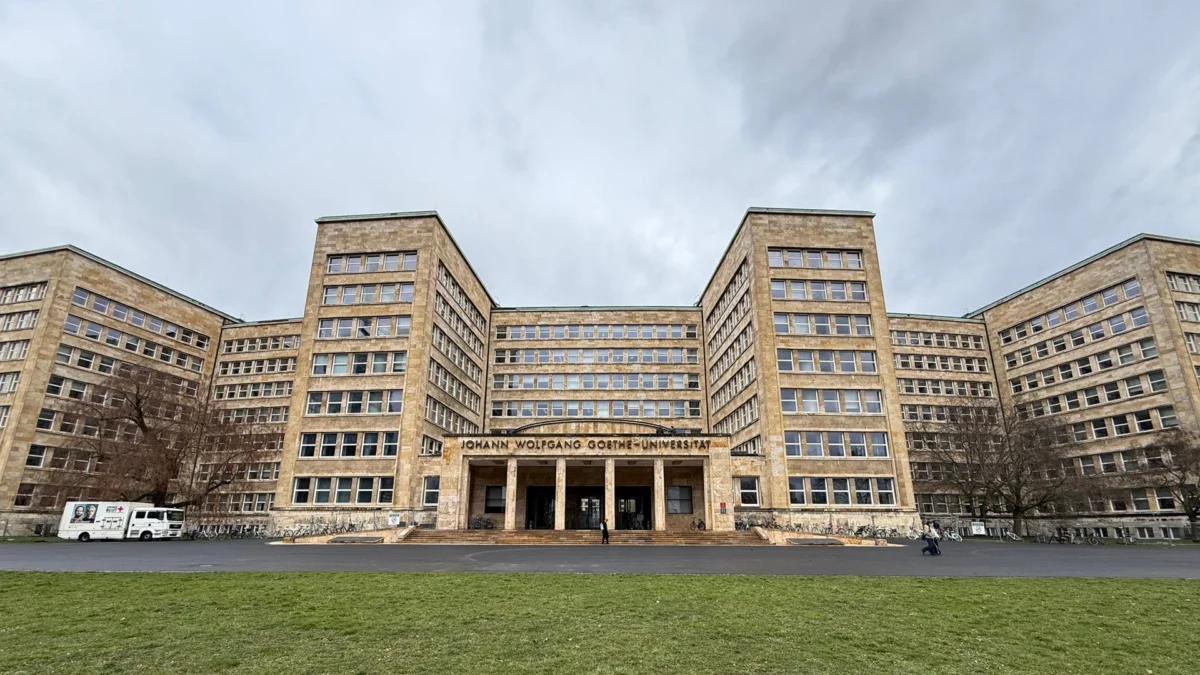
The prestigious Goethe University Frankfurt, one of Germany’s largest and most significant academic institutions, is currently embroiled in a profound internal crisis. A 59-page strategic document, titled "Shaping Future Viability – Framework Concept for Goethe University as a Foundation University 2031+," has unveiled ambitious and controversial plans by the university’s leadership to fundamentally overhaul the institution’s structure.
The proposed reforms, which include a drastic reduction in the number of academic departments and significant staffing cuts, have triggered a wave of indignation among students, faculty, and political observers. At the heart of the conflict is a perceived disconnect between the university’s top-down management and the community it serves, compounded by the pressures of the state-mandated "Higher Education Pact" (Hochschulpakt).
Main Facts: A Blueprint for Transformation
The core of the controversy lies in the "2031+" document, which aims to navigate the university through the financial and demographic challenges of the coming decade. While the university administration frames these measures as a necessary response to shifting societal needs—citing the rise of Artificial Intelligence, digital transformation, and demographic shifts—the substance of the proposal has sent shockwaves through the campus.
According to reports from the Frankfurter Allgemeine Zeitung (FAZ) and the Frankfurter Rundschau (FR), which gained early access to the internal draft, the university is contemplating a consolidation that would reduce its current structure to just seven core faculties. This move is intended to streamline operations and offset the significant budgetary constraints imposed by the Hessian state government.
For an institution with over 40,000 students and an annual budget of approximately €837 million (as of 2025), such a restructuring represents a seismic shift. The administration maintains that these are, at this stage, preliminary proposals intended to stimulate discourse. However, the lack of prior consultation has led many to perceive the document as a fait accompli designed to circumvent democratic consensus.
Chronology of the Dispute
The timeline of this unfolding crisis highlights the friction between fiscal policy and academic governance:
- 2024 (Contextual Backdrop): Negotiations surrounding the Hessian Higher Education Pact (2026–2031) solidify, mandating that universities across the state implement efficiency measures. The Goethe University is tasked with an average annual budget reduction of 10%.
- Late 2024/Early 2025: The university’s executive leadership (Präsidium) quietly drafts the "2031+" framework. During this phase, faculty and student representatives report a total lack of involvement.
- Early 2025 (The Leak): The FAZ and FR publish reports detailing the contents of the internal paper, including the reduction of departments and the potential loss of 60 professorships.
- February 2025: The public outcry reaches a tipping point. Student organizations (AStA) and labor unions (GEW) voice formal protests, claiming that the university’s leadership is attempting to push through structural changes via an authoritarian, "top-down" approach.
- Ongoing: Discussions between the university administration and the Senate are scheduled for the coming year, with implementation targeted for 2028.
Supporting Data and Financial Context
To understand the gravity of the situation, one must look at the fiscal environment. The Hessian Higher Education Pact requires the state’s universities to find collective savings of approximately €30 million in the current year alone.
The administration’s argument for "courageous structural change" is anchored in these figures. With a mandate to save 10% of its budget, the leadership argues that mere administrative cost-cutting is insufficient to maintain academic excellence. They claim that the university must reinvent its departmental architecture to remain competitive in a landscape defined by global research competition and the rapid evolution of technology.
However, the Ministry of Science, led by Minister Timon Gremmels (SPD), has distanced itself from the specific restructuring plans. The Ministry notes that while the Pact requires savings, it only dictates a one-time 1.3% reduction for 2026, with funding projected to return to 2025 levels by 2027 and annual growth thereafter. The Ministry argues that the drastic structural changes at Goethe University are a choice made by the university’s own leadership, not a direct command from the state.
Official Responses and Political Fallout
The University Administration’s Stance
President Enrico Schleiff and the university executive have emphasized that the document is a "draft" rather than a final policy. In an official statement, the leadership argues that ignoring the need for change would be negligent. They frame the "2031+" document as a necessary exercise in crisis management, intended to safeguard the university’s long-term future in an era of demographic decline.

The Ministry of Science
Minister Timon Gremmels has taken a defensive posture, asserting that the state provides the framework, but the university provides the vision. "How the university utilizes these conditions and which structural changes it deems meaningful is the responsibility of the university itself," Gremmels stated. This "hands-off" approach has been met with skepticism from opposition politicians.
Criticism from the Opposition
Nina Eisenhardt, higher education policy spokesperson for the Green Party in the Hessian Landtag, labeled the Minister’s stance as "dishonest or ignorant." She argues that it is impossible to divorce the planned cuts of 60 professorships from the financial pressure exerted by the state’s austerity policies.
Similarly, Heike Leitschuh, a representative of Die Linke in the Frankfurt city council, accused President Schleiff of hypocrisy. She pointed to the dissonance between the university’s recent public celebrations regarding their success in the federal "Excellence Strategy" and the simultaneous "slashing" of academic departments.
Implications: The Erosion of Academic Self-Governance
The crisis at Goethe University has broader implications for the German academic model, which traditionally relies on strong shared governance between administrators, professors, and students.
The "Top-Down" Problem
The most significant grievance shared by stakeholders is the lack of transparency. Professor Nikolaus Müller-Schöll, a member of the university Senate, expressed shock at the scale of the plans, noting that the Senate—the body intended to represent the university’s collective voice—was effectively bypassed. When management moves to restructure the entire academic landscape without prior deliberation with the faculty, it erodes the foundational trust required for a university to function as a collaborative research community.
Student Marginalization
Mathilde Henning, representing the AStA (General Students’ Committee), described the process as "authoritarian and undemocratic." The student body argues that education should not be subject to the same austerity metrics as industrial manufacturing. They fear that reducing the number of faculties will inevitably lead to a dilution of degree quality, larger class sizes, and the elimination of niche academic programs that are vital to the university’s intellectual diversity.
The Threat to Quality
The GEW (Educational Union) has warned that these measures threaten a "downward spiral" in educational quality. As workloads increase for remaining staff and resources are consolidated, the university risks losing its top-tier talent to international institutions. The fear is that the "2031+" plan prioritizes fiscal survival over the very "Excellence" the university claims to strive for.
Looking Ahead: A Divided Future
As the university moves toward the proposed decision-making phase in the coming year, the path forward remains deeply uncertain. The administration is caught in a vice: it must satisfy state-imposed budgetary constraints while simultaneously maintaining the loyalty of a workforce and student body that feels alienated and unheard.
The resistance in Frankfurt is not an isolated incident. Across Hessian university cities—most notably in Gießen—protests against the Higher Education Pact are intensifying. These demonstrations suggest that the "Frankfurt Model" of restructuring will face significant pushback.
Ultimately, the Goethe University leadership faces a critical test of its legitimacy. If it proceeds with its "2031+" vision without fundamentally resetting its relationship with the academic community, it risks not only institutional instability but a permanent loss of the collegial culture that defines a true university. Whether the administration will choose to integrate the input of its faculty and students or push forward with its top-down agenda remains the central question of this unfolding institutional drama. For now, the "2031+" plan stands as a stark warning: in the pursuit of fiscal viability, a university risks losing the very soul of its academic mission.