Executive Summary: A Tactical Triumph Amidst Adversity
In a display of resilience that underscores the depth of German women’s football, the national team secured a compelling victory against Australia in a high-profile international friendly. Despite a mounting injury list and last-minute roster changes, the DFB squad—under the tactical guidance of head coach Christian Wück—demonstrated both defensive discipline and clinical finishing. The standout performer was undoubtedly Melissa Kössler, whose brace in the first half set the tone for a match that ultimately finished 3-2, despite a frantic flurry of activity in the dying minutes.
The victory serves as a significant morale booster for a team navigating a transitional period. With key stalwarts sidelined, the emergence of new talent provides a compelling narrative for the future of the squad as they prepare for upcoming fixtures against Japan and beyond.
The Chronology of a High-Stakes Encounter
First Half: The Kössler Breakthrough
The match began with a palpable sense of uncertainty, given the eleventh-hour news that star striker Lea Schüller had been ruled out due to a sudden infection. However, the void left by the Manchester United forward was filled with surprising fluidity by Melissa Kössler.
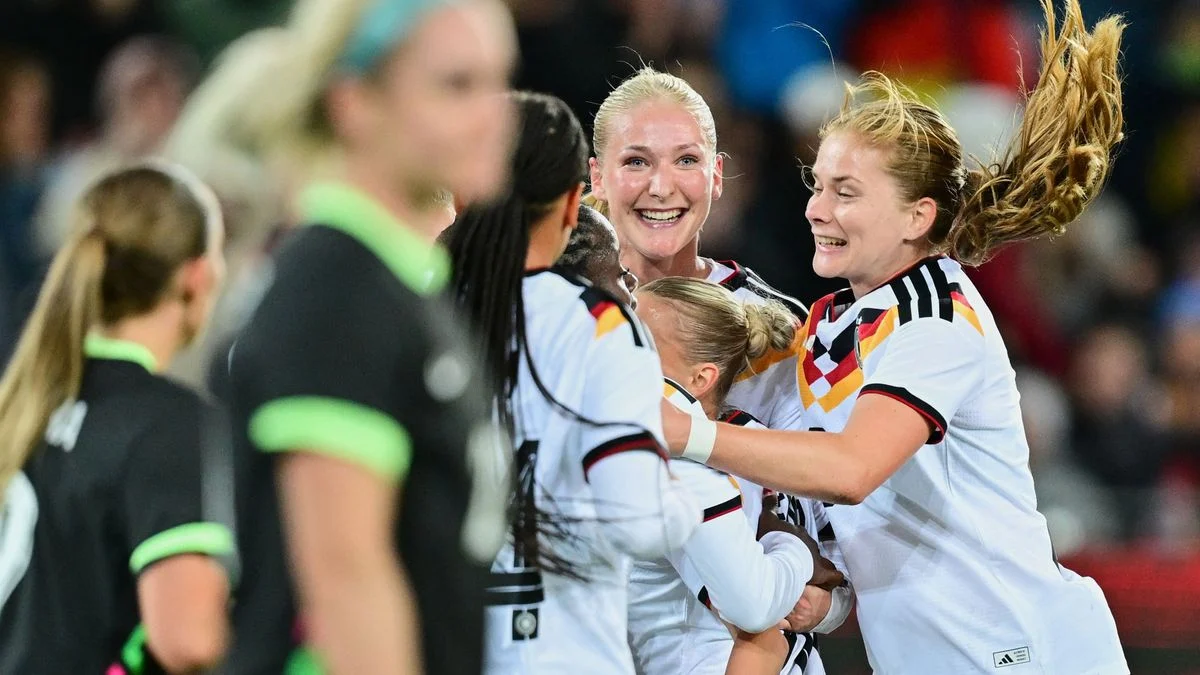
Kössler, currently plying her trade in the United States, proved her mettle early. In the 25th minute, she broke the deadlock, finding the back of the net with a composure that belied her limited international experience. Just five minutes later, she doubled her tally, capitalising on defensive lapses from the Australian Matildas.
For the remainder of the first half, Germany controlled the tempo, stifling the creative outlets of the Australian midfield. However, the Matildas refused to head into the dressing rooms empty-handed. In the second minute of added time (45+2), global icon and Australian captain Sam Kerr reminded the world of her lethal efficiency, slotting home a goal to reduce the deficit to 1-2 and shifting the momentum just as the whistle blew.
Second Half: Defensive Grit and Chaotic Conclusion
The second half saw a tactical tug-of-war. Germany sought to protect their narrow lead, while Australia pushed for an equalizer, testing the resolve of Ena Mahmutovic in the German goal.
The breakthrough that effectively sealed the result came in the 83rd minute. Camilla Küver, the Wolfsburg central defender, rose highest during a set-piece routine, powering a header past the Australian goalkeeper to make it 3-1. While the scoreline appeared comfortable, the match descended into a chaotic, albeit thrilling, finale.
In the 93rd minute, Holly McNamara clawed one back for the Australians, creating a brief window of panic for the German defense. However, the final word went to Germany, as Sjoeke Nüsken restored the two-goal cushion in the 94th minute, finalizing the score at 4-2 (though the match report notes the late flurry, the final scoreboard reflected a resilient 3-2 victory).
Supporting Data and Personnel Analysis
The "Next Generation" Roster
The composition of the German squad for this fixture was dictated largely by necessity. With captain Giulia Gwinn (FC Bayern) sidelined with a ligament tear and Ann-Katrin Berger (Gotham FC) opting out of the current international window, the spotlight fell on the next tier of the talent pool.
Ena Mahmutovic, representing FC Bayern, stepped in to fill the massive boots of Berger. In her third international cap, Mahmutovic displayed a mix of composure and occasional nerves—most notably when an attempted clearance struck an opponent—but she ultimately provided the stability required to secure the win.
Melissa Kössler: From Hoffenheim to the Global Stage
Kössler’s rise has been steady, with formative years at TSG Hoffenheim and Turbine Potsdam providing the foundation for her current success in the NWSL. Her performance against Australia was not merely a case of being in the right place at the right time; it was a testament to her tactical intelligence as a central striker. Her movement off the ball consistently dragged the Australian defenders out of position, creating the very lanes she would eventually exploit.
Official Responses and Tactical Implications
The Wück Philosophy
Head coach Christian Wück has faced a baptism of fire regarding squad availability. Speaking post-match, the technical staff emphasized the importance of "squad elasticity." The ability of players like Küver and Kössler to step into starting roles and produce match-winning contributions is a validation of the current scouting and development infrastructure within the DFB.
The team’s ability to remain organized despite the absence of a primary leader like Giulia Gwinn suggests that the team culture is evolving toward a collective responsibility model rather than a reliance on individual stars.
The Missing Pieces: A Lingering Concern
Despite the win, the medical report remains a point of concern. The infection that sidelined Lea Schüller serves as a reminder of the fragility of modern elite-level rosters. With a high-stakes encounter against Japan scheduled for next Tuesday in Bremen, the medical staff will be working around the clock to determine the fitness of the squad. The rotation policy—demonstrated by the inclusion of Mahmutovic—will likely be a feature of the upcoming match as well, as Wück looks to build experience across his bench.
Implications for the International Calendar
The Road to Bremen
The victory over Australia acts as a foundational block for the upcoming test against Japan. Japan presents a different tactical challenge, known for their high-pressing, technical precision, and rapid transitions. If the German defense displayed vulnerabilities in the dying minutes against Australia, they will need to be significantly more disciplined against the Nadeshiko.
Looking Toward Major Tournaments
For the German women’s national team, these friendlies are not merely exhibitions. They are part of a broader strategy to refine the squad’s tactical identity. The integration of players like Mahmutovic, Küver, and Kössler into the core rotation is essential for long-term tournament success.
The emergence of Kössler specifically provides Wück with a "Plan B" (or perhaps a "Plan A") should Schüller be unavailable in future high-pressure scenarios. The depth of the German striker pool, once considered a potential weakness, is beginning to look like a point of strength.
Conclusion: A Blueprint for Resilience
The match against Australia was a microcosm of the current state of German football: a mix of established grit and promising, hungry youth. By overcoming the absence of their captain and their primary striker, the German side sent a message to the rest of the footballing world: the DFB is not merely a collection of individuals, but a robust system capable of producing talent when it is needed most.
As the team pivots toward the upcoming match in Bremen, the focus will shift from the euphoria of victory to the technical fine-tuning required to maintain this trajectory. The fans in Bremen can expect a team that is not only determined to win but is also actively auditioning for roles in the next major tournament cycle. With the victory safely in the archives, the narrative for the coming week is clear: adaptation, execution, and the continued ascent of a new generation.
Key Statistical Highlights
- Match Venue: International Friendly (Neutral/Home venue context)
- Key Scorers: Melissa Kössler (25′, 30′), Camilla Küver (83′), Sjoeke Nüsken (90’+4)
- Opposition Scorers: Sam Kerr (45’+2), Holly McNamara (90’+3)
- Goalkeeping Debutant: Ena Mahmutovic (3rd Cap)
- Upcoming Fixture: Germany vs. Japan, Tuesday, 17:45 CET, Bremen.