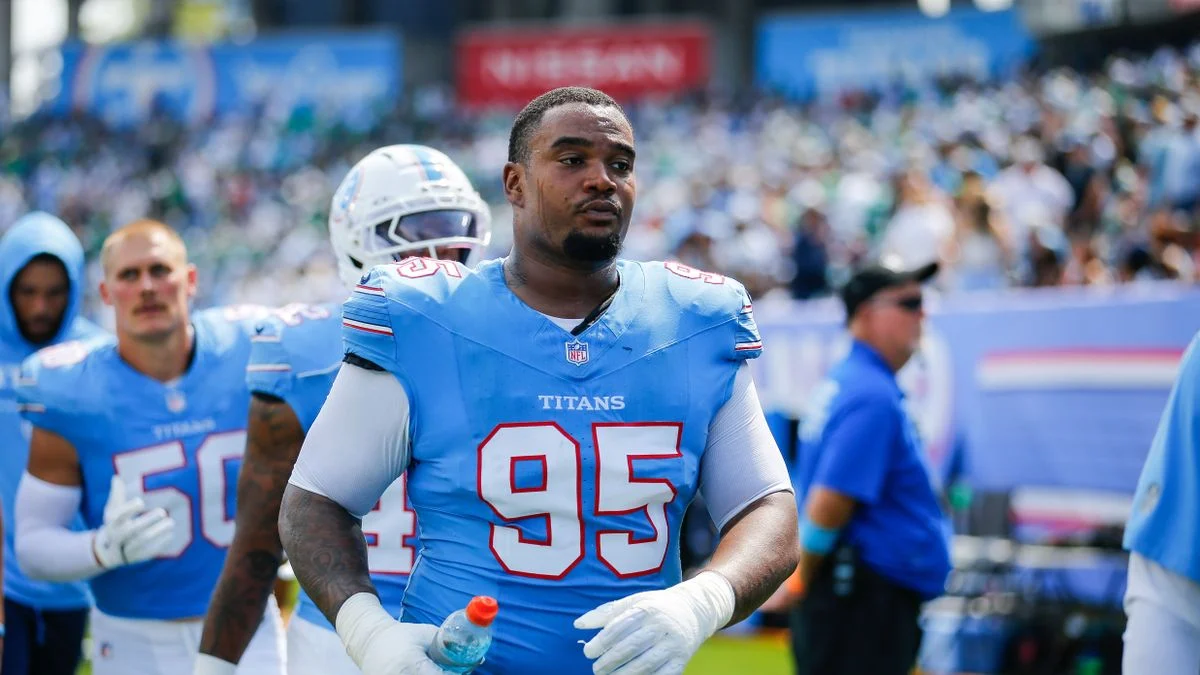
By Investigative Sports Desk
The National Football League is grappling with a deeply troubling incident that has sent shockwaves through the Tennessee Titans organization. Jordan Elliott, a veteran defensive tackle whose professional journey seemed to be hitting its stride, has been released by the team following a grave confrontation on club premises. Reports confirm that Elliott allegedly brandished a firearm during an altercation with a teammate, a breach of conduct so severe it triggered an immediate termination of his contract. While the physical safety of all personnel remained intact, the psychological and structural fallout of the event has ignited a fierce debate regarding the mental health support systems available to professional athletes.
The Incident: A Breach of NFL Protocol
The incident took place on Thursday, October 15, on the parking grounds of the Tennessee Titans’ facility. According to internal reports, a verbal dispute between Elliott and fellow teammate J.C. Latham escalated rapidly. In a move that shattered the boundaries of professional conduct, Elliott reportedly retrieved a firearm from his personal vehicle during the heat of the argument.
The presence of a firearm within a professional NFL facility is a strictly prohibited offense. Under league-wide policy, all employees—players, coaches, and staff—are explicitly forbidden from carrying or storing firearms in team facilities, stadiums, team hotels, or while traveling on team-chartered flights and buses. The violation of this policy is typically met with immediate disciplinary action, and the Titans organization acted swiftly, notifying the league office of the breach within hours of its occurrence.
By Tuesday, the organization had finalized its decision: Jordan Elliott’s tenure with the Titans had come to an abrupt and ignominious end.
Chronology of a Professional Collapse
To understand the magnitude of this event, one must look at the timeline leading up to the final decision.

- October 15: The altercation between Jordan Elliott and J.C. Latham occurs on the parking lot of the Titans’ facility. The incident involves the brandishing of a weapon. No physical injuries are reported.
- October 16-19: The Titans organization conducts an internal investigation, gathering statements and reviewing evidence. League security is informed, and a formal review process is initiated.
- October 20: The Titans officially announce the release of Jordan Elliott. The team cites a “serious incident” that occurred five days prior as the catalyst for the termination of his contract.
- October 22: Titans Head Coach Robert Saleh breaks his silence, providing context and a controversial defense of the former player, framing the event as a “cry for help” rather than a criminal act.
The speed of the release signals the NFL’s “zero-tolerance” approach to weapon-related incidents, yet the aftermath has been anything but standard.
The Defense: A Coach’s Plea for Empathy
In a move that has surprised many in the sports media landscape, Titans Head Coach Robert Saleh has emerged as an unlikely defender of his former player. In a candid press briefing, Saleh urged the public and the league to look beyond the immediate optics of the incident.
“He is a good person who had a terrible lapse in judgment—a moment I view more as a cry for help than a criminal act,” Saleh stated. The coach’s comments suggest that there is a significant discrepancy between the “reflexive reaction of the public” and the sentiments held by those within the locker room.
Saleh’s defense of Elliott rests on the premise that elite athletes are often subject to immense, often unseen, psychological burdens. By labeling the act a “cry for help,” the head coach is attempting to pivot the conversation from one of criminality to one of mental health advocacy. He noted that the decision to release Elliott was necessary for the integrity of the team, but he maintained that the individual behind the jersey deserves support.
Contextualizing the Conflict
J.C. Latham, the teammate involved in the confrontation, has offered little to fuel the fire, describing the event as an “unfortunate situation.” In a brief statement, Latham noted, “We honestly never had a dispute before this. It is just an unfortunate situation.”
This lack of prior animosity makes the incident even more perplexing. It suggests that the catalyst for the conflict may have been entirely internal to Elliott—a culmination of personal stressors that boiled over during a routine interaction. This aligns with Coach Saleh’s assessment that “there is something bigger going on.”

The Wider Implications: Mental Health in the NFL
Coach Saleh’s comments carry weight, particularly when he links the incident to the broader, often tragic, history of the league. He explicitly referenced past suicides of NFL players, acknowledging that in those instances, the warning signs were likely present but ignored by the system.
“These kids go through so much,” Saleh said, his tone shifting to one of advocacy. “They could have been crying out for help, and everyone ignored it. I’m not saying Jordan was at that point, but the pressure is immense.”
The NFL has made strides in recent years to provide mental health resources, including mandatory counseling sessions and 24/7 helplines. However, the stigma surrounding vulnerability remains a formidable barrier. The league is currently reviewing the incident to determine if further disciplinary action, such as a suspension from the league entirely, is warranted, regardless of the player’s current free-agent status.
A Career at a Crossroads
Jordan Elliott entered the league with high expectations. Selected in the third round of the 2020 NFL Draft by the Cleveland Browns, he spent four seasons honing his craft in a rigorous defensive system. His performance eventually earned him a two-year, $7 million contract with the San Francisco 49ers.
When the Titans signed him this past offseason to a two-year, $8 million deal, they were banking on his veteran presence to bolster their defensive line. Now, at 28, Elliott’s future in the NFL is in jeopardy.
Despite the severity of the incident, Coach Saleh went as far as to issue a public appeal to the remaining 31 teams in the league. “My message to the other teams is: If you need a hell of a defensive tackle who can stop the run and help you in a playoff run, give me a call.”

Whether any team is willing to risk the public relations fallout to sign a player with such a recent, high-profile disciplinary record remains to be seen.
Analyzing the Institutional Response
The response from the Titans organization has been characterized by a strict adherence to policy balanced with a degree of personal compassion. By terminating the contract, they protected their culture and adhered to the league’s rigid standards. Yet, by allowing their head coach to speak publicly about the “human element” of the tragedy, they have acknowledged that the issue is multifaceted.
The NFL’s review is expected to conclude in the coming weeks. The outcome will likely serve as a benchmark for how the league handles future incidents involving conduct detrimental to the team that stem from mental health struggles.
Conclusion: The Price of Professionalism
The story of Jordan Elliott is a sobering reminder of the volatility inherent in professional sports. Behind the multimillion-dollar contracts and the high-stakes games, there are individuals grappling with the pressures of elite performance, public scrutiny, and personal instability.
While the act of brandishing a weapon is indefensible in any professional setting, the discourse surrounding this incident highlights a growing shift in how organizations perceive their players. No longer are athletes viewed merely as commodities; they are increasingly recognized as individuals whose mental well-being is intrinsically tied to their performance and their actions off the field.
As the dust settles in Tennessee, the focus will shift from the drama of the incident to the long-term question of support. Can the NFL build a culture where a “cry for help” is answered with intervention rather than just termination? For Jordan Elliott, that answer has come too late. For the rest of the league, the incident serves as a stark, unavoidable warning.