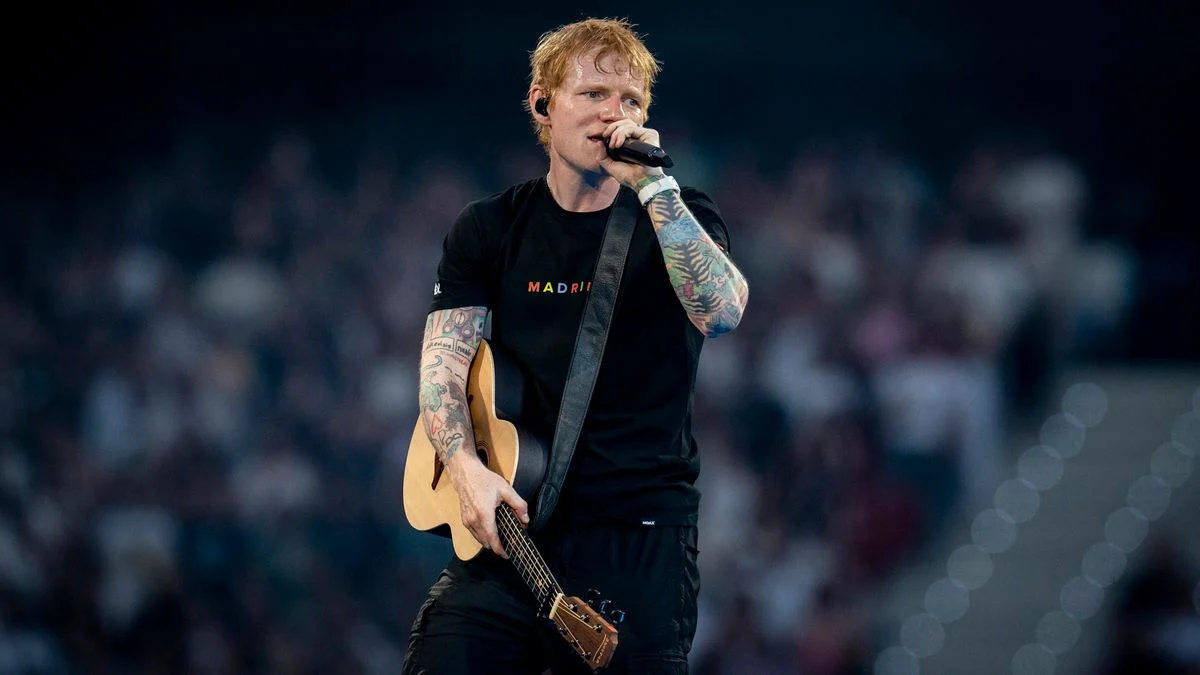
Ed Sheeran’s "Mathematics" (or "Loop") Tour has long been celebrated as a technical marvel of modern music—a testament to the power of a singular artist holding a stadium’s attention with nothing more than a guitar and a loop station. However, the North American leg of this massive global trek has recently become the epicenter of a geopolitical firestorm. What began as a routine series of stadium performances has devolved into a high-stakes debate over the role of artists in global conflicts, the boundaries of free speech in private venues, and the delicate balance of maintaining a "safe space" in an increasingly polarized world.
The Catalyst: Macklemore, Gaza, and the Stadium Pressure Cooker
The controversy originated with the tour’s inclusion of American rapper Macklemore as a support act. Known for his outspoken activism, Macklemore did not shy away from using the massive platforms provided by the tour to address the ongoing humanitarian crisis in the Gaza Strip. In several instances, he explicitly voiced his solidarity with Palestinians, utilizing charged language that included accusations of apartheid and genocide against the State of Israel.
The backlash was immediate and centered on the influence of private venue ownership. Robert Kraft, the billionaire owner of the New England Patriots and the Gillette Stadium in Foxborough, Massachusetts, reportedly took personal issue with the rhetoric being disseminated on his property. According to industry reports, Kraft and his management team exerted significant pressure on Ed Sheeran’s management to terminate the partnership with Macklemore.
The fallout was swift. Following the decision to drop Macklemore from the lineup, the tour experienced a rare act of collective solidarity from the remaining support acts. Artists, including Finneas (the producer and brother of Billie Eilish) and members of Sheeran’s own touring ensemble, reportedly chose to step away from the tour in protest of the management’s decision to bow to external pressure. This left the tour’s logistics in a precarious state, forcing the organizers to scramble for replacements while navigating a public relations minefield.

Chronology of a Disrupted Tour
The timeline of the disruption paints a picture of a tour struggling to regain its footing amidst mounting external pressures:
- Late September: Severe weather in the Northeastern United States forced the cancellation of shows at Gillette Stadium, owned by Robert Kraft. While the primary reason for the cancellation was a severe storm, the timing added fuel to the fire of the burgeoning controversy surrounding the venue owner’s stance.
- Early October: As the tour moved to Atlanta, the management team confirmed that the vacancy left by the departing support acts had been filled. Isaac Slade, the former lead singer of the iconic pop-rock band The Fray, was tapped to take over the support duties for the remainder of the US stadium run.
- October 3, 2024: In Atlanta, Slade made his first major public comments regarding the situation, signaling a shift in the tone of the tour’s opening sets.
- Late October: Macklemore, now unmoored from the Sheeran tour, announced his own "Free Palestine Tour," with initial dates scheduled for Dublin, Paris, and London—all of which sold out almost immediately, demonstrating the resonance of his message among his core fan base.
The Entry of Isaac Slade: A Strategic Pivot
The appointment of Isaac Slade as the new support act is, in many ways, a study in contrast to the volatility that preceded it. Slade, who rose to global fame in the mid-2000s as the frontman of The Fray—the band responsible for the ubiquitous, multi-platinum anthem "How to Save a Life"—had effectively left the band in 2022. His return to the global stage under these circumstances is notable not just for the music, but for his distinct political philosophy.
Slade has historically positioned himself as an independent thinker, often eschewing the binary choices of the American two-party system. In 2018, for instance, he threw his support behind an independent candidate for the Maryland Senate race, signaling a distrust of the standard Democratic-Republican divide.
During his set in Atlanta, Slade addressed the audience with a carefully measured speech that sought to bridge the gap between activism and the "neutrality" often demanded by corporate-sponsored tours. "It is good that the world is taking a stand," Slade told the audience, according to Billboard. "What is happening in Gaza is wrong. But if we are going to get through this, we need people who are willing to move to this middle ground, this common base."

Slade’s rhetoric—which he likened to "a campfire in the middle of a field" where all sides can be seen—is a deliberate attempt to pivot away from the binary "us vs. them" narrative that led to the exclusion of his predecessor. For Slade, peace is not merely the absence of conflict, but the presence of a delicate equilibrium.
Implications for the Live Music Industry
The situation surrounding the "Loop Tour" raises profound questions about the future of live performance. When an artist is booked to perform, what are the obligations of the venue owner, the promoter, and the artist regarding political discourse?
The "Safe Space" Doctrine
Ed Sheeran has maintained that his concerts are intended to be "a safe space for all." For Sheeran, this appears to mean a space where the focus remains on the music, free from the acrimonious divisions of current geopolitical crises. However, critics argue that defining "safe" is an inherently political act. If a space is only safe for those who avoid discussing human rights, is it truly inclusive, or is it merely sanitizing reality?
The Power of Venue Owners
The role of Robert Kraft highlights the immense leverage held by venue owners in the modern music economy. Because stadium tours require specific infrastructure and massive capital investment, artists are often beholden to the billionaire owners of the arenas they play. When those owners hold strong personal or political views, the independence of the artist—and the freedom of the opening acts—becomes subject to the owner’s brand alignment.

The Rise of Independent Activism
Macklemore’s move to launch his own tour suggests that artists are increasingly willing to sacrifice the stability of a high-paying support slot for the freedom to advocate for their causes. The fact that his "Free Palestine Tour" sold out rapidly indicates that there is a significant audience segment that is not just willing to hear, but eager to support, artists who engage with contemporary political struggles.
Conclusion: A New Landscape for Touring
As Ed Sheeran continues his trek across the United States, supported by Isaac Slade and others like American Idol alum Brooks Rosser, the industry is watching closely. The "Loop Tour" controversy has become a microcosm of the wider cultural war, illustrating the difficulty of maintaining a unified, apolitical brand in an era where silence is often interpreted as complicity.
Whether this marks a permanent shift toward artists exercising greater caution in their support acts, or conversely, a move toward more politically charged, independent tours, remains to be seen. What is clear, however, is that the era of the "neutral" stadium performance is facing unprecedented challenges. For artists like Sheeran, the task of filling stadiums now requires not just technical mastery of the loop station, but an adept navigation of the complex, often treacherous, political realities of their audience and their hosts.
The "middle ground" that Slade advocates for may be the goal, but in today’s climate, the path to that middle is increasingly narrow and fraught with the potential for further disruption. As the tour winds its way toward its conclusion, the focus will undoubtedly remain on the music—but the echoes of this debate will likely resonate in the industry for years to come.