In the ongoing quest to decarbonize urban transport, the physical presence of electric vehicle (EV) charging infrastructure has become a point of contention. While thousands of charging columns have sprouted across Germany, they often clutter narrow sidewalks, disrupt historic aesthetics, and face opposition from local residents. Now, the city of Kassel is piloting a discreet alternative: integrating charging technology directly into the curb. This shift from "vertical columns" to "horizontal infrastructure" represents a significant experiment in urban planning, aiming to balance the surging demand for public charging with the limited space available in dense residential areas.
Main Facts: A New Way to Charge
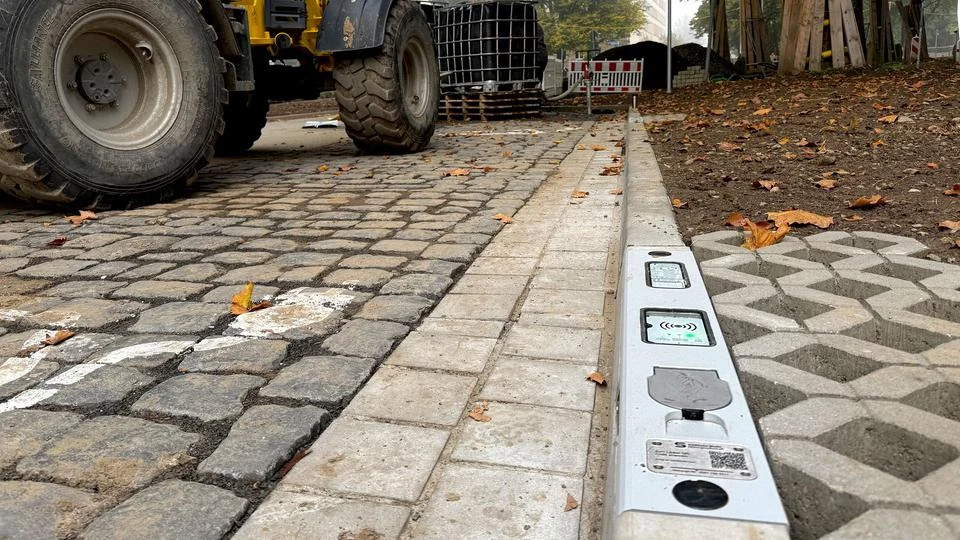
The pilot project, currently underway in Kassel’s Goethestraße, replaces the traditional bulky charging pillar with a sleek, low-profile unit embedded directly into the sidewalk curb. The premise is simple: the driver pulls up, opens a small flap on the curb, connects their cable, and initiates the charging process via an app or card.
The primary driver behind this innovation is "aesthetic integration." As Margarethe Heirich from the Städtische Werke Kassel (Kassel Municipal Utilities) notes, many urban areas are protected by historic preservation laws or suffer from limited public space. "In areas characterized by historic preservation or aesthetic concerns, we would naturally prefer this alternative," she explains.
While the concept appears minimalist, the engineering behind it is robust. The units are designed to be weather-resistant, capable of withstanding the harsh realities of street-level existence—ranging from heavy rain and snow to the occasional brush with a car tire. However, the innovation comes with a price tag. At approximately 3,000 to 4,000 euros per unit, the curb-based solution is more expensive than standard charging stations.
Chronology of Development
The introduction of these curbs in Kassel is part of a broader, long-term strategy to scale EV infrastructure in line with national climate goals.
- Early 2025: Initial discussions between municipal authorities and the engineering firm Rheinmetall (the manufacturer) began, focusing on finding solutions for residents in historic or high-density districts without private driveways.
- Mid-2025: Kassel establishes itself as a leader in charging-to-car ratios. Data from the Federal Network Agency and the Kraftfahrt-Bundesamt (KBA) highlights that the city holds the top spot in Germany for accessibility, with only 10.8 electric vehicles per public charging point.
- Late 2026 (Current Status): The first two pilot curb-chargers are installed in the Goethestraße in the Vorderer Westen district. These installations coincide with local road improvements, including the construction of a dedicated bicycle street, demonstrating an integrated approach to modern traffic planning.
- Future Outlook: The municipal government plans to monitor usage patterns, maintenance costs, and public feedback. Based on this data, the city will decide whether to scale the project or reserve it for specific, high-need historic districts.
Supporting Data: The Growing Need
The necessity for such projects is underscored by the rapid growth of the EV market in Germany. According to the Kraftfahrt-Bundesamt, there were over 179,000 pure electric vehicles registered in Hesse on January 1, 2026. By July of the same year, that number had surged to nearly 209,000.
Despite this, the charging landscape remains fragmented. As of August 2026, there were 16,324 public charging points across the state of Hesse. However, the distribution is uneven. While Kassel boasts a favorable ratio of 10.8 cars per charger, other cities like Offenbach struggle with ratios as high as 37.5. On a national level, Hesse ranks 13th in the state-by-state comparison, with an average of 18.7 vehicles per public charger.
The Städtische Werke Kassel intentionally chose to deploy the new curb-chargers in a dense residential neighborhood where the majority of residents lack private parking spaces or the ability to install home-based "wallboxes." This target-oriented deployment is essential for ensuring that the transition to e-mobility is inclusive rather than limited to those with private garages.

Official Responses and Perspectives
The project has received support from local political leadership, who view it as a milestone in urban modernization. Kassel’s Mayor, Sven Schoeller (Green Party), emphasized the importance of convenience: "If people want to switch to an electric car, they must be able to charge it in their everyday lives without hassle. The new charging curbs show how innovative technology can create additional comfort without taking up more space in the street."
Simone Fedderke, the City Climate Officer, added, "Kassel is at the forefront of expanding charging infrastructure—and we want to keep it that way."
However, not all feedback is positive. Academics point to technical limitations. Jens Friebe, head of the Power Electronics department at the University of Kassel, remains cautious: "I don’t believe this will catch on everywhere. I think it is a robust variant for narrow inner cities, but it has its limits." Friebe highlights that the current systems are capped at 11 or 22 kilowatts, meaning they are strictly for "slow" or "destination" charging rather than rapid highway-style power-ups. Furthermore, he points out a maintenance issue: upgrading a traditional charging station is simple—you just replace the head unit. Upgrading a curb-embedded system would require extensive civil engineering work, digging up sidewalks, and potentially disrupting traffic.
Implications: A Niche or a Standard?
The reaction from the public in Kassel is a microcosm of the national debate. Some residents, such as Simon Becker, appreciate the visual cleanliness: "A curb looks better than a massive charging pillar." Others, like Renate Burgmann, are concerned about visibility and durability. "You would need to mark them better," she says. "What happens if they are covered in mud, snow, or blocked by a parked bike?"
The manufacturer, Rheinmetall, insists that the systems are designed for these exact challenges, promising durability against the elements and common urban hazards.
The implications for other cities are clear. With similar pilots already emerging in Düsseldorf, Dortmund, Leipzig, Mönchengladbach, and Bamberg, the "curb-charger" is moving from a prototype to a recognized urban planning tool. However, it is unlikely to become the universal standard. Its future depends on a delicate trade-off:
- The Aesthetic Benefit: Significant improvement in the visual quality of historic streets.
- The Cost Barrier: Higher capital expenditure compared to traditional pillars.
- The Utility Limit: Suitable only for overnight or long-duration parking, not for rapid charging.
In conclusion, the Kassel pilot is a vital test case for the "invisible city." As the number of EVs continues to climb, the challenge for municipalities is no longer just providing electricity; it is integrating that electricity into the existing urban fabric without destroying the character of the neighborhoods they serve. While curb-chargers may not replace the traditional charging column, they are poised to become an essential tool in the toolkit of the modern, densely populated city. Whether they become a widespread solution or remain a niche remedy for historic districts, Kassel has once again positioned itself as a testing ground for the future of mobility.