

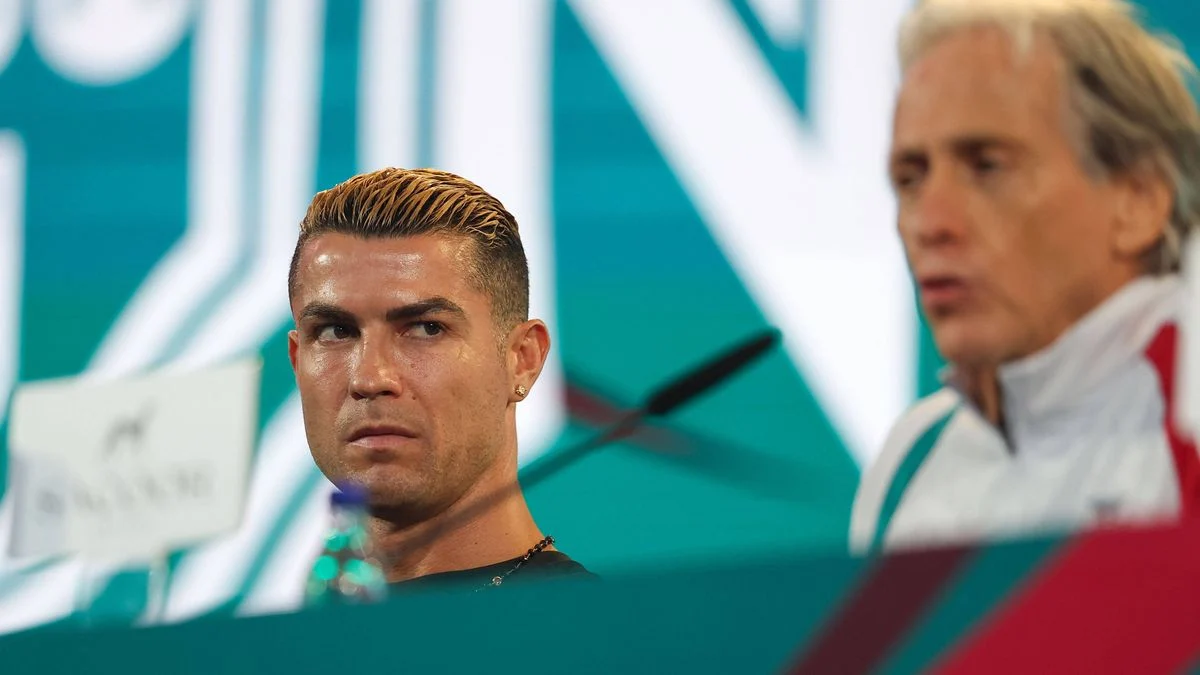
The world of international football was rocked this past week by an event that, in many ways, marks the twilight of an era. Cristiano Ronaldo, the most decorated player in the history of the Portuguese national team, abruptly departed the squad’s training camp, leaving behind a storm of controversy, accusations of betrayal, and a nation questioning the future of its greatest sporting icon.
At 41, Ronaldo remains a figure of immense influence, yet his latest friction with head coach Jorge Jesus has exposed deep-seated tensions within the Seleção. In a detailed, impassioned statement, the superstar has broken his silence, accusing the coaching staff of a fundamental breach of trust while simultaneously signaling his intent to continue his international career once the dust has settled.
The Chronology of a Breakdown
The sequence of events leading to this rupture is as complex as the personalities involved. According to Ronaldo, the tension did not stem from a single moment but from a series of broken promises regarding his playing time.
The conflict reached a breaking point during the recent international break. Ronaldo had been informed that he would not start in the high-stakes match against Norway, a decision he seemingly accepted. However, the situation escalated when the coaching staff requested he prepare for a 30-minute appearance. When that opportunity never materialized, the veteran striker felt his professional dignity had been compromised.
Seeking to resolve the friction, Ronaldo engaged in a private, high-level discussion with Jorge Jesus and Sporting Director Simao Coutinho. The expectation was that the coach would address the misunderstanding during the subsequent press conference. Instead, Ronaldo described the coach’s public demeanor as "aggressive," "arrogant," and "haughty"—a stark departure from the tone struck in their private dialogue. Feeling that his presence was becoming a distraction that could harm the squad’s harmony, Ronaldo chose to exit the camp entirely.
A Breach of Trust and the Burden of Responsibility
In his public statement, Ronaldo did not shy away from the gravity of his decision. He acknowledged that walking out on his national teammates was a professional misstep, regardless of the provocations he felt he endured.
"I decided to leave the training camp without waiting for another broken promise," Ronaldo wrote. "For me, truth is the most important thing in human relationships."
He continued, expressing a rare moment of vulnerability: "Despite the absolute breach of trust by the coach—which witnesses to our conversations can confirm—I should not have done what I did. The responsibility lies solely with me. I felt that, from that moment on, my presence would only harm the team, and I did what I have always said I would do: when I no longer feel useful, I pack my bags and go."
The Coach’s Perspective: A Door Left Ajar
Despite the public sparring, the response from the Portuguese Football Federation (FPF) and Jorge Jesus has been surprisingly measured. The 72-year-old coach, who managed Ronaldo previously at Al-Nassr and guided the club to a domestic championship, has framed the incident as a misunderstanding that can be mended.
"For me, Cris is a candidate for the squad in the next nomination, provided he is playing for Al-Nassr," Jesus stated in the aftermath. "If he wants to return, he will return."
The coach’s rhetoric suggests a desire to de-escalate, viewing the incident not as a terminal bridge-burning, but as a personality clash that, while intense, does not preclude a future collaboration. This pragmatic approach underscores the reality of the situation: Portugal is currently navigating a highly successful period, having won all four of their recent Nations League matches to secure a spot in the quarterfinals, and the federation is understandably keen to avoid a permanent rift with its historical captain.

The Weight of History: Ronaldo’s Unmatched Legacy
To understand the magnitude of this crisis, one must look at the numbers. Cristiano Ronaldo has represented Portugal in 234 international matches, netting an astonishing 146 goals. These are not merely statistics; they are global benchmarks.
His journey with the national team was supposed to conclude following the World Cup in the United States, Mexico, and Canada. However, it was the intervention of the FPF President that persuaded him to continue. Furthermore, it has been revealed that Ronaldo himself played a pivotal role in the appointment of Jorge Jesus as head coach, having personally recommended the veteran manager to the federation leadership. This adds a layer of personal tragedy to the current conflict; the man who helped bring the coach to the helm now finds himself at odds with his own recommendation.
Implications for the Future
The implications of this standoff extend beyond the immediate squad dynamics. For the Portuguese Football Federation, the challenge is to maintain authority without alienating a player who, despite his age, remains a colossal brand and a potent offensive threat.
Ronaldo has already accepted that a sanction from the federation is likely forthcoming. Yet, his message to the fans and the team is clear: he views his departure as a temporary detour, not an end. "Should I be physically fit and playing for my club—and hopefully scoring goals—I will be available after any suspension imposed on me," he declared. "I will be ready to represent our national team and win, as I have always done until today."
The Wider Context: Sport, Ego, and Time
Observers of the game are left to ponder the "CR7 Conundrum." Is this a case of a legend refusing to accept a diminished role? Or is it a failure of leadership to handle a player whose influence transcends the tactical system?
The narrative of "sporting decline" is often applied to aging superstars, and while Ronaldo’s output has shifted in his forties, his drive remains as intense as it was two decades ago. The friction between a player who demands total clarity and a coach who must balance the needs of a collective squad is a classic football trope, yet amplified by the status of the protagonists.
As Portugal moves toward the Nations League quarterfinals, the team has shown resilience, winning in the face of this distraction. Yet, the absence of their captain—and the narrative of the "broken promise"—will linger. The resolution of this saga will likely depend on whether both parties can find a middle ground that respects the legacy of the individual while preserving the discipline of the collective.
For now, the saga of Cristiano Ronaldo and the Portuguese national team remains one of the most compelling and uncomfortable narratives in modern sport. It is a story about the difficulty of transitioning from the center of the stage to a supporting role, and the painful process of deciding when the curtain should finally fall. Whether this is the final chapter or merely a dramatic intermission remains to be seen, but one thing is certain: the world of football will be watching the next squad announcement with bated breath.
Timeline Summary of the Recent Conflict:
- The Lead-up: Ronaldo is informed he will not start in the Nations League match against Norway.
- The Promise: Coaching staff suggests a 30-minute appearance, which does not occur.
- The Confrontation: A private meeting between Ronaldo, Jorge Jesus, and Simao Coutinho fails to resolve the underlying tension.
- The Public Disconnect: The coach’s subsequent public comments are perceived by Ronaldo as "arrogant" and a violation of their private understanding.
- The Departure: Ronaldo leaves the training camp, citing a loss of utility to the team.
- The Aftermath: Coach Jesus remains open to a return, while the FPF prepares a formal disciplinary response.
As the international break concludes, the Portuguese Federation finds itself at a crossroads. The success of the team on the pitch provides a buffer, but the cultural impact of this conflict will resonate throughout the footballing world for weeks to come. Whether Ronaldo wears the red and green jersey again is now not just a matter of fitness, but a matter of reconciliation between two strong-willed men at the twilight of their respective careers.












