

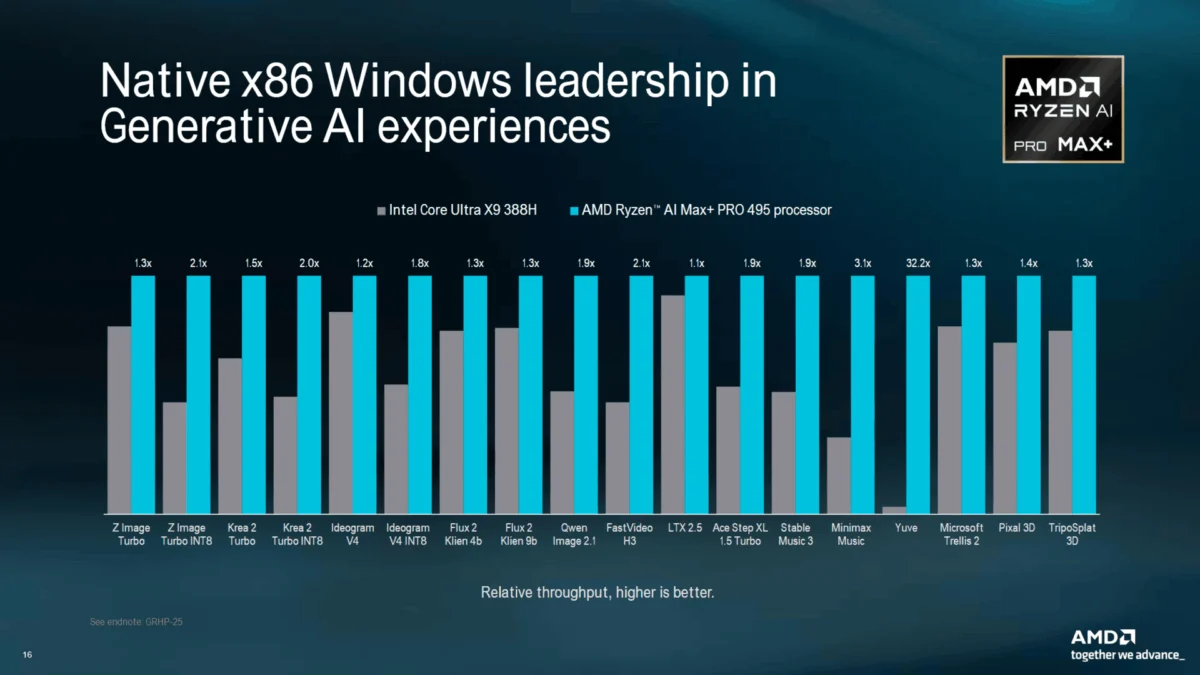
The landscape of high-performance computing is undergoing a seismic shift. As the industry pivots aggressively toward "Agentic PCs"—systems capable of autonomous decision-making and complex local AI processing—the hardware requirements have shifted from raw clock speeds to massive, unified memory bandwidth and capacity. At the center of this revolution sits the AMD Ryzen AI Max Pro 400 series, codenamed "Gorgon Halo." With support for up to 192GB of RAM, this architecture has become the gold standard for enthusiasts and professional AI developers alike.
The Main Facts: Why Gorgon Halo is Disrupting the Market
The core value proposition of the AMD Ryzen AI Max Pro 400 series is its unprecedented memory density. In an era where large language models (LLMs) and local AI agents demand massive datasets to remain resident in memory, traditional consumer hardware has hit a wall. Intel’s current "Panther Lake" architecture, often capped at 64GB of RAM, finds itself at a significant disadvantage when pitted against the 192GB ceiling offered by AMD’s new flagship APUs.
AMD has positioned these chips as the ultimate solution for "Agentic AI"—a term describing software that can perform tasks on behalf of a user across multiple applications. Unlike standard AI-accelerated tasks that might only require a few gigabytes of VRAM, autonomous agents require significant memory headroom to keep context windows open, background processes running, and model parameters loaded simultaneously. By delivering this in an APU (Accelerated Processing Unit) format, AMD is effectively democratizing workstation-grade performance for mini-PCs and high-end notebooks.
A Chronology of the Shift
The momentum behind the Ryzen AI Max Pro 400 series has been building since early September 2026, following the IFA trade show in Berlin.
- Early September 2026 (IFA): The initial reveal of the Ryzen AI Max 400 series created significant buzz. Industry analysts began noting that AMD’s move to high-capacity unified memory was a direct challenge to the traditional workstation market.
- Late September 2026: Pre-orders for the first wave of "Gorgon Halo" systems went live. Early adopters and corporate procurement teams began securing inventory, with shipping schedules confirmed for October and November.
- October 2026: The market landscape intensified when Nvidia entered the fray with a "lite" version of its DGX Spark, which was restricted to 64GB of RAM. This move sparked immediate backlash and provided a strategic opening for AMD’s marketing teams and hardware partners to emphasize the "memory advantage" of their platform.
- Present Day: The market is now witnessing a flurry of system integrator experiments, such as the Lucebox Zero 495, as companies scramble to differentiate their offerings based on this silicon.
Supporting Data: The Cost of Performance
When evaluating the market, the entry price for these systems is steep, reflecting the premium nature of the hardware. Current pricing for a base-level "Gorgon Halo" mini-PC starts at approximately $6,500. While this is a substantial investment, it is essential to contextualize this against the cost of traditional workstation hardware.

For example, manufacturers like Lucebox have begun experimenting with hybrid configurations. Their latest system includes the Ryzen AI Max Pro 495 coupled with an additional AMD Radeon AI PRO R9700 discrete graphics card. However, this creates a technical paradox: the R9700 is connected via only four PCIe 4.0 lanes, which can lead to performance bottlenecks for certain professional workloads. Furthermore, the base configuration often includes only 128GB of RAM; jumping to the full 192GB capacity requires a staggering $2,199 premium.
This creates a complex decision matrix for buyers: Is it more cost-effective to utilize the massive unified memory of the APU, or to pay a premium for a discrete GPU that may be throttled by its interconnect? Currently, the consensus is that the APU-only approach is more efficient for most AI-centric workloads.
Official Responses and Strategic Positioning
AMD’s communication strategy has been remarkably consistent: "Buy now." By highlighting the lack of direct competition, the company is creating a sense of urgency. During a recent press event, AMD representatives made it clear that no other manufacturer currently offers a comparable balance of memory density and integrated processing power.
Nvidia’s decision to throttle its DGX Spark product to 64GB has been a gift to AMD. Partners have been quick to leverage this, with marketing campaigns explicitly advising customers: "Buy AMD Strix Halo/Gorgon Halo instead of an Nvidia DGX Spark with 64GB." This aggressive stance highlights a pivot in the industry: the battle is no longer just about TFLOPS (Teraflops); it is about the "Memory Wall."
Implications for the Future of Computing
The Evolution of the "Max" Series
The journey of the Max series—from the initial "Strix Halo" announcement to the current "Gorgon Halo" iteration—is a masterclass in market adaptation. When the Strix Halo was first unveiled two years ago, even AMD seemed unsure of its target demographic. They attempted to pitch it as a "Jack-of-all-trades" that could handle high-end gaming, professional creative work, and AI tasks simultaneously.

The market has since spoken: Gaming, as a primary driver for this specific hardware tier, has largely taken a backseat to the demands of professional AI. The gaming performance of these chips is excellent, but the value proposition is almost entirely centered on AI agent development. Consequently, consumers who missed out on the initial Strix Halo runs may find excellent value in older units, which can sometimes be found at half the price of the newer Gorgon Halo systems while still providing sufficient power for most current AI applications.
The Agentic PC Revolution
The rise of the Agentic PC marks a permanent shift in how we view local computing. We are moving away from thin-client models where the heavy lifting is done in the cloud. Instead, the "Gorgon Halo" era suggests a future where high-memory, high-bandwidth local systems become the hubs for personal AI, security, and complex data analysis.
For the average consumer, this technology remains in the "prosumer" and enterprise bracket due to the high barrier to entry in terms of price. However, the trajectory is clear: the hardware being released today for $6,500 will inevitably trickle down to more accessible price points over the next 24 to 36 months.
Conclusion
As we look toward the remainder of 2026, the competitive landscape will only intensify. With Nvidia’s RTX Spark looming on the horizon and Intel continuing to refine its own architecture, the market for high-performance mobile and compact systems is more dynamic than it has been in a decade. For now, however, AMD holds the crown in the high-memory, high-AI-compute segment. Whether this "Gorgon Halo" lead remains unchallenged depends on how quickly the competition can solve the memory bottleneck—a challenge that, for the moment, seems to favor the architects in Santa Clara.
Disclaimer: ComputerBase received information regarding this report from AMD under a Non-Disclosure Agreement (NDA). The only constraint provided was the earliest possible publication time.


























