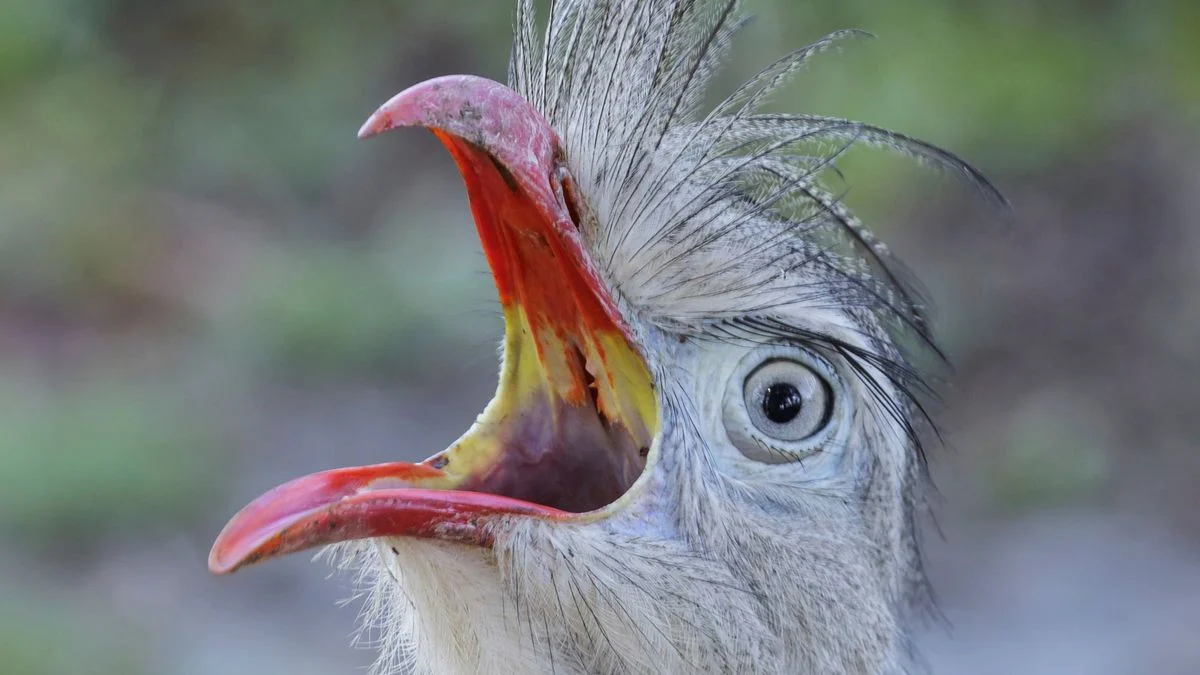
In the dense, echoing rainforests of Brazil and the rugged terrains of the United States, a new acoustic battle has begun. Ornithologists, equipped with high-precision technology once reserved for the golf course, have identified two avian contenders that are challenging the long-standing record for the loudest bird on the planet.
Since 2019, the White Bellbird (Procnias albus) has held the title of the world’s undisputed loudest bird. Its mating call, an ear-splitting 125.4 decibels, is more intense than the roar of a chainsaw or the cacophony of a construction site. However, a groundbreaking study published in the journal Evolution suggests that this crown is under siege. Researchers João Menezes and Jeff Podos have documented two other species—the Red-legged Seriema and the Bare-throated Bellbird—that are pushing the limits of biological sound production, raising fundamental questions about the mechanics and evolutionary purpose of extreme vocalizations in the animal kingdom.
Main Facts: A Symphony of Decibels
The study, which analyzed 123 different bird species, represents a massive leap forward in bioacoustics. The results are nothing short of startling:
- The White Bellbird (The Current Champion): With a record of 125.4 decibels, this bird has remained the gold standard for acoustic power.
- The Red-legged Seriema: During their research, scientists recorded an average call of 121 decibels over a 20-millisecond window, placing it firmly in the upper echelon of avian volume.
- The Bare-throated Bellbird: This species delivered the most intense individual vocalization recorded during the study, clocking in at a staggering 131 decibels.
To put these figures into perspective, a normal conversation takes place at about 60 decibels. A lawnmower operates at roughly 90 decibels. At 130 decibels, the human ear experiences pain, and hearing damage becomes a risk with prolonged exposure. For these birds, however, such volume is simply a standard part of their daily communication.

The Chronology of Discovery: How Science Got Louder
For decades, ornithology was hampered by a lack of standardization. Measuring the volume of a bird call in the wild is notoriously difficult; distance, humidity, and surrounding vegetation can all significantly distort sound levels. Researchers were often forced to rely on estimates, leading to inconsistent data that made comparing species nearly impossible.
The breakthrough came when researchers began to borrow tools from other industries. By utilizing laser rangefinders—the same devices used by professional golfers to calculate the distance to a pin—scientists were finally able to pinpoint exactly how far they were from their subjects. Combined with high-end, portable sound-level meters typically used by industrial hygienists for occupational safety, they created a standardized "loudness profile."
By capturing both the precise distance and the sound pressure simultaneously, researchers were able to calculate what the volume would be at a standardized distance of one meter. This methodology, applied to 123 species, allowed for the first truly accurate comparison of avian vocal power in history. Of the 123 species studied, 113 had their decibel levels measured for the first time, providing a treasure trove of data for evolutionary biologists.
Supporting Data: The Anatomy of a Scream
The study did more than just list the loudest birds; it sought to explain how these creatures achieve such extraordinary feats. The correlation between physical morphology and acoustic power is striking.

The loudest birds identified in the study were almost universally larger than their quieter counterparts. They possessed robust, muscular chests, which the researchers believe are essential for compressing air and pushing it through the vocal tract with massive force. Furthermore, these species often exhibited broader, more flexible beak openings, allowing for a wider, more powerful projection of sound.
The research also highlighted the sheer range of avian communication. At the lower end of the spectrum, the study recorded hummingbirds producing sounds as low as 64 decibels. The gap between these delicate pollinators and the thunderous call of the Bare-throated Bellbird illustrates the incredible diversity of evolutionary pressures at play.
Official Responses and Scientific Context
The lead authors of the study, João Menezes and Jeff Podos, have been careful to interpret their findings with scientific rigor. While the 131-decibel peak of the Bare-throated Bellbird is technically louder than the White Bellbird’s established record, the scientific community is still debating how to define "the loudest."
"Is it the loudest single burst, or the average output over a sustained period?" Menezes noted in an interview with CNN. "Is it the maximum volume achieved by a single individual, or the species average?" Because of these nuances, the White Bellbird officially retains its title for now.

However, the team emphasizes that their goal was never to crown a winner, but to understand the "how" and "why" of vocal evolution. "We know how it works now," says Menezes. "It’s about bigger bodies, more powerful muscles, and wider beaks. But the ‘why’—the ecological reason behind this acoustic arms race—is still very much open to interpretation."
Implications: The Evolution of Communication
The findings open a new chapter in our understanding of evolutionary biology. Why would a bird need to sound like a jackhammer?
1. Sexual Selection
The most prominent theory is that volume is a key component of mate attraction. In dense, noisy rainforests, the ability to cut through the background hum of insects and other animals is a significant advantage. A louder call may signal superior health, strength, and vigor, making a male more attractive to females.
2. Territorial Defense
Beyond courtship, extreme volume serves as a powerful deterrent. By projecting their presence over a vast area, these birds can warn off rivals without having to engage in physically dangerous territorial skirmishes. It is an acoustic boundary line that says, "I am here, and I am powerful."

3. Future Research
The researchers admit that the current dataset, while impressive, is still only a small fraction of the world’s thousands of bird species. "To truly understand what is happening on an ecological and evolutionary level, we need to gather data on a much broader range of species," says Podos.
The study acts as a call to action for the scientific community to standardize their methods. By using the protocols established in this research, ornithologists worldwide can contribute to a global map of avian sound, potentially uncovering even louder, more bizarre adaptations in the hidden corners of the globe.
Conclusion: A Living Phenomenon
The race to define the world’s loudest bird is a testament to the wonders of nature. It reminds us that even in the modern age, there are still biological records waiting to be broken and mysteries waiting to be solved. Whether or not the White Bellbird is eventually unseated by the Bare-throated Bellbird or the Red-legged Seriema is secondary to the fact that these creatures have evolved to command their environments through sheer, unadulterated power.
As researchers continue to refine their methods and expand their studies, we are likely to find that the "loudest" birds are not just anomalies, but sophisticated specialists in a world where sound is the most effective tool for survival. For now, the forests of Brazil remain a place where one can hear the sound of evolution at its absolute loudest—a reminder that in the wild, being heard is often the key to existence.