The 2026 FIFA World Cup third-place play-off will be remembered as one of the most chaotic, entertaining, and high-scoring fixtures in tournament history. In a "small final" that defied tactical norms, Thomas Tuchel’s England secured a 6-4 victory over a disjointed France, marking the Three Lions’ best World Cup finish in 60 years.
A Tale of Two Halves: The Tactical Breakdown
The match, held on July 19, 2026, served as a poignant farewell for French manager Didier Deschamps, who concludes a legendary 14-year tenure. For England, it was a statement of intent under Tuchel, despite the absence of several first-choice stars in the starting XI.
The game was defined by a Jekyll-and-Hyde performance from the Equipe Tricolore. In the first half, France was defensively catatonic. Having made seven changes to his side, Deschamps saw his team suffer from poor positioning and a lack of defensive cohesion that bordered on negligent. By the time the whistle blew for the interval, England had carved out a 4-0 lead, a scoreline that left the French faithful in disbelief.
However, the second half saw a dramatic shift. Deschamps, visibly frustrated by his team’s lack of professional pride, made four tactical substitutions at halftime. This sparked a furious, if ultimately futile, comeback attempt that pushed the game into the realm of the absurd.
Chronology of a Goal-Scoring Marathon
The First Half: The English Blitz
England opened the scoring as early as the 3rd minute. Declan Rice, captaining the side, intercepted a sloppy pass from Désiré Doué. Advancing toward the edge of the area, Rice demonstrated clinical composure, curling a precise right-footed strike into the bottom corner.
The dominance continued in the 18th minute. Following a corner kick delivered by Rice, Ezri Konsa rose above the static French defense to head home the second. The "Hydration Break" did nothing to stall England’s momentum; if anything, it allowed Tuchel’s side to reset and sharpen their focus.
The crowning moment of the first half—and perhaps the game—arrived in the 37th minute. A deep pass from Bukayo Saka found Marcus Rashford, who, despite being denied by Mike Maignan, saw the ball bounce back into the path of Saka. The Arsenal forward finished the sequence, marking the first time in World Cup history that France had conceded three goals in a single opening half. Saka added his second of the night in stoppage time (45+1’), assisted by Eberechi Eze, sending England into the dressing room with a commanding 4-0 cushion.
The Second Half: The French Resurgence
The second half began with a tactical overhaul from France. Dayot Upamecano, fresh off the bench, immediately disrupted England’s rhythm, winning the ball in midfield to set up Kylian Mbappé for a clinical left-footed finish in the 48th minute.
The floodgates had opened. Bradley Barcola, another halftime substitute, narrowed the gap to 2-4 in the 54th minute. The game transformed into an end-to-end spectacle. While England’s defense looked increasingly porous, France’s attacking trident—spearheaded by an inspired Michael Olise—created chances by the minute.
Mbappé struck again in the 66th minute, assisted by Olise, who reached a remarkable milestone of seven assists in the 2026 tournament. With the score at 4-2, the momentum hung in the balance. However, the experience of the Three Lions proved decisive. In the 87th minute, after Djed Spence was fouled by Gusto in the box, Saka stepped up to convert the penalty, securing his hat-trick and restoring a three-goal cushion.
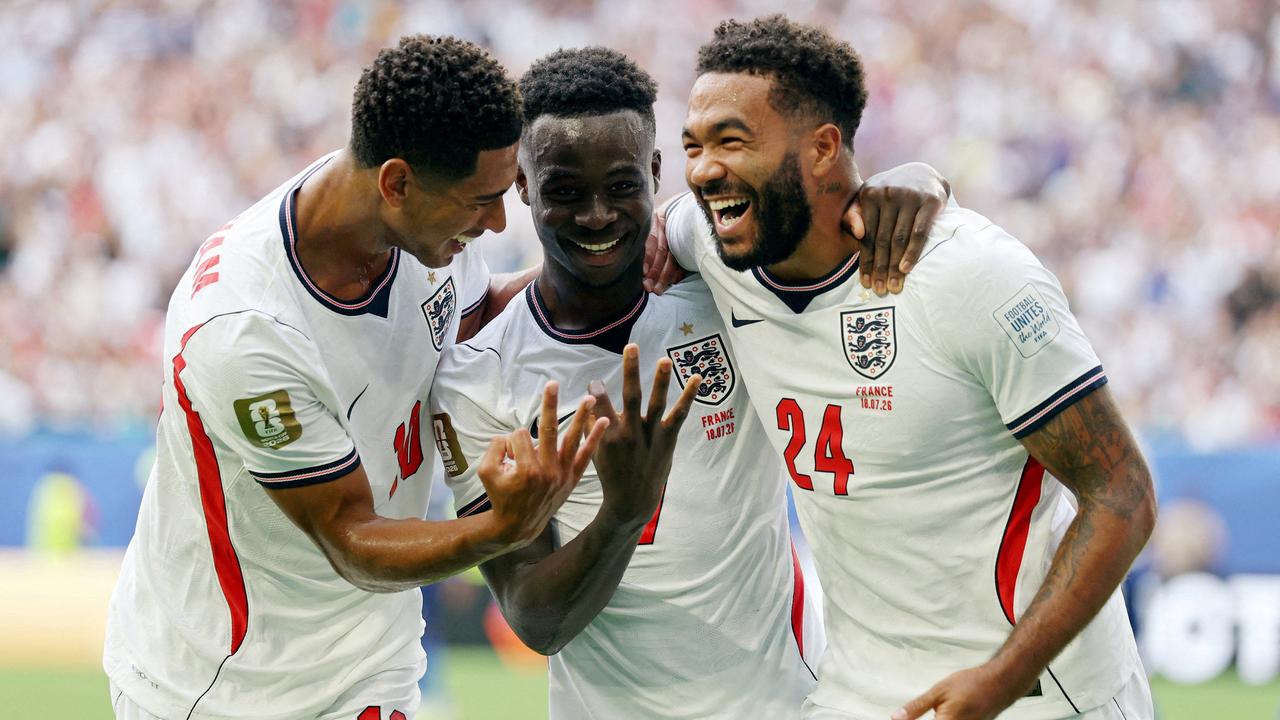
Ousmane Dembélé clawed one back in the 90+6th minute, but Jude Bellingham—who had come off the bench to manage the tempo—sealed the 6-4 result with a brilliant individual solo effort in the 90+8th minute.
Supporting Data and Statistical Milestones
The numbers behind this fixture are as staggering as the scoreline itself.
- Saka’s Brilliance: Bukayo Saka’s hat-trick cements his status as one of the tournament’s most lethal attackers. His ability to exploit the high defensive line of France was the tactical catalyst for the victory.
- Mbappé’s Legacy: Despite the loss, Kylian Mbappé finished the tournament as the top scorer with 10 goals and 4 assists. His 22 total World Cup goals now place him ahead of Lionel Messi in the all-time tournament scoring list, a historic achievement for the French icon.
- Olise’s Record: Michael Olise’s seventh assist of the tournament set a new World Cup record for individual playmaking, highlighting his transition into one of the world’s premier creative forces.
- Efficiency: England’s first-half performance was a masterclass in efficiency. They generated 1.11 Expected Goals (xG) but capitalized on defensive lapses to convert four of those chances.
Official Responses: Pride, Frustration, and Reflection
Thomas Tuchel (England Manager):
"I must give a massive compliment to the mentality of this group. To play a match of this magnitude after the disappointment of the semi-final and perform with such brilliance is a testament to their character. We have built a foundation here that we can take into the next cycle."
Bukayo Saka (Man of the Match):
"It was a crazy game. We are still gutted not to be in the final, but we wanted to finish on a high for our country. To score three goals in a match of this importance is a proud moment, but this is a team effort."
Didier Deschamps (France Manager):
"In the first half, we did not honor the French shirt. We played as if it were a friendly, and that is unacceptable. I take responsibility for the first half, but I am proud of the fight shown in the second. It is not the exit I wanted, but the players showed heart in the end."
Kylian Mbappé:
"We won the second half, but that doesn’t change the reality of the result. We weren’t focused, and at this level, you get punished. It is a painful end to the tournament."
Implications for the Future of Both Nations
For England, this bronze medal represents their best finish since the 1966 World Cup. It serves as a validation of the project under Thomas Tuchel, blending tactical discipline with the natural flair of their attacking talents. The team has shown that they can compete with—and defeat—the world’s elite, providing a massive psychological boost ahead of the European qualifiers.
For France, the aftermath is one of transition. With the departure of Deschamps, the national team faces a period of uncertainty. While the attacking talent—centered around the record-breaking Mbappé and the creative genius of Olise—remains the envy of the world, the defensive vulnerabilities exposed in this match suggest that the next manager will have significant work to do to restore the Equipe Tricolore to its status as the world’s preeminent defensive powerhouse.
As the 2026 World Cup reaches its climax with the final between Spain and Argentina, both England and France leave the tournament with clear lessons: England has found its identity, while France begins the search for a new era. This 6-4 thriller will remain etched in the annals of football history as a reminder of the beautiful game’s unpredictable, exhilarating nature.