By Global Business Desk
October 26, 2026
The Volkswagen Group, already navigating a period of profound structural transformation and economic uncertainty, has been plunged into a fresh crisis of optics and governance. Audi CEO Gernot Döllner, who also holds a seat on the Volkswagen Group’s board of management, finds himself at the center of a firestorm following his appearance at a campaign rally for U.S. President Donald Trump.
The incident, which saw Döllner sharing a stage with the President to announce a new four-billion-dollar Audi production facility in Georgia, has been condemned by labor leaders as a "shameful" breach of corporate neutrality and a potential violation of internal compliance guidelines. As the company weighs the strategic necessity of U.S. manufacturing against the political volatility of the current administration, the incident has exposed deep fissures between the executive board and the workforce representatives.
The Core Controversy: Compliance vs. Campaigning
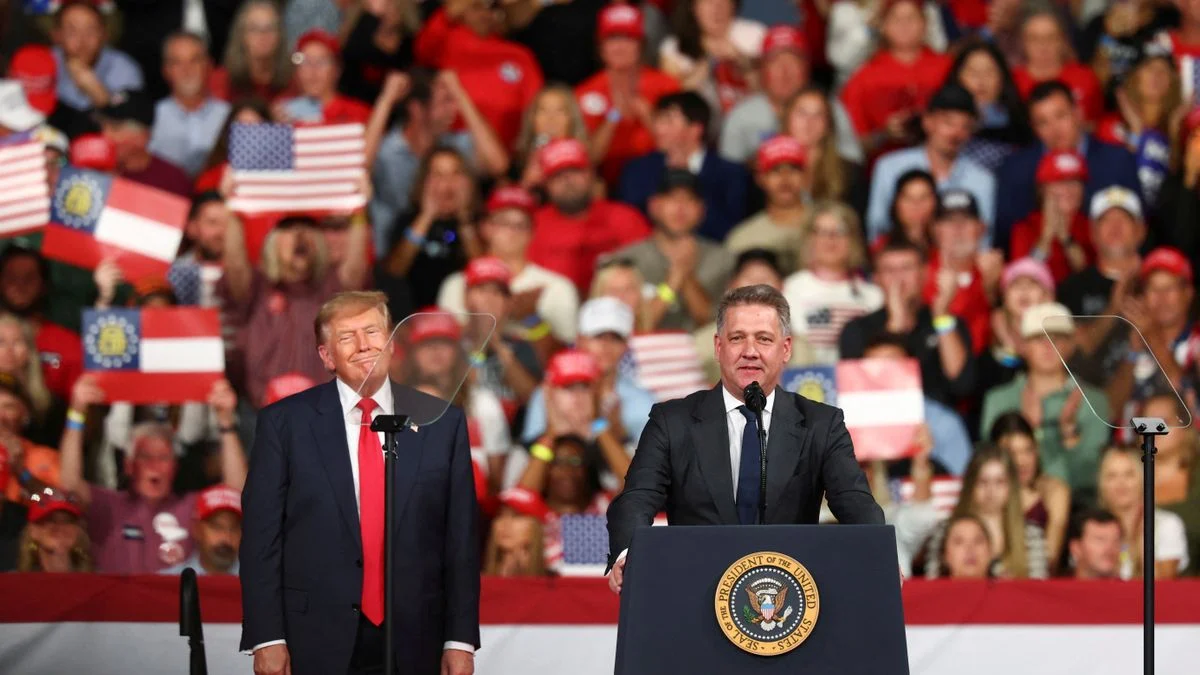
The controversy ignited on Saturday when Donald Trump, in a surprise move, announced the construction of an Audi plant in Perry, Georgia. Shortly after the announcement, Döllner appeared on stage, publicly thanking the President for his support.
For Daniela Cavallo, the chair of the Volkswagen Group’s General Works Council, this was not merely a business milestone; it was an act of political partisanship that crossed a red line. In an internal interview, Cavallo did not mince her words: "Several minutes of racism, sexism, defamation of foreigners, transphobia, and contempt for democracy—and then one of our top corporate representatives takes the stage to engage in active campaign assistance."
Cavallo argued that for anyone witnessing the rhetoric preceding Döllner’s appearance, the sight of a top-tier German executive endorsing such a platform was cause to "sink into the ground with shame." She emphasized that the appearance was not just a lapse in judgment, but a documented violation of corporate policy. According to internal Audi guidelines, public appearances with political candidates are strictly prohibited in the three months leading up to an election. Cavallo noted that Döllner, as a senior executive, had personally signed off on these principles only months ago.
Chronology of a Political Gamble
The timeline of the announcement suggests a carefully orchestrated, if politically fraught, choreography:

- Pre-Election Lead-up: Audi, like many global manufacturers, has faced mounting pressure from the Trump administration regarding import tariffs.
- Saturday, October 24, 2026: During a campaign event in Georgia, President Trump announces a major investment: a new Audi facility aimed at producing 200,000 SUVs annually.
- The Appearance: Immediately following the President’s remarks, Audi CEO Gernot Döllner joins him on stage. The visual of a high-ranking German executive appearing at a Trump rally becomes an instant focal point for international media.
- Monday, October 26, 2026: The fallout begins. Daniela Cavallo and IG Metall leader Christiane Benner issue strong condemnations, questioning the strategic and moral alignment of the move.
Economic Strategy vs. Political Reality
The proposed Georgia facility represents a massive commitment: four billion dollars in investment and the creation of 4,500 jobs. From a purely cold-blooded economic perspective, analysts concede there is a logic to the move. The United States remains one of the world’s most lucrative automotive markets, yet Volkswagen’s market share in the U.S. has remained stubbornly low compared to its global footprint.
Furthermore, the threat of high tariffs—a hallmark of Trump’s trade policy—has cost the VW Group billions in recent years. By localizing production, Audi aims to insulate itself from these levies. However, Cavallo’s assessment is more nuanced. While she acknowledges that the U.S. market is vital, she remains skeptical of the stability of such political "gifts."
"How much are such promises worth beyond a possible change in government?" she asked. The reliance on a single political figure’s favor is, in her view, a "game with fire."
Official Responses and Internal Friction
The criticism has not been limited to the Works Council. Christiane Benner, the powerful leader of the IG Metall trade union, echoed Cavallo’s sentiment, describing the appearance as "politically unacceptable." Benner went further, labeling the way Döllner presented himself and the brand as "embarrassing" and unworthy of the company’s workforce.
Cavallo also aimed her fire at the wider Volkswagen Group board, led by CEO Oliver Blume. She accused the leadership of allowing themselves to be turned into "puppets in a propaganda show" by a political figure who fundamentally contradicts the company’s stated values.
The weight of this criticism is amplified by history. Volkswagen was founded during the Nazi era and served as a flagship company for the Third Reich. Cavallo noted that the immediate comparisons to this history, which have already begun to circulate, are an inevitable consequence of the board’s perceived lack of political sensitivity.
Implications for the Workforce and Future Production
Beyond the immediate political scandal, the announcement has triggered significant anxiety regarding the future of Volkswagen’s domestic footprint in Germany.

Labor representatives have made it clear that they will not provide a "blank check" for international expansion. Cavallo stated that the Works Council would only green-light a new U.S. factory if there was absolute clarity on the impact for existing plants in Germany. "Without a total picture of the planning round, with a view toward all locations, we are not giving the green light," she declared.
Independent experts share these concerns. Frank Schwope, an auto industry analyst at the Fachhochschule des Mittelstands (FHM) in Berlin, warned that a new Audi plant in the U.S. could jeopardize jobs in Germany.
"VW already has overcapacities," Schwope stated. "There is a risk of a shift in production models, rendering German plants redundant." He specifically identified the Neckarsulm site, which employs roughly 15,000 people, as particularly vulnerable. There are also fears that Porsche, which falls under the same corporate umbrella, could see production shifted, potentially leading to further job losses at home.
Conclusion: A Corporate Identity at a Crossroads
The incident in Georgia has forced Volkswagen into an uncomfortable conversation about the nature of global leadership in a polarized world. While the executive board is tasked with navigating the complexities of international trade and market share, they are now facing a reality where silence—or in this case, participation—is perceived as a political act.
As the November 3rd U.S. midterm elections approach, the pressure on Volkswagen’s leadership will likely intensify. The company must now balance the need to satisfy a protectionist U.S. government with the necessity of maintaining the trust of its German workforce and the integrity of its own internal values.
For Gernot Döllner, the path forward is narrow. He must prove that the Georgia plant is a sound industrial investment rather than a political concession, while simultaneously repairing the damaged relationship with his own employees. Whether the board can reconcile these competing demands remains the central question of the coming months. For now, the "Audianer"—the brand’s loyal workforce—are waiting for answers, and they have made it clear: they will not be used as pawns in a foreign political theater.