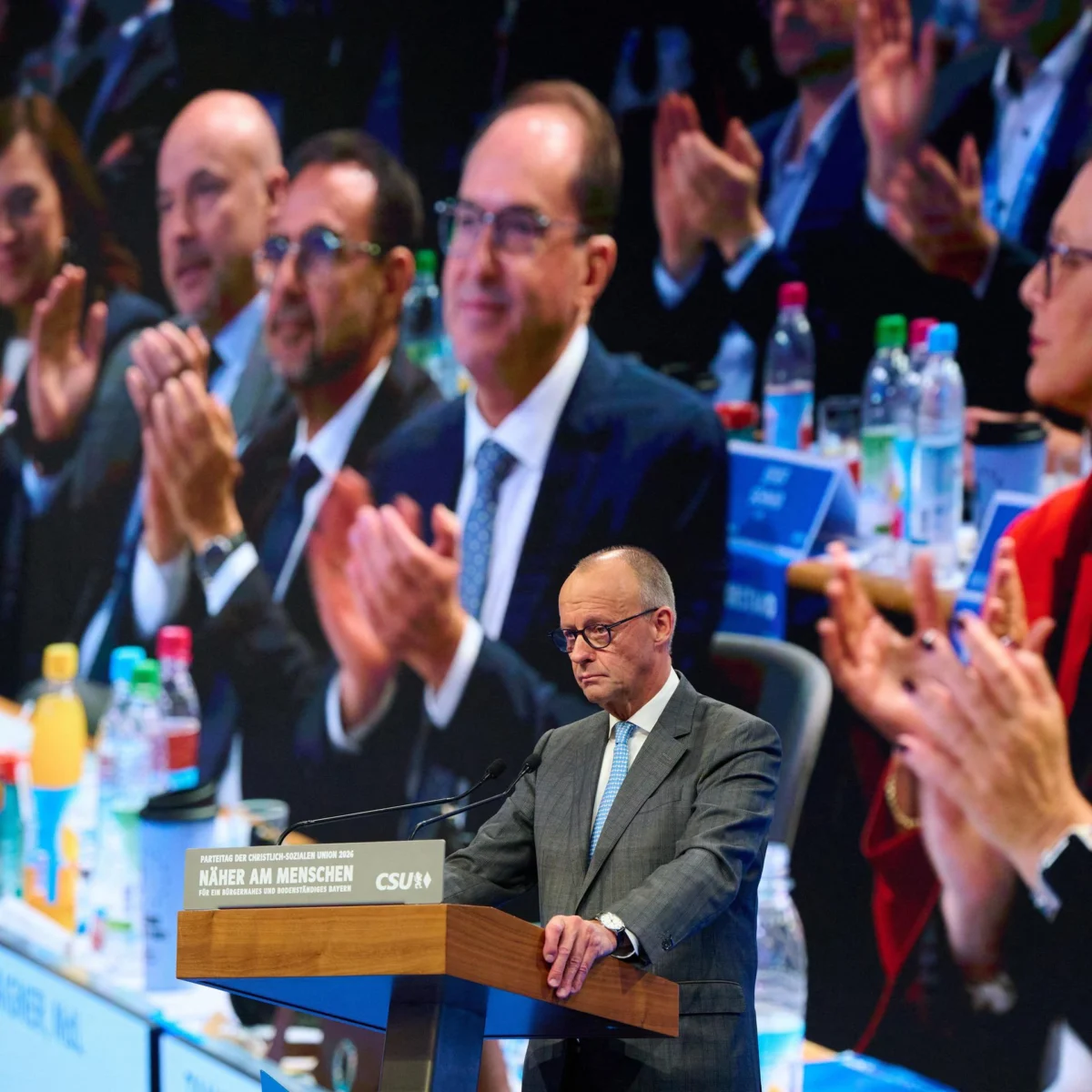
Munich, Germany – October 25, 2026 – In a pivotal address at the CSU Party Conference in Munich, Bundeskanzler Friedrich Merz, leader of the Christian Democratic Union (CDU), lauded the enduring collaboration within Germany’s conservative "Union" bloc. Yet, his speech was not merely a celebration of past successes; it served as a potent call to action, emphasizing the critical need for even closer cooperation between the CDU and its Bavarian sister party, the Christian Social Union (CSU), to safeguard Germany from the twin threats of extremism from both the far left and the far right. While conspicuously refraining from direct commentary on the burgeoning debate surrounding the succession of Bundespräsident Frank-Walter Steinmeier, Merz’s remarks and subtle gestures nonetheless generated enthusiastic applause, signaling a strategic maneuver in the intricate dance of German federal politics.
His speech, delivered against a backdrop of complex economic challenges and an increasingly polarized political landscape, underscored his vision for a Germany that is both economically robust and socially cohesive. Merz’s advocacy for a reduction in electricity tax for all consumers and his stern admonition to his Social Democratic Party (SPD) coalition partners for swifter implementation of reforms highlighted the internal strains within the federal government. Furthermore, his explicit warning against external threats, particularly from Russia, resonated with delegates keenly aware of Germany’s precarious geopolitical position.
I. Main Facts: Merz Charts Course Amidst Coalition Tensions and Presidential Race
Bundeskanzler Friedrich Merz’s appearance at the CSU Party Conference was more than a customary visit; it was a carefully choreographed demonstration of unity and a strategic articulation of his government’s priorities and challenges. The CDU leader, now Chancellor, utilized the platform to address several pressing national issues, painting a clear picture of the path he believes Germany must tread.
A Call for Enduring Union Unity Against Extremism
At the heart of Merz’s message was a powerful appeal for the CDU and CSU to strengthen their bond. He stressed that a united conservative front was indispensable for protecting the foundational democratic values of Germany against ideological assaults from both extremes of the political spectrum. This warning comes at a time when Germany, like many Western democracies, grapples with the rise of populist and extremist movements, challenging the established political order and societal cohesion. Merz’s rhetoric aimed to galvanize the Union base, framing the CDU/CSU as the bulwark against forces seeking to undermine the nation’s democratic institutions and social fabric.
Economic Relief: The Push for Electricity Tax Reduction
A significant portion of Merz’s address was dedicated to the economic well-being of German citizens and businesses. He unequivocally advocated for a reduction in electricity tax for all consumers in the coming year, positioning this as a crucial step to alleviate the burden of persistently high energy costs. This proposal, however, directly contradicted recent statements from Bundesfinanzminister Christian Klingbeil (SPD), who had indicated that anticipated higher tax revenues would be insufficient to finance such a cut. This public divergence highlights a key point of tension within the ruling coalition, signaling potential battles over fiscal policy in the upcoming budget cycle. Merz’s firm stance underscores his commitment to immediate economic relief, placing it as a central pillar of his government’s agenda.
The Presidential Succession: A Subtle Nod and Strategic Reservation
Perhaps the most intriguing aspect of Merz’s speech was his handling of the impending presidential succession. While he deliberately avoided explicitly naming a preferred candidate for Bundespräsident Frank-Walter Steinmeier’s successor, his actions spoke volumes. By specifically greeting Bavarian Landtagspräsidentin Ilse Aigner (CSU) by name, directly after CSU leader Markus Söder, Merz acknowledged and implicitly elevated her standing. This gesture was met with considerable enthusiasm from the delegates, particularly in light of Söder’s open endorsement of Aigner for the nation’s highest ceremonial office just the day before. However, the subsequent clarification from CDU circles—that the party reserves the right to field its own candidate—underscores the complex power dynamics and strategic calculations at play. This suggests that while Aigner may have received a boost, the CDU is keeping its options open, potentially setting the stage for an internal Union contest or a broader negotiation with other parties.
Coalition Reforms and National Pride
Merz also took the opportunity to pressure his coalition partner, the SPD, for the "rapid implementation of reforms," lamenting that ongoing debates were "unsettling the entire country." This pointed criticism reflects growing frustration within the CDU/CSU over the pace and direction of government policy, particularly concerning key structural changes deemed necessary for Germany’s future competitiveness. Beyond the internal political wrangling, Merz delivered a broader message of national confidence, asserting that Germans should be able to feel "proud of Germany." He lauded the nation’s "extraordinary strengths," an apparent counter-narrative to prevalent anxieties and self-doubt. Finally, he reiterated a firm warning against Russia, describing it as an ongoing external threat, reinforcing Germany’s commitment to robust defense and security in an unstable global environment.
II. Chronology: A Weekend of Bavarian Politics and National Strategy
The CSU Party Conference in Munich served as a critical platform for both Bavarian and federal political discourse, culminating in Bundeskanzler Merz’s impactful address. The events leading up to and during his speech reveal a carefully orchestrated series of political maneuvers and public pronouncements.
Pre-Conference Build-up and Söder’s Presidential Endorsement (October 24, 2026)
The stage for the conference was set by intense internal CSU debates and strategic positioning. The day before Merz’s speech, CSU leader and Bavarian Minister-President Markus Söder delivered his own keynote address. In a move that garnered significant attention, Söder openly and enthusiastically advocated for Ilse Aigner, the President of the Bavarian State Parliament, to succeed Frank-Walter Steinmeier as Bundespräsident. Söder’s endorsement immediately propelled Aigner into the national spotlight, signaling the CSU’s clear preference and initiating a crucial phase in the presidential succession debate. This move put pressure on the CDU, which traditionally fields candidates for federal offices, to respond or align.
Finance Minister Klingbeil’s Prior Statement on Budget Constraints (Early October 2026)
Weeks prior to the conference, Bundesfinanzminister Christian Klingbeil (SPD) had publicly articulated the federal government’s fiscal limitations. He stated that despite anticipated higher tax revenues, these would not be sufficient to finance a broad reduction in electricity tax for all consumers. Klingbeil’s remarks were made in the context of ongoing budget negotiations and the government’s commitment to fiscal prudence, especially in light of lingering economic uncertainties and the need for significant investments in areas like defense and climate protection. This set up a direct policy conflict that Merz would later address.
The Opening of the CSU Party Conference (October 25, 2026 Morning)
The CSU Party Conference commenced with a palpable sense of anticipation. Delegates gathered in Munich, eager to hear from their party leadership and, crucially, from the CDU Chancellor. The atmosphere was charged with a mixture of Bavarian pride and national political strategizing. The conference served as a forum for reaffirming CSU principles, discussing regional concerns, and projecting the party’s influence onto the federal stage.
Söder’s Introduction and Aigner’s Reception (October 25, 2026 Mid-morning)
As the conference progressed, Markus Söder formally introduced Merz. The reception for Ilse Aigner during the initial phase of the conference was notably warm, reflecting the party’s enthusiastic backing for her presidential aspirations. Her presence and the delegates’ response served as a powerful visual testament to the CSU’s unity behind their preferred candidate.
Merz’s Arrival and the Atmosphere (October 25, 2026 Late morning)
Upon Bundeskanzler Merz’s arrival, the mood in the hall shifted to one of heightened federal significance. The Chancellor, as leader of the CDU and the head of government, commanded the attention of the delegates. The atmosphere was respectful but also expectant, with many looking to Merz for signals regarding the future direction of the Union and the federal coalition.
Key Moments of Merz’s Speech (October 25, 2026 Midday)
Merz began his address by extending greetings, notably acknowledging Ilse Aigner by name directly after Söder. This specific mention, following Söder’s earlier endorsement, was immediately recognized by observers as a subtle but significant nod towards Aigner’s presidential candidacy, generating widespread cheers and delegates rising from their seats.
He then transitioned into the core themes of his speech:
- Unity Call: Merz passionately urged for stronger CDU/CSU cooperation, framing it as essential for national defense against extremism.
- Economic Proposals: He forcefully advocated for a universal reduction in electricity tax, directly challenging the Finance Minister’s prior assessment.
- Coalition Warnings: Merz issued a clear warning to the SPD, demanding faster implementation of reforms to prevent national unease.
- National Identity: He emphasized the importance of national pride and acknowledging Germany’s strengths, seeking to foster a more positive national narrative.
- Geopolitical Threat: Merz reiterated the warning against Russia, reinforcing the Union’s stance on national security.
Immediate Reactions from Delegates
Throughout Merz’s speech, particularly during his calls for unity, his economic proposals, and his subtle endorsement of Aigner, the delegates responded with enthusiastic applause and standing ovations. This immediate positive reception underscored the resonance of his message with the CSU base and suggested a strong alignment of strategic interests between the two sister parties, at least on the surface. The blend of policy proposals, strategic gestures, and calls for national cohesion marked a critical moment in German politics, setting the tone for upcoming debates and decisions.
III. Supporting Data: The Landscape of Germany in 2026
To fully appreciate the context and implications of Bundeskanzler Merz’s speech, it is crucial to understand the political, economic, and social landscape of Germany in late 2026. The issues he addressed are deeply embedded in the nation’s contemporary challenges.
A. Political Climate: The Rise of Populism and the "Wehrhafte Demokratie"
Germany in 2026 is grappling with a significant shift in its political landscape. The rise of populist and extremist parties, particularly the Alternative for Germany (AfD) on the far right, has fundamentally altered parliamentary dynamics and public discourse. Recent state elections and national polls indicate that the AfD has solidified its position as a major political force, drawing support from voters disillusioned with mainstream parties and concerned about issues such as immigration, economic stability, and energy policy. While the "far left" might refer to fringe elements or radicalized groups, the traditional Left Party (Die Linke) has also faced its own internal struggles and electoral challenges. Merz’s call to protect Germany from "extremists from the far left and far right" directly taps into a widespread concern about the erosion of democratic norms and the increasing polarization of society. This emphasis on a "wehrhafte Demokratie" (a democracy capable of defending itself) reflects a growing consensus among established parties to actively counter anti-democratic forces. The memory of historical extremism in Germany lends particular weight to such warnings, making Merz’s appeal a resonant one.
B. Economic Headwinds: Energy Costs, Inflation, and Industrial Competitiveness
Germany’s economy in 2026 continues to navigate the complex aftermath of the global energy crisis, compounded by persistent inflation and structural challenges to its industrial competitiveness. While energy prices have stabilized somewhat compared to their peaks, they remain significantly higher than pre-crisis levels, impacting both household budgets and industrial production costs. Businesses, particularly energy-intensive industries, are struggling to maintain competitiveness in a global market, leading to concerns about deindustrialization. Households are contending with a reduced purchasing power due to inflation, which, although moderating, has not yet fully receded.
The federal budget situation, as highlighted by Finance Minister Klingbeil, reflects these pressures. The government faces a delicate balancing act: the need to invest in climate transition, digitalization, and defense, while also adhering to fiscal discipline and potentially offering relief to citizens. Merz’s proposal to reduce the electricity tax is therefore not just a political statement but a direct response to a deeply felt economic burden. The economic arguments for such a cut focus on stimulating demand, reducing business costs, and improving international competitiveness. Counter-arguments, likely voiced by Klingbeil and the SPD, emphasize the need for fiscal stability, the potential for increased national debt, and the question of how such a tax cut would be financed without compromising other essential public services or investments.
C. The Presidential Office: Steinmeier’s Legacy and the Election Process
The office of the Bundespräsident in Germany is largely ceremonial but holds significant moral authority and acts as a unifying figure above partisan politics. Frank-Walter Steinmeier, a former Foreign Minister, has served two terms and is widely respected across the political spectrum. His tenure has been marked by calls for unity, dialogue, and upholding democratic values, particularly in times of national crisis and international tension. His second term is set to conclude, necessitating the election of a successor.
The Bundespräsident is not directly elected by the people but by the Federal Convention (Bundesversammlung), a unique body comprising all members of the Bundestag (the federal parliament) and an equal number of delegates chosen by the state parliaments. This electoral process requires broad political consensus, often leading to a candidate who can garner support from multiple parties. The CSU’s strong endorsement of Ilse Aigner and the CDU’s strategic reservation signify the intricate negotiations that will unfold among the parties of the Union, and potentially with other political blocs, to find a suitable and electable candidate. Aigner, as the President of the Bavarian State Parliament, is a seasoned politician with extensive experience in both state and federal politics, known for her pragmatic approach and ability to connect with diverse audiences. Her qualifications make her a strong contender, but the CDU’s potential to field its own candidate—perhaps a high-profile figure from within its ranks—adds an element of uncertainty to the race.
D. Government Coalition Dynamics: A Grand Coalition Under Strain
The presence of Bundeskanzler Merz (CDU) and Bundesfinanzminister Klingbeil (SPD) strongly suggests that Germany is currently governed by a Grand Coalition (Große Koalition) between the CDU/CSU and the SPD. Such coalitions, while providing broad parliamentary majorities, are often characterized by internal tensions and compromises between parties with differing ideological priorities. Merz’s call for "rapid implementation of reforms" and his criticism of coalition debates "unsettling the entire country" point to significant friction within this government.
Common areas of dispute in a Grand Coalition often include fiscal policy (as seen with the electricity tax), social welfare reforms, environmental regulations, and the pace of digitalization. The SPD, as the junior partner in a CDU-led government (assuming Merz is Chancellor), would likely emphasize social equity, worker protection, and robust public services, potentially clashing with the CDU’s focus on economic competitiveness, deregulation, and fiscal conservatism. The slow pace of reforms often attributed to Grand Coalitions stems from the need to reconcile these divergent interests, leading to lengthy negotiation processes and public disagreements.
E. Geopolitical Realities: Russia as an Enduring Threat
Merz’s reiteration of Russia as an "external threat" underscores the enduring geopolitical realities facing Germany and Europe. The ongoing conflict in Ukraine, the associated energy crisis, and the broader deterioration of relations with Russia have profoundly impacted Germany’s foreign and security policy. Germany, as a key member of NATO and the EU, has significantly increased its defense spending and commitment to collective security. The warning serves as a reminder of the need for continued vigilance, strong alliances, and robust defense capabilities, aligning with the Union’s traditionally firm stance on national security. This rhetoric also seeks to unify the nation behind a common understanding of external challenges, strengthening resolve in uncertain times.
IV. Official Responses: A Multitude of Reactions
Bundeskanzler Merz’s speech at the CSU Party Conference immediately triggered a range of official and unofficial responses from across the German political spectrum, highlighting the complex interplay of power, policy, and public perception.
A. The Christian Social Union (CSU): Strategic Alignment and Presidential Momentum
The CSU’s reaction was overwhelmingly positive, marked by the enthusiastic applause during Merz’s speech. This reception signifies a strategic alignment with the CDU leader, particularly on the themes of Union unity, national pride, and the warning against extremism. CSU leader Markus Söder, who had already set the tone by endorsing Ilse Aigner, likely viewed Merz’s subtle acknowledgment of Aigner as a significant boost to her presidential campaign. The CSU sees itself as a key partner in the Union, and Merz’s presence and message reinforced this sense of shared purpose. For the CSU, Merz’s call for closer cooperation was not merely rhetorical; it was an affirmation of their indispensable role in shaping national conservative policy and a tacit endorsement of their preferred candidate for the Bundespräsident. The party machinery would likely begin to leverage this momentum, presenting Aigner as a broadly acceptable candidate within the Union.
B. The Christian Democratic Union (CDU): Internal Deliberations and Chancellor’s Agenda
Within the CDU, Merz’s speech was widely seen as a strong reaffirmation of his leadership and a clear articulation of the party’s agenda. His emphasis on economic relief through tax cuts and the need for faster reforms resonated with CDU members eager to see tangible progress from the Grand Coalition. The CDU’s official statement that it "reserves the right to field its own candidate" for the Bundespräsident signals an ongoing internal deliberation. While Merz’s nod to Aigner was a conciliatory gesture towards the CSU, the CDU leadership will meticulously weigh its options. Potential CDU candidates, perhaps a respected former minister or a prominent state premier, would be considered based on their electability within the Federal Convention and their ability to unify various political factions. This strategic ambiguity allows the CDU maximum flexibility in negotiations, ensuring they are not beholden to the CSU’s unilateral endorsement. The party is keen to avoid any perception of weakness or being dictated to by its Bavarian counterpart, especially on such a symbolically important national office.
C. The Social Democratic Party (SPD): Fiscal Prudence and Coalition Friction
Bundesfinanzminister Christian Klingbeil (SPD) would likely reiterate his stance on fiscal prudence in response to Merz’s call for electricity tax cuts. The SPD’s official position would emphasize responsible budgeting, the need to avoid increasing national debt, and the importance of targeted social spending over universal tax cuts. They might argue that a broad tax cut would disproportionately benefit higher earners and could jeopardize funding for essential public services or crucial long-term investments.
Regarding Merz’s criticism about the slow pace of reforms, the SPD would likely defend its record, highlighting the complexities of legislative processes in a Grand Coalition and the need for thorough deliberation. They might accuse Merz of playing to his party base and undermining coalition stability by airing grievances publicly. The SPD would likely push back on the notion that "debates are unsettling the country," arguing that democratic discourse and careful policy formulation are essential for good governance. This public exchange underscores the inherent tensions within the Grand Coalition, revealing deep-seated disagreements on economic priorities and the effectiveness of joint governance.
D. Opposition Parties (Greens, FDP, AfD, Die Linke): Diverse Critiques
- The Greens: Would likely criticize Merz’s focus on broad tax cuts, arguing instead for targeted relief measures and investments in sustainable energy infrastructure. They might also challenge his framing of "extremists," emphasizing the importance of inclusive dialogue and addressing root causes of discontent rather than solely focusing on security. They would likely support the need for climate action and condemn external threats.
- The Free Democratic Party (FDP): While potentially agreeing with the principle of tax reduction, the FDP might question the financing of Merz’s proposal and demand a comprehensive fiscal reform package. They might also align with Merz’s call for faster reforms but would likely advocate for different policy directions, emphasizing market liberalization and bureaucratic streamlining.
- The Alternative for Germany (AfD): Would likely dismiss Merz’s warnings against extremism as hypocritical or insufficient, positioning themselves as the true voice of the people. They might selectively agree with aspects of Merz’s economic criticism, particularly concerning energy costs, but would frame it within their anti-establishment and nationalist rhetoric.
- Die Linke (The Left Party): Would strongly oppose Merz’s tax cut proposals, advocating for wealth redistribution and increased social spending. They would likely critique his "extremist" warning, arguing that it distracts from systemic inequalities and social injustices. They would also likely call for de-escalation in international relations rather than emphasizing external threats.
E. Business Associations and Trade Unions: Conflicting Interests
- Business Associations: Would generally welcome Merz’s proposal for electricity tax reduction, seeing it as a vital step to boost competitiveness and alleviate burdens on German industry. They would likely support calls for faster reforms, particularly those aimed at reducing bureaucracy and stimulating economic growth.
- Trade Unions: Might express skepticism about universal tax cuts, arguing for targeted support for low-income households and investments in public services. They would prioritize job security and fair wages, potentially viewing tax cuts as benefiting employers more than employees.
F. Media Analysis and Expert Opinion:
Initial media analysis would focus on the internal coalition tensions revealed by Merz’s speech and the subtle maneuvering around the presidential succession. Political commentators would dissect Merz’s rhetoric on extremism, evaluating its effectiveness and potential for unifying the Union. Economic experts would debate the feasibility and impact of the proposed electricity tax cut, offering various projections and alternative policy recommendations. The speech would be widely interpreted as a strategic move by Merz to consolidate his leadership, set the agenda, and define the Union’s position on critical national issues.
V. Implications: Shaping Germany’s Future Trajectory
Bundeskanzler Merz’s address at the CSU Party Conference carries significant implications for the future trajectory of German politics, affecting the stability of the Grand Coalition, the upcoming presidential election, the national economic discourse, and the broader fight against extremism.
A. Future of the Union: Renewed Sense of Purpose or Continued Underlying Tensions?
Merz’s call for intensified cooperation between the CDU and CSU is a strategic attempt to reinforce the unity of the conservative bloc. This renewed emphasis on cohesion could provide the Union with a stronger, more unified front in future electoral contests and in its opposition to extremist parties. It signals a desire to present a united vision for Germany. However, the underlying tensions, particularly evident in the subtle maneuvering around the Bundespräsident succession, suggest that while unity is a stated goal, internal competition and differing priorities will continue to shape the relationship. The CDU’s reservation to field its own candidate, despite Merz’s nod to Aigner, indicates that the CSU cannot take CDU support for granted, potentially leading to a complex negotiation process that could either solidify or strain their alliance in the long run. The outcome will significantly impact the Union’s ability to act as a cohesive political force in upcoming state and federal elections.
B. Government Stability and Policy Direction: Coalition Clashes or Accelerated Action?
Merz’s public criticism of the SPD regarding the pace of reforms and his direct challenge to the Finance Minister’s fiscal stance point to significant friction within the Grand Coalition. This open disagreement could either lead to heightened coalition clashes, potentially paralyzing legislative processes and undermining the government’s ability to act decisively, or it could force the SPD to accelerate reform efforts and reconsider its position on economic relief measures. The budgetary implications of a universal electricity tax cut are substantial, requiring either cuts elsewhere, increased borrowing, or a re-evaluation of revenue forecasts. If the SPD resists, the coalition could face a prolonged period of internal conflict, risking its stability and public trust. Conversely, if a compromise is reached, it could signal a new phase of accelerated policy implementation, albeit likely at the cost of further concessions from one side or the other. The outcome will define the Merz government’s ability to deliver on its promises and navigate pressing national challenges.
C. The Presidential Election: Aigner’s Boost and CDU’s Calculus
Merz’s subtle endorsement of Ilse Aigner undeniably provides a significant boost to her presidential aspirations, elevating her profile on the national stage and signaling a degree of acceptance from the CDU leadership. This could strengthen her position as a viable candidate capable of garnering cross-party support within the Federal Convention. However, the CDU’s stated intention to reserve the right to field its own candidate ensures that the presidential election remains a contested and complex affair. The CDU will now have to carefully weigh its options: fully endorse Aigner for the sake of Union unity, or nominate its own candidate to assert its dominance as the larger sister party. The decision will not only impact the outcome of the presidential election but also shape the power dynamics within the Union for years to come. A protracted battle could divide the Union, while a unified approach could project an image of strength and stability.
D. Combating Extremism: Societal Impact and Legislative Responses
Merz’s strong warning against extremism from both the far left and far right underscores a growing concern within mainstream German politics. This rhetoric aims to galvanize centrist voters and reinforce the notion that the Union is the primary guardian of democratic values. The effectiveness of this call will depend on whether it translates into concrete legislative actions to strengthen democratic institutions, enhance security measures, and address the socio-economic grievances that often fuel extremist ideologies. The broader societal impact will be a reinforcement of the "wehrhafte Demokratie" concept, potentially leading to increased public support for measures that protect the constitutional order. However, critics might argue that such warnings, without addressing root causes, could be perceived as merely rhetorical or could inadvertently alienate segments of the population.
E. Merz’s Political Standing: Consolidation of Leadership and Agenda Setting
For Bundeskanzler Merz, the speech was a crucial exercise in consolidating his leadership and setting the agenda for the next phase of his chancellorship. By addressing core economic concerns, pressing for reforms, and positioning the Union as the bulwark against extremism, Merz aimed to project an image of decisive leadership and strategic foresight. His willingness to openly challenge his coalition partner on policy matters also signals his intent to vigorously pursue his own policy objectives, even if it creates internal friction. This speech is a testament to Merz’s strategic positioning, demonstrating his intent to shape Germany’s future trajectory, both domestically and internationally, navigating complex political landscapes with a clear vision for the nation’s stability and prosperity. The ultimate implication is a clearer articulation of the direction Merz intends to steer Germany,