By Sandra Meyer, MDR KULTUR (Adapted)
Date: August 22, 2026
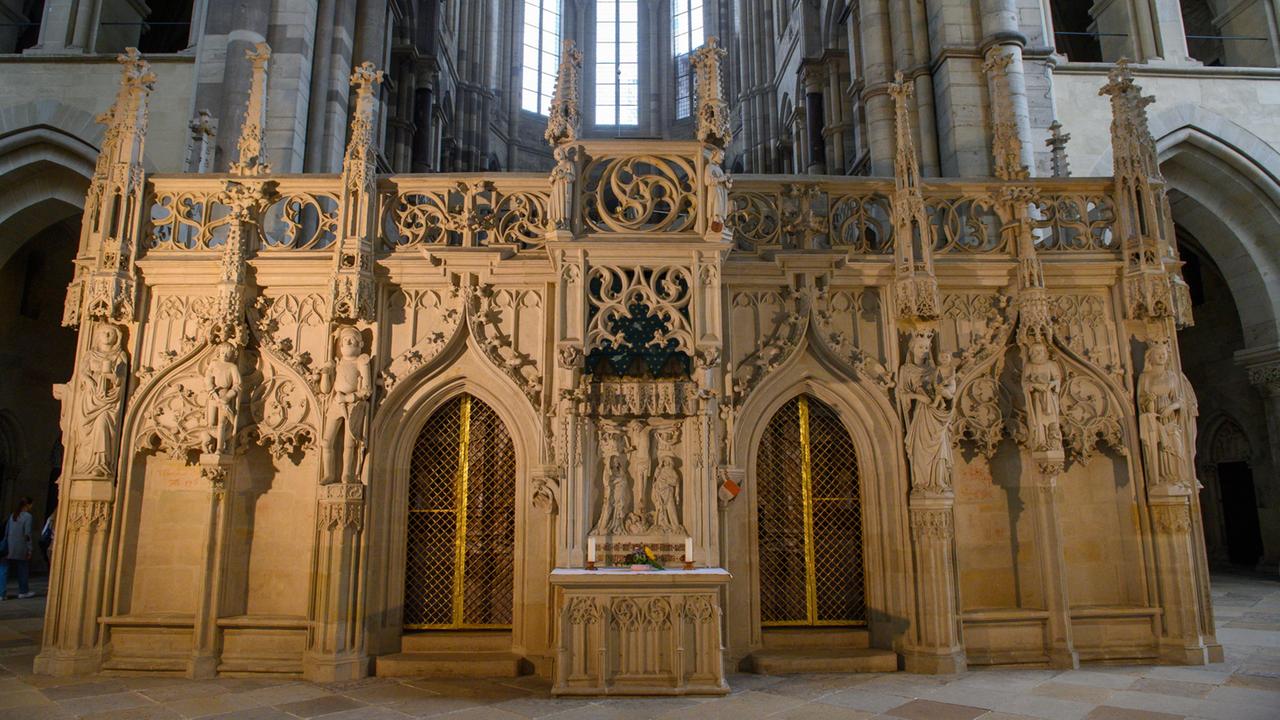
For over a millennium, the mortal remains of Otto I—the man who unified a fractured Europe and laid the foundations for the Holy Roman Empire—have rested within the walls of the Magdeburg Cathedral. However, in early 2025, the cathedral’s High Choir transformed into a high-security laboratory. What began as a desperate structural preservation project to save a crumbling sarcophagus evolved into an unprecedented scientific endeavor, revealing the intimate details of a medieval icon’s life, health, and identity.
The Urgency of Preservation: A Monument at Risk
Otto the Great (912–973) stands as a colossus of European history. Crowned Emperor in Rome in 962, he elevated Magdeburg to the status of an Archbishopric in 968, choosing it as his final resting place alongside his first wife, Queen Editha. His tomb is not merely a funerary monument; it is a symbol of European sovereignty.
By 2024, routine monitoring revealed that this symbol was facing a catastrophic structural failure. Sachsen-Anhalt’s Minister of Culture, Rainer Robra, described the situation as critical. "We had to act immediately to prevent the total collapse of the burial site," Robra explained. "The combination of hair-line fractures in the ancient limestone, the corrosion of iron fasteners used in previous centuries, and the immense weight of the 300-kilogram marble slab created a ticking time bomb. Our primary objective was to ensure the emperor’s bones were not crushed by his own monument."
The restoration was a multi-agency effort involving the Cultural Foundation of Saxony-Anhalt, state heritage preservationists, archaeologists, and the Evangelical Church in Central Germany. The project required the complete opening of the tomb—a move that sparked significant debate regarding the ethics of disturbing the deceased.
The Ethics of Disruption: Totenruhe vs. Duty
The opening of the sarcophagus involved removing crude cement patches from past repairs and extracting rusting iron nails that had, over decades, expanded and fractured the stone from within. Beneath the limestone casing, experts discovered a wooden coffin, severely compromised by centuries of moisture.
Oberkirchenrat Albrecht Steinhäuser addressed the ethical concerns directly. "There is always a tension between the sanctity of the dead and the necessity of preservation," he noted. "However, to strictly uphold the ‘Totenruhe’ (eternal rest) while ignoring the structural integrity of the tomb would have eventually led to the collapse of the sarcophagus. Such a collapse would have been a far more egregious violation of his rest than our controlled, scientific intervention."
Chronology of the Investigation
The project unfolded in several distinct phases, blending traditional archaeological techniques with cutting-edge medical technology:
- Early 2025: The High Choir of the Magdeburg Cathedral is secured. The limestone sarcophagus is carefully dismantled.
- Spring 2025: The wooden inner coffin is opened. Archaeologists and forensic experts begin the delicate task of inventorying the remains.
- Summer 2025: High-resolution CT and MRI scans are performed at the University of Magdeburg.
- Autumn 2025: DNA samples are sent to the Max Planck Institute for Evolutionary Anthropology in Leipzig for comparison with other Ottonian remains.
- Winter 2025–Spring 2026: Synthesis of medical data regarding the Emperor’s health and physical appearance.
- August 2026: Finalization of the new titanium sarcophagus design.
- September 1, 2026: Scheduled re-interment of the remains.
Unlocking the Genetic Code: Confirming the Identity
One of the most persistent questions in medieval history has been whether the remains in the Magdeburg Cathedral were, in fact, those of Otto I. Given the tomb’s history of multiple openings and potential intermingling of remains, skepticism remained high.
"In archaeology, particularly with high-profile medieval graves, you can never assume the identity of the occupant without empirical evidence," said State Archaeologist Harald Meller. "We had to be certain."
The scientific team achieved a breakthrough by comparing the genetic material found in Magdeburg with samples from Kaiser Heinrich II, whose remains are held in the Bamberg Cathedral. The DNA analysis confirmed a third-degree kinship, providing the definitive proof that the remains indeed belong to Otto the Great. Harald Ringbauer of the Max Planck Institute described the discovery as "a stroke of incredible fortune," noting that the rare opportunity to sample two Ottonian emperors within the same calendar year provided the statistical confidence required to end centuries of speculation.
Medical Insights: Life and Death of a Medieval Monarch
The clinical examination of Otto’s remains provided a fascinating, and at times humanizing, look at a man often mythologized as a distant, iron-fisted ruler.
Using state-of-the-art diagnostic imaging, researchers reconstructed the physical health of the 61-year-old monarch. The data suggests that Otto was a man of considerable physical strength, maintained through a lifetime of military campaigning. However, he was not immune to the ravages of time. Scans showed evidence of moderate arthritis, likely a result of decades spent in the saddle.
Perhaps the most human detail came from an examination of his oral health. Frank Tavassol, head of the Department of Oral and Maxillofacial Surgery at the University of Halle, noted that the Emperor suffered from significant tooth loss and advanced dental decay. "The evidence suggests a complete lack of oral hygiene," Tavassol observed. "For a man of his status, this was not due to a lack of resources, but rather a reflection of the era’s understanding of health. He simply didn’t brush his teeth; there was no societal pressure or knowledge to do so."
Furthermore, the skull exhibited several lesions consistent with battlefield trauma—scars of a life lived on the front lines of his empire’s expansion. The researchers are now turning their attention to forensic phenotyping, using the genetic data to estimate eye, hair, and skin color. Meller believes that, with the current advancements in forensic facial reconstruction, "we will be able to give Otto a face once again."
A New Vessel: Modern Art Meets Ancient History
While the scientific team focused on the past, the Cultural Foundation of Saxony-Anhalt looked to the future. A competition was held to design a new inner coffin, with the mandate that it be contemporary rather than a pastiche of medieval styles.
The commission was awarded to the Halle-based artist Silke Trekel. Her design is a masterclass in minimalism and durability. The new vessel is a sleek, elongated form crafted from titanium, featuring a lid that incorporates a subtle, dynamic twist. Gold banding represents the royal status of the occupant, while silver accents provide a sophisticated material contrast.
"Designing a final resting place for such a monumental figure is a task that humbles you," said Trekel. "I wanted to create something that feels timeless yet distinctly modern. By using titanium, we are ensuring that the vessel is as structurally sound as possible—built to last another millennium."
Implications and Future Outlook
The findings from the Magdeburg project represent a paradigm shift in how we view the intersection of state, church, and science. The collaboration has not only secured the physical monument for future generations but has also rewritten the biography of one of Europe’s most significant rulers.
As the restoration phase draws to a close, the focus shifts to the final act of the project: the re-interment. On September 1, 2026, the remains of Otto the Great will be transferred into the new titanium sarcophagus. This vessel will then be placed back into the original limestone shell, which has been meticulously cleaned and structurally reinforced. The ancient marble slab will be resealed, marking the beginning of what authorities hope will be another several centuries of undisturbed peace for the Emperor.
For historians and the public alike, this project proves that the past is never truly static. Through the combination of rigorous conservation and advanced genetic analysis, the "Great" emperor of the Middle Ages has been brought into the light of the 21st century, reminding us that even the most legendary figures were, in the end, flesh and bone.