By [Your Name/News Agency Name]
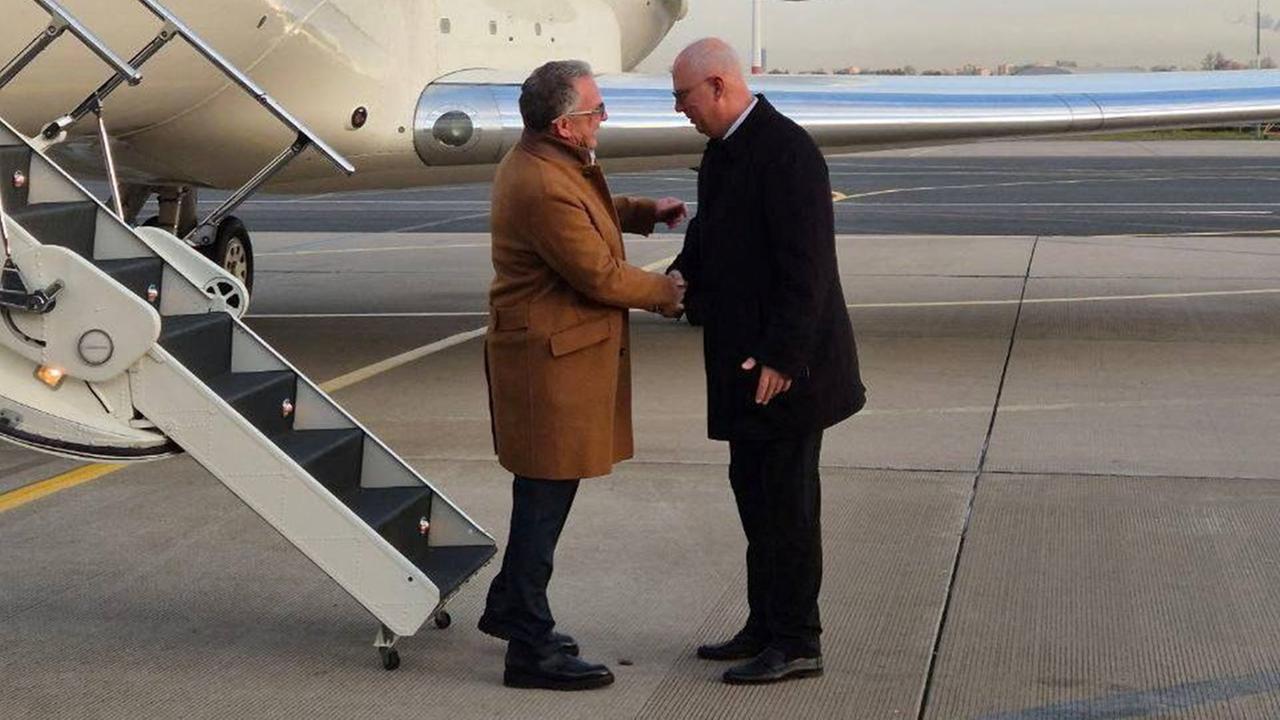
St. Petersburg, Russia – October 21, 2026 – In a significant diplomatic maneuver, U.S. Special Envoy Steve Witkoff has arrived in St. Petersburg for crucial talks with Russian President Vladimir Putin, aiming to de-escalate the protracted conflict in Ukraine. This high-stakes meeting follows Witkoff’s intensive discussions in Oslo, Norway, where he engaged with Ukrainian President Volodymyr Zelenskyy and representatives from NATO and the European Union. The diplomatic push comes at a critical juncture, marked by recent pronouncements from U.S. President Donald Trump that have raised questions about the unwavering nature of American support for Kyiv, alongside renewed reports of military offensives by both sides of the conflict.
The Diplomatic Landscape: Oslo to St. Petersburg
The current diplomatic offensive is rooted in a series of discussions held in Oslo, where U.S. Special Envoy Steve Witkoff met with Ukrainian President Volodymyr Zelenskyy. The Norwegian capital served as a crucial venue for exploring potential pathways toward peace, with representatives from the North Atlantic Treaty Organization (NATO) and the European Union also participating in the deliberations.
Sources close to the Oslo talks described the atmosphere as constructive, though U.S. Secretary of State Marco Rubio cautioned against expecting immediate breakthroughs. "While the meeting in Oslo was positive, we did not witness anything unexpected or surprising," Rubio stated. "Now, Envoy Witkoff will share these ideas with the Russian side. Then we will see if we can make progress." This measured optimism underscores the complex and delicate nature of the ongoing peace efforts.
The core agenda in Oslo reportedly encompassed several critical issues:
- Security Guarantees for Ukraine: Exploring robust mechanisms to ensure Ukraine’s future security in the post-conflict era.
- Territorial Integrity: Addressing the contentious issue of territorial disputes, a central sticking point in any lasting peace settlement.
- Sanctions Regime: Discussing the future of international sanctions imposed on Russia and their potential role in negotiations.
- European Security Architecture: Considering the broader implications for regional security and the post-war order in Europe.
Norwegian Prime Minister Jonas Gahr Støre expressed confidence that the Oslo consultations had laid a foundation for continued efforts to end the war. He articulated hope that Witkoff’s engagement with the Russian leadership could pave the way for trilateral discussions involving the United States, Russia, and Ukraine. This prospect is particularly significant, as the Kremlin has historically been reluctant to engage in direct negotiations with Kyiv, often citing preconditions that are unacceptable to Ukraine.
Shifting U.S. Stance: Trump’s "Deal" and Doubts Over Commitment
Adding a layer of complexity and concern to the diplomatic initiatives are the recent public statements by U.S. President Donald Trump. These pronouncements have fueled speculation about the enduring extent of American backing for Ukraine. Shortly after the Oslo discussions, President Trump reiterated his assertion that Russia is prepared to end the conflict. He directly urged President Zelenskyy to conclude the war through a "deal."
Furthermore, President Trump has repeatedly voiced his sentiment that the United States has provided substantial aid to Ukraine without receiving commensurate returns. "We have given Ukraine so much, and gotten absolutely nothing back," he stated, a sentiment he has echoed on previous occasions.
These remarks come in the wake of several policy shifts attributed to the Trump administration. Less than two weeks prior to the current diplomatic push, President Trump announced that Russia would supply hundreds of thousands of tons of diesel fuel to the United States. A few days later, he announced the suspension of a recently enacted sanctions package against Russia, citing "national interest." These actions have been interpreted by some as a move towards rapprochement with Moscow, potentially at the expense of Ukraine’s interests.
In response to these developments and the ongoing diplomatic overtures, German Chancellor Friedrich Merz emphasized that Ukraine’s capitulation is not an option. "That would be equivalent to a capitulation for all of us," Merz stated, underscoring Germany’s continued commitment to supporting Ukraine. He affirmed that Berlin would continue to provide assistance to Kyiv in its own strategic interest.
Ukraine’s Concerns: Exclusion and Escalation
The approach adopted by President Trump has been met with significant bewilderment and sharp criticism from Ukraine. President Zelenskyy has accused the United States of implicitly accepting the continuation of Russia’s war efforts. He has also repeatedly voiced concerns about the perceived lack of timely deliveries of crucial military equipment, particularly air defense missiles, which are critically needed by the Ukrainian armed forces.
Adding to Ukraine’s anxieties are recent reports of the throttling of satellite communication services, including Starlink and Starshield, which have played a vital role in coordinating the Ukrainian military, facilitating drone operations, and bolstering air defense capabilities.
A primary fear within Ukraine is the possibility of peace negotiations proceeding without its direct involvement, potentially leading to agreements made "over their heads." These concerns have been amplified by reports suggesting that Russian President Vladimir Putin intends to seek a meeting with President Trump and Chinese President Xi Jinping on the sidelines of the upcoming Asia-Pacific Economic Cooperation (APEC) summit in November.
In response to this potential scenario, Ukrainian President Zelenskyy has urgently called for Ukraine’s participation in any such high-level summit. "There can be no talks about Ukraine without Ukraine," he asserted, highlighting Kyiv’s demand for a seat at the table in any discussions concerning its future.
Escalation on the Ground: Renewed Attacks Amidst Diplomatic Efforts
Despite the ongoing mediation efforts aimed at achieving a ceasefire, military actions have continued unabated. In a significant development, the Russian military launched attacks on several Ukrainian regions overnight. Ukrainian Minister for Reconstruction, Serhiy Korezkyj, reported via Telegram that at least four people were killed in these assaults. Two individuals lost their lives when a drone struck a multi-story building in the capital, Kyiv, while two others perished in the northeastern region of Kharkiv.
Korezkyj detailed that Russia had been "relentlessly" targeting energy facilities, railway infrastructure, shopping centers, and residential buildings since Tuesday evening. The affected regions included Kyiv, Volyn, Odesa, and Mykolaiv. Ukrainian authorities also reported further attacks targeting a university in Kremenchuk, Poltava region, which resulted in at least two injuries.
The Russian Ministry of Defense confirmed the strikes on Poltava and Kyiv, as reported by Reuters. In Poltava, a drone storage facility was reportedly attacked, while in Kyiv, a substation crucial for supplying power to Ukraine’s defense and industrial sectors, as well as logistics centers, was targeted.
Conversely, Russian officials reported drone attacks on the Leningrad region, according to regional governor Alexander Drosdenko. This region in northwestern Russia encircles St. Petersburg, the location of the planned meeting between Presidents Putin and Witkoff. The Bryansk region also reportedly experienced drone attacks, with its regional governor, Yegor Kovalchuk, reporting at least one fatality and two injuries.
Geopolitical Implications and the Path Forward
The confluence of high-level diplomatic engagement, shifting geopolitical alliances, and continued military hostilities presents a deeply complex and precarious situation. The U.S. envoy’s direct engagement with President Putin signifies a renewed, albeit fraught, attempt to find a diplomatic resolution. However, the backdrop of President Trump’s pronouncements and past actions casts a long shadow, raising questions about the consistency and reliability of U.S. policy towards Ukraine.
For Ukraine, the stakes remain existential. The nation faces the dual challenge of defending its sovereignty on the battlefield and navigating a diplomatic landscape where its own agency appears increasingly challenged. President Zelenskyy’s insistence on Ukraine’s direct participation in any peace talks underscores the fundamental principle that any resolution must be one that Ukraine itself can endorse.
The broader implications extend to the future of European security and the global balance of power. The conflict in Ukraine has already reshaped alliances and underscored the fragility of international norms. The outcome of these diplomatic efforts, and the underlying dynamics between major global powers, will undoubtedly have far-reaching consequences for years to come.
As the world watches, the diplomatic shuttle between Oslo and St. Petersburg, coupled with the persistent violence on the ground, highlights the urgent need for de-escalation and a genuine commitment to a just and lasting peace. The coming days and weeks will be critical in determining whether these diplomatic overtures can translate into tangible progress or if the conflict will continue its devastating trajectory.
Disclaimer: Information from parties involved in the conflict, or from observers, cannot be independently verified at this time due to the ongoing situation.