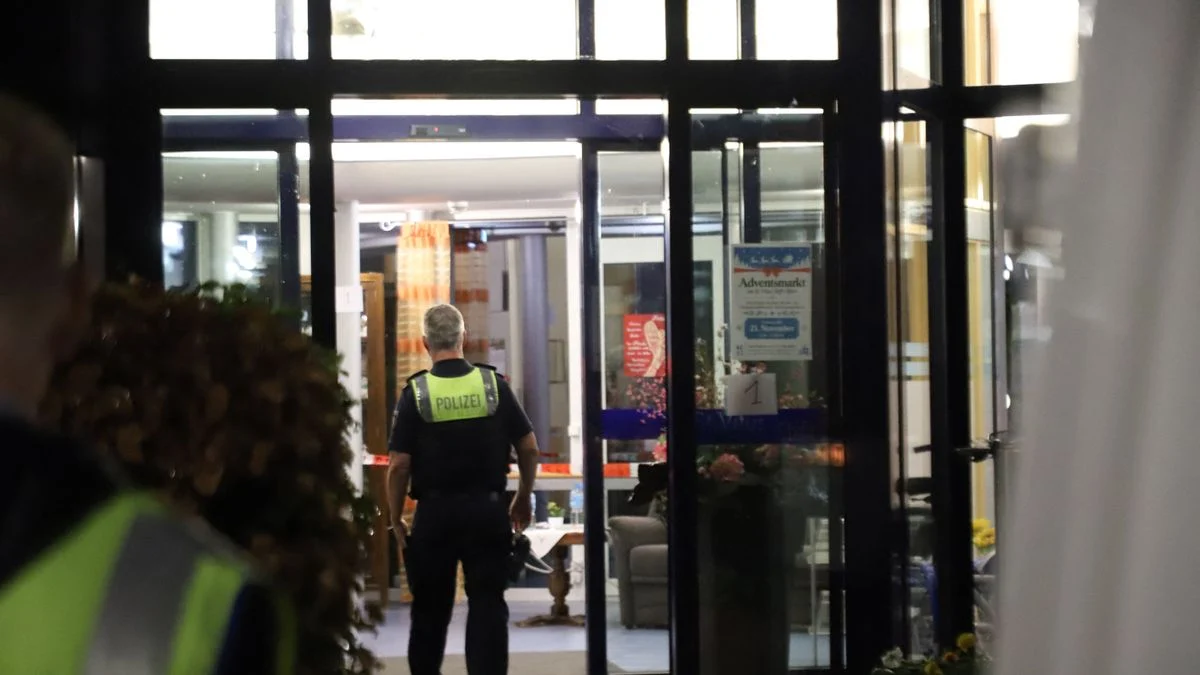
The quiet town of Olfen, nestled in the Münsterland region of North Rhine-Westphalia, is grappling with a horrific act of violence that has shattered the peace of a local senior care home. An 86-year-old woman is dead, and two others remain hospitalized following a knife attack that has sent shockwaves through the nation, raising urgent questions about safety, mental health, and the living conditions within institutional care.
The Incident: A Sudden Act of Violence
On a seemingly unremarkable Friday evening, the residents of the city-run senior care facility in Olfen were subjected to an unthinkable ordeal. A 72-year-old male resident, who reportedly relies on a wheelchair for mobility, allegedly launched a targeted knife attack against three female residents in the facility’s cafeteria.
The consequences were immediate and devastating. An 86-year-old woman succumbed to her injuries at the scene. Two other women, aged 81 and 83, sustained severe wounds. One of the survivors was initially listed in critical condition; however, medical professionals confirmed on Saturday that her condition had stabilized.
The suspect was apprehended by local law enforcement without resistance shortly after the incident. According to reports from the Bild newspaper, the man simply retreated to his own room following the attack, where he was later located by police. A murder commission has been established to investigate the circumstances surrounding the incident. The suspect now faces charges of manslaughter and two counts of attempted manslaughter in conjunction with aggravated assault. It is expected that he will be held in custody at a specialized prison hospital while the investigation continues.
A Chronology of the Tragedy
The events unfolded rapidly, leaving staff and emergency responders with little time to react.
- Friday Evening: The attack occurs within the communal area of the cafeteria. Emergency services are alerted, and a large-scale police operation is launched to secure the facility and provide medical aid.
- Late Friday: The death of the 86-year-old victim is confirmed. The two injured women are transported to nearby hospitals. The suspect is detained without incident.
- Saturday Morning: Investigators begin the process of collecting evidence and interviewing witnesses. The suspect is formally charged, and a warrant is issued for his arrest.
- Saturday Afternoon: Medical staff report that the condition of the critically injured victim has stabilized, providing a small glimmer of hope amidst the overwhelming grief.
- Sunday: The community gathers at the St. Vitus parish, which has opened its doors as a support center for the families and residents affected by the trauma.
The Aftermath: A Community in Shock
By Saturday, the atmosphere surrounding the facility was one of heavy, oppressive silence. Police vehicles remained stationed outside the entrance, and staff ensured that family members were guided into the building through alternative, private access points. The windows of the cafeteria—the site of the violence—remained tightly shuttered, serving as a grim reminder of the events that had transpired just hours earlier.
For the people of Olfen, the incident has been deeply traumatic. Pfarrer Ulrich Franke of the Catholic parish of St. Vitus noted that the town is "shocked and deeply affected." The parish has organized prayers for the victims and their families during Sunday services. The Diocese of Münster expressed its collective sorrow on social media, stating, "We pray for everyone for whom today is no longer like yesterday."
The Broader Context: Violence in Care Facilities
While the specifics of the Olfen attack are uniquely harrowing, experts argue that this incident must trigger a wider national conversation about the realities of life in nursing homes. Eugen Brysch, Chairman of the German Foundation for Patient Protection, emphasized that violence within care facilities is an uncomfortable but undeniable reality.
"Violence certainly occurs in care facilities and nursing homes, and one must be aware of that," Brysch stated. He pointed out that these environments force diverse groups of people to live in close proximity, often without the freedom of choice. When individuals with varied medical histories, cognitive impairments, and personal traumas are confined to small spaces, the potential for conflict rises significantly.
A nationwide study supports this assessment, revealing that over 60 percent of nursing home managers reported at least one incident of violence between residents within the previous twelve months. Common catalysts include advanced dementia, impaired impulse control, and disputes over personal space or privacy.
Data Gaps and the Call for Reform
Despite the high reported frequency of conflicts, there is a notable "research gap" regarding the scope of violence in care settings. Current data largely relies on anecdotal reports from staff or management, rather than comprehensive, standardized reporting.
"It is time to shed light on the dark," Brysch remarked. He called upon the Federal Minister of Health to take decisive action, arguing that the current lack of oversight and data makes it impossible to implement effective preventative measures.
However, Brysch also emphasized that the scale and nature of the Olfen attack appear to be an outlier. "In a way, this case stands for itself," he said, noting that while minor interpersonal conflicts are relatively common, a lethal attack of this nature is exceptionally rare.
Understanding the Facility
The facility at the center of this tragedy is a city-run center housing 77 residents who require varying levels of support. According to the operator, the center is designed to accommodate people with "different abilities who require assistance and care due to health impairments."
The investigation is ongoing, and the focus remains on determining the motive behind the attack and the nature of the relationship between the suspect and his victims. For now, the town of Olfen remains in a state of mourning. The tragedy has forced a difficult discussion onto the public stage: how do we ensure the dignity, safety, and psychological well-being of the most vulnerable members of our society?
As the legal process begins, the community of Olfen continues to grapple with the realization that their quiet, orderly world has been irrevocably changed. The focus for the coming weeks will likely shift from the immediate trauma of the investigation to the long-term mental health support required by the surviving residents and the staff who were forced to witness the unspeakable.
For the families involved, the wait for answers will be agonizing. But for the nation, the tragedy in Olfen serves as a stark reminder that the challenges of institutional care are complex, multifaceted, and in desperate need of systemic attention. As the investigation moves forward, the people of Olfen will continue to rely on their faith and their neighbors to navigate the difficult road toward healing.