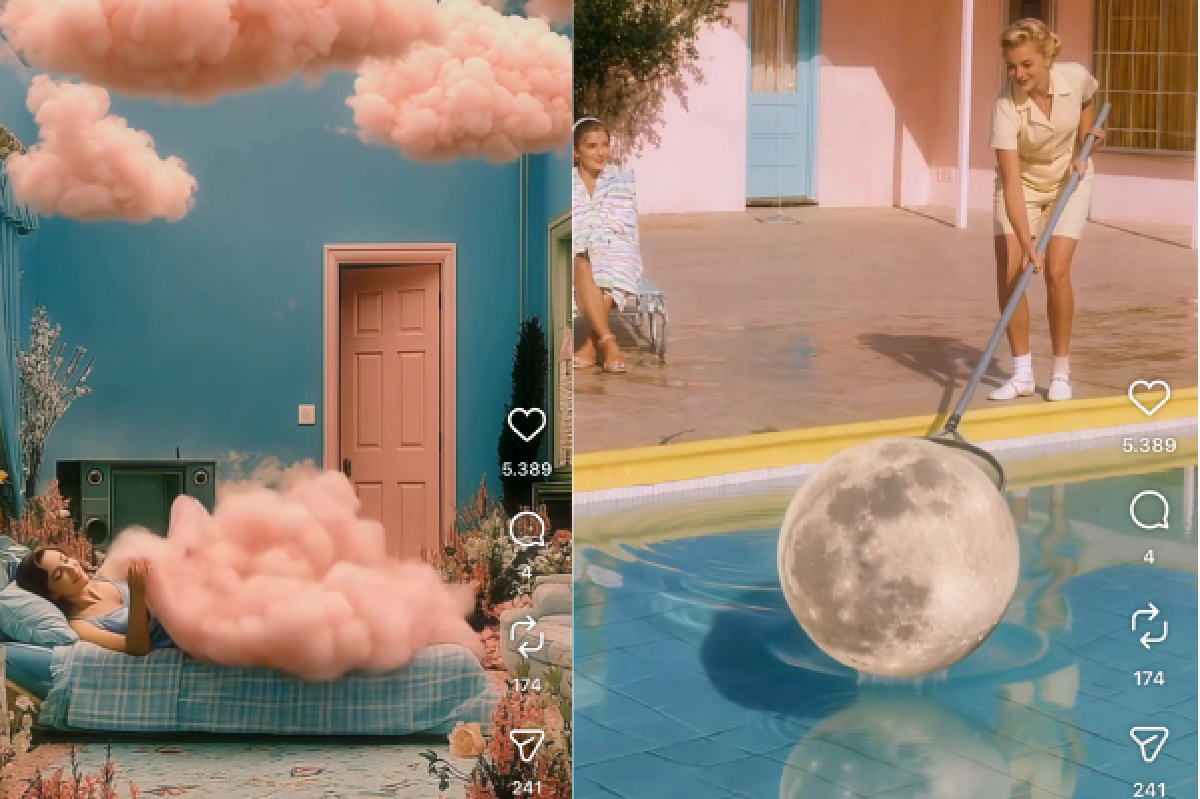
Social media timelines are increasingly awash with ethereal, pastel-hued landscapes, populated by impossibly fluffy clouds being laundered and whimsical structures leading nowhere. This burgeoning aesthetic, dubbed "Dreamcore," presents a curious paradox: a blend of childlike wonder and subtle unease. Crafted entirely by artificial intelligence, these digital reveries are captivating millions, yet simultaneously sparking a critical conversation about the future of our digital leisure, the influence of tech giants, and the very nature of our collective imagination.
What begins as a seemingly innocuous video of soft clouds being air-dried, then sold in a surreal supermarket, set against a backdrop of gently suspenseful piano music, quickly morphs into an exploration of pastel houses and impossible streetscapes. These AI-generated vignettes, while undeniably charming, often evoke a peculiar cocktail of comfort and disquiet. "These are dreams, exactly as we imagined them as children," reads a popular comment under one such video, encapsulating the deep-seated nostalgia and innocent appeal that underpins the "Dreamcore" phenomenon. Yet, as delightful as these algorithmically generated fantasies may appear, their pervasive nature prompts a deeper look into their origins, implications, and the broader digital ecosystem they inhabit.
Main Facts: The Rise of an AI-Generated Aesthetic
"Dreamcore" is more than just a passing trend; it represents a significant milestone in the popularization of AI-generated content. Characterized by its soft color palettes—pinks, blues, lavenders—and a distinctively surreal quality, it conjures scenes that defy physical laws, resembling a child’s imaginative drawing brought to life by advanced algorithms. Common motifs include oversized, anthropomorphic clouds, floating islands, buildings with non-Euclidean geometry, and objects interacting in whimsical, illogical ways. The overall effect is one of serene fantasy, a digital escape into a world unburdened by reality.
Platforms like Instagram and TikTok have become fertile ground for "Dreamcore" content, with videos and images racking up millions of views and engagements. Users are drawn to its soothing visuals, the sense of escapism it provides, and the intriguing blend of familiarity and strangeness. The phenomenon demonstrates the remarkable capability of generative AI models, such as Midjourney, DALL-E, and Stable Diffusion, to interpret and synthesize complex aesthetic prompts into visually coherent and emotionally resonant outputs. These tools, accessible to a growing number of creators, have democratized the production of highly stylized digital art, moving it from the exclusive domain of professional artists to the fingertips of everyday users.
However, beneath the comforting pastel surface lies a crucial point of contention: this entire aesthetic is a product of artificial intelligence. It is not born from human dreams or artistic expression in the traditional sense, but from complex algorithms trained on vast datasets of existing imagery and text. This realization introduces a layer of cognitive dissonance for many viewers. While the immediate reaction might be one of delight and immersion, a subsequent awareness of its artificial genesis can trigger a sense of unease. It raises fundamental questions about authenticity, originality, and the increasing blurring of lines between human creativity and machine simulation. The "Dreamcore" trend, therefore, is not merely a visual spectacle but a powerful indicator of AI’s growing capacity to shape our aesthetic preferences and potentially redefine our understanding of reality itself.
Chronology: From Digital Doodles to Dreamscapes
The journey to "Dreamcore" is rooted in the broader evolution of digital art, internet aesthetics, and artificial intelligence. Understanding its emergence requires tracing several interconnected timelines.
Early Forays into Algorithmic Art (Mid-20th Century to 2000s): The concept of machines creating art is not new. Early pioneers in the mid-20th century experimented with algorithms to generate visual patterns. These early attempts were often abstract and rudimentary, driven by mathematical principles rather than artistic intent. The rise of computer graphics in the late 20th century further expanded the possibilities, allowing artists to create digital landscapes and characters, albeit often through laborious manual processes. Generative art, where an artist defines a set of rules and a system creates the artwork, gained traction in academic and experimental art circles, laying the conceptual groundwork for AI’s creative capabilities.
The Rise of Internet Aesthetics (2010s): The 2010s saw the explosion of distinct "internet aesthetics" like Vaporwave, Seapunk, Cottagecore, and Dark Academia. These movements were often characterized by specific visual styles, musical accompaniments, and cultural touchstones, forming niche communities on platforms like Tumblr, Pinterest, and later Instagram. These aesthetics demonstrated the power of collective digital curation and the human desire to categorize and inhabit visually distinct online spaces. They proved that digital environments could foster strong cultural identities and visual languages, setting a precedent for how a new aesthetic like "Dreamcore" could organically spread and define itself.
The Generative AI Revolution (Late 2010s – Present): The true catalyst for "Dreamcore" lies in the rapid advancements of generative artificial intelligence.
- GANs (Generative Adversarial Networks): Developed by Ian Goodfellow in 2014, GANs allowed two neural networks to compete against each other—one generating images and the other trying to distinguish them from real images—leading to increasingly realistic outputs. Early GANs could generate faces or simple objects.
- Transformer Models and Diffusion Models (Early 2020s): The development of transformer architectures, initially for natural language processing, later influenced image generation. More recently, diffusion models (like those behind DALL-E 2, Midjourney, and Stable Diffusion) have revolutionized the field. These models learn to generate images by progressively denoising a random image, guided by a text prompt. This breakthrough made it possible for users to generate highly complex, nuanced, and stylistically consistent images and short videos from simple text descriptions.
The Emergence of "Dreamcore" (Recent Years): Against this backdrop, "Dreamcore" began to solidify as a recognizable aesthetic. While elements of surreal, pastel imagery have existed online for years, the specific combination of AI-generated content with the "dreamlike" narrative gained significant traction in the last 1-2 years. Users, experimenting with new AI art tools, discovered that prompts related to "childhood dreams," "liminal spaces," "pastel surrealism," and "comfort" often yielded results that resonated with a collective yearning for escape and nostalgia. The algorithms, in turn, learned from user engagement, optimizing for these visual cues and further propagating the style. The narrative of "dreams as children imagined them" quickly became a unifying theme, offering an emotional hook to the technologically sophisticated yet emotionally resonant visuals.

The Metaverse Connection: The rise of "Dreamcore" also occurs parallel to, and perhaps in contrast with, the grand visions of immersive digital worlds like Mark Zuckerberg’s Metaverse. While Meta’s ambition for a fully interactive, persistent virtual reality faced significant challenges and skepticism (leading to substantial financial losses and a re-evaluation of its immediate feasibility), the underlying desire for new forms of digital existence and engagement remained. "Dreamcore," in a sense, offers a more accessible, passive form of digital escapism, a curated aesthetic experience that doesn’t demand VR headsets or complex interactions, but rather a simple scroll through a feed. It highlights a continuing fascination with synthetic realities, whether they are fully immersive worlds or algorithmically curated dreamscapes.
Supporting Data: The Mechanics of Algorithmic Allure
The widespread appeal of "Dreamcore" is not accidental; it is deeply intertwined with the sophisticated mechanisms of social media algorithms, human psychology, and the economic drivers of the AI industry.
Algorithmic Reinforcement: Social media platforms are designed to maximize engagement. When a user pauses on a "Dreamcore" video, likes it, shares it, or comments on it, the algorithm notes this preference. It then serves up more similar content, creating a feedback loop that reinforces the trend. The sheer volume of AI-generated content available, combined with the ease of its creation, means that platforms can quickly saturate feeds with these aesthetics once they gain initial traction. This algorithmic curation ensures that "Dreamcore" isn’t just a niche interest but a pervasive phenomenon that reaches millions, effectively shaping collective aesthetic tastes.
Psychological Underpinnings: The appeal of "Dreamcore" taps into several fundamental human psychological needs:
- Nostalgia and Innocence: The recurrent theme of "childhood dreams" resonates deeply. In an increasingly complex and often harsh real world, the pastel innocence and surreal whimsy offer a comforting escape, a return to a perceived simpler time when imagination knew no bounds.
- Escapism: "Dreamcore" provides a potent form of escapism. Its impossible landscapes and gentle narratives offer a temporary reprieve from daily stressors, anxieties, and the mundane. It allows viewers to passively immerse themselves in a world free from the constraints and responsibilities of reality.
- Aesthetic Pleasure: The soft colors, flowing forms, and often serene imagery are inherently pleasing to the eye. The aesthetic is gentle, non-threatening, and visually harmonious, contributing to a sense of calm and relaxation.
- The Uncanny Valley Effect (and its inverse): While some AI-generated content falls into the "uncanny valley"—being almost human-like but subtly off, causing revulsion—"Dreamcore" often operates in a different, softer zone. Its deliberate surrealism and clear departure from reality avoid the uncanny valley of realism, instead creating a whimsical "otherness." However, the knowledge that it’s AI-generated can introduce a subtle unease, a cognitive dissonance between the comforting visuals and the artificial origin, leading to the "mix of unease and joy" described by the author.
Economic and Tech Landscape: The rise of "Dreamcore" is also a testament to the rapid advancements and economic potential of the generative AI industry.

- Investment and Innovation: Billions are being poured into AI research and development, leading to increasingly powerful and user-friendly tools. Companies like OpenAI (DALL-E), Midjourney Inc. (Midjourney), and Stability AI (Stable Diffusion) are at the forefront, constantly improving their models and expanding their capabilities.
- Data Collection and Refinement: Every interaction with AI-generated content provides valuable data. User preferences, prompts that lead to popular images, and engagement metrics all feed back into the training data for future AI models, making them even more adept at generating content that resonates with human tastes.
- Monetization Avenues: "Dreamcore" and similar AI aesthetics open up new monetization avenues. Influencers can generate vast amounts of content quickly. Brands can leverage AI to create unique marketing campaigns. Platforms benefit from increased user engagement, which translates into advertising revenue. The commercial potential of easily generated, highly engaging visual content is immense, further incentivizing its creation and propagation.
- Cultural Reflection: On a broader cultural level, the popularity of "Dreamcore" might reflect a collective societal yearning. In an era marked by climate anxiety, political polarization, and economic uncertainty, the desire for safe, predictable, and aesthetically pleasing escapism is understandable. "Dreamcore" offers a digital balm, a curated fantasy that promises comfort, even if it’s an illusion.
Official Responses and Industry Perspectives
The proliferation of AI-generated aesthetics like "Dreamcore" elicits varied responses from different stakeholders, ranging from enthusiastic adoption to cautious skepticism and outright critique.
Tech Giants and Developers: For companies investing heavily in generative AI, the "Dreamcore" trend is largely seen as a validation of their technology and a proof of concept for AI’s creative potential. They view it as a demonstration of how AI can empower users, foster new forms of expression, and drive engagement on their platforms. From their perspective, such trends signify progress towards a future where AI plays a central role in content creation and digital interaction. Mark Zuckerberg’s initial vision for the Metaverse, despite its setbacks, implicitly relied on the idea of creating rich, engaging virtual environments, a goal that AI-generated aesthetics could theoretically help fulfill. Their primary focus remains on refining algorithms, expanding capabilities, and integrating AI tools more deeply into their user interfaces, often with an emphasis on "democratizing creativity."
Artists and Creative Communities: The response from human artists and the broader creative community is far more nuanced and often critical. While some embrace AI as a new tool to augment their creative process, many express deep concerns:
- Originality and Authorship: Questions abound regarding who "owns" AI-generated art. If an AI creates an image based on countless human-made artworks, where does the originality lie? Does the prompt engineer deserve full credit?
- Ethical Sourcing of Data: A major concern revolves around the datasets used to train these AI models. Many artists argue that their copyrighted work has been scraped from the internet without consent or compensation, effectively using their labor to train systems that could eventually displace them.
- Job Displacement: There’s a palpable fear that AI, capable of generating high-quality art quickly and cheaply, could lead to job losses for graphic designers, illustrators, concept artists, and other creative professionals.
- Dilution of Creativity: Some argue that the ease of AI generation could lead to a homogenization of aesthetics, a proliferation of "AI slop" that lacks the depth, nuance, and genuine human experience embedded in traditional art.
Ethicists and Academics: Researchers and ethicists raise broader societal and philosophical questions:
- Authenticity and Truth: As AI-generated content becomes indistinguishable from human-created content, how do we discern what is real? This concern extends beyond aesthetics to deepfakes and misinformation, potentially eroding trust in digital media.
- Data Privacy and Surveillance: The development and deployment of advanced AI models often rely on vast amounts of data, raising questions about how this data is collected, stored, and used. In the context of "Dreamcore," user preferences and interactions could be used to create highly personalized (and potentially manipulative) digital experiences.
- Algorithmic Bias: If training data contains biases, the AI will perpetuate them. While less immediately apparent in "Dreamcore," this is a pervasive concern across all AI applications.
- The Nature of Human Experience: Philosophers question what it means for humans to outsource their dreams, fantasies, and even creativity to machines. Does it enrich or diminish our capacity for imagination and genuine emotional connection?
User Reactions Beyond the Surface: While many users express simple delight, a significant portion also vocalize the "unsettling" or "creepy" aspect. Comments often describe the content as "liminal," "eerie," or "too perfect." This duality highlights a collective subconscious grappling with the implications of AI. The comfort is sought, but the artificiality is sensed, creating a fascinating tension that speaks to our innate human need for authenticity, even when presented with a beautiful illusion.

Implications: The Future of Our Digital and Real Worlds
The "Dreamcore" phenomenon, far from being a mere fleeting trend, carries profound implications for the future of digital aesthetics, human creativity, our understanding of reality, and the very structure of our leisure time.
The Normalization of AI-Generated Realities: "Dreamcore" is a precursor to a world where AI-generated content is not an anomaly but a norm. As these technologies become more sophisticated, accessible, and integrated into our daily digital lives, we may find ourselves increasingly immersed in algorithmically curated realities. The question shifts from if AI will create our digital environments to how it will shape our perceptions within them. Will our feeds become entirely bespoke, offering only what algorithms predict we desire, potentially creating echo chambers of aesthetic preference?
Impact on Human Creativity and Labor: The debate over AI’s impact on human creativity will intensify. While AI can certainly be a powerful tool for artists, assisting with ideation, rendering, and even generating initial concepts, its capacity to autonomously produce polished content raises legitimate concerns about the value of human artistic labor. If "AI slop"—a term used to describe generic, algorithmically generated content—becomes pervasive and economically viable, how will human artists differentiate themselves, and how will their work be valued? There’s a risk of a "race to the bottom" in terms of creative compensation, as AI offers speed and scale that humans cannot match. This could lead to a further commodification of art, where unique human expression is devalued in favor of mass-produced, algorithmically optimized aesthetics.
Blurring the Lines Between Real and Simulated: The "Dreamcore" aesthetic, with its deliberate surrealism, already plays with the boundaries of reality. But as AI models become more capable of generating hyper-realistic content, the distinction between what is real, what is human-created fiction, and what is AI-generated simulation will become increasingly blurred. This has significant implications for our cognitive processes and our ability to critically assess information. If our "dreams" are outsourced to algorithms, what happens to our capacity for genuine imagination, for wrestling with the messy, unpredictable beauty of the real world? The danger is not just misinformation, but a subtle erosion of our connection to objective reality and an increased reliance on curated, often idealized, digital substitutes.
The Consumerism of Comfort and Passive Engagement: "Dreamcore" offers a form of passive consumption. It’s aesthetically pleasing and comforting, but it doesn’t demand critical thinking, active participation, or deep engagement. If our leisure time becomes dominated by such easily digestible, algorithmically-served content, it could foster a culture of perpetual comfort-seeking, where genuine challenges, complex narratives, or the discomfort of reality are avoided in favor of digital palliatives. This aligns with the business models of many tech giants, who benefit from maximizing screen time and passive engagement. The initial warning in the original article about tech giants profiting from a world reduced to "AI slop" becomes particularly salient here.

Re-evaluating the Metaverse and Immersive Digital Futures: While Zuckerberg’s Metaverse encountered significant hurdles, the underlying ambition to create immersive digital environments persists. Trends like "Dreamcore" can be seen as either a less ambitious, more palatable stepping stone towards such worlds, or as a distraction from their more complex challenges. If people are content with passively scrolling through AI-generated dreamscapes, will there be less impetus for the active, interactive, and often clunky experiences offered by current VR/AR technologies? Conversely, the proficiency of AI in generating captivating visuals could eventually breathe new life into Metaverse concepts, offering dynamic and endlessly customizable environments.
Ultimately, the "Dreamcore" phenomenon serves as a powerful reminder of the double-edged sword of technological progress. While AI offers unprecedented tools for creativity and escapism, it also necessitates a critical examination of its societal implications. The author’s poignant call to appreciate "real rain clouds in the beech forests near Neustrelitz" instead of pastel AI illusions is not just a romantic plea for nature; it’s a profound reminder to remain anchored in the tangible world, to cherish authentic experiences, and to actively resist the gravitational pull of algorithmically curated comfort. As we navigate an increasingly AI-saturated future, the ability to discern, to question, and to choose genuine engagement over passive consumption will be paramount to preserving our humanity and our collective imagination.