By Tech Insights Bureau
The Open Compute Project (OCP) Global Summit 2026 has served as the definitive stage for a monumental shift in data center architecture. As the demand for generative AI and agentic computing continues to exert unprecedented pressure on global infrastructure, Intel has responded with a dual-pronged strategy: the official launch of the high-performance D270 GPU (codenamed "Crescent Island") and a bold return to ultra-dense CPU-only server racks.
In a landscape where competition from rivals like AMD has reached a fever pitch, Intel’s latest announcements aim to reclaim leadership in both raw compute density and specialized AI acceleration.
The Resurgence of the CPU-Centric Rack
While the industry has been fixated on GPU-accelerated clusters, Intel’s announcement at the OCP Summit highlights a crucial reality: the foundational work of AI—data preparation, logic processing, and general-purpose computing—still relies heavily on the CPU.
Intel has unveiled a server architecture capable of housing 46,080 cores within a single rack, powered by its latest "Xeon 6+" processors, specifically the "Clearwater Forest" series. These chips are manufactured using Intel’s cutting-edge 18A process technology, offering an impressive density of up to 288 cores per socket.
Architectural Breakdown: Scaling to 46,000+ Cores
To achieve this density, Intel has utilized a dual-socket motherboard configuration. Given that each Clearwater Forest processor delivers 288 cores, a single server blade can house 576 cores. By integrating 80 of these boards into a deep-chassis rack, Intel hits the 46,080-core milestone.
This design utilizes modern, high-depth server blades that maximize vertical space, a standard now common among hyperscalers. The efficiency of this deployment is a key talking point for Intel; the company asserts that a fully populated rack of this magnitude operates at a power envelope of approximately 133.45 kW. This is a critical metric for data center operators who are increasingly constrained by the "power wall"—the physical limit of electricity a single rack can consume without requiring specialized, ultra-expensive cooling infrastructure.
The D270 GPU: Enter "Crescent Island"
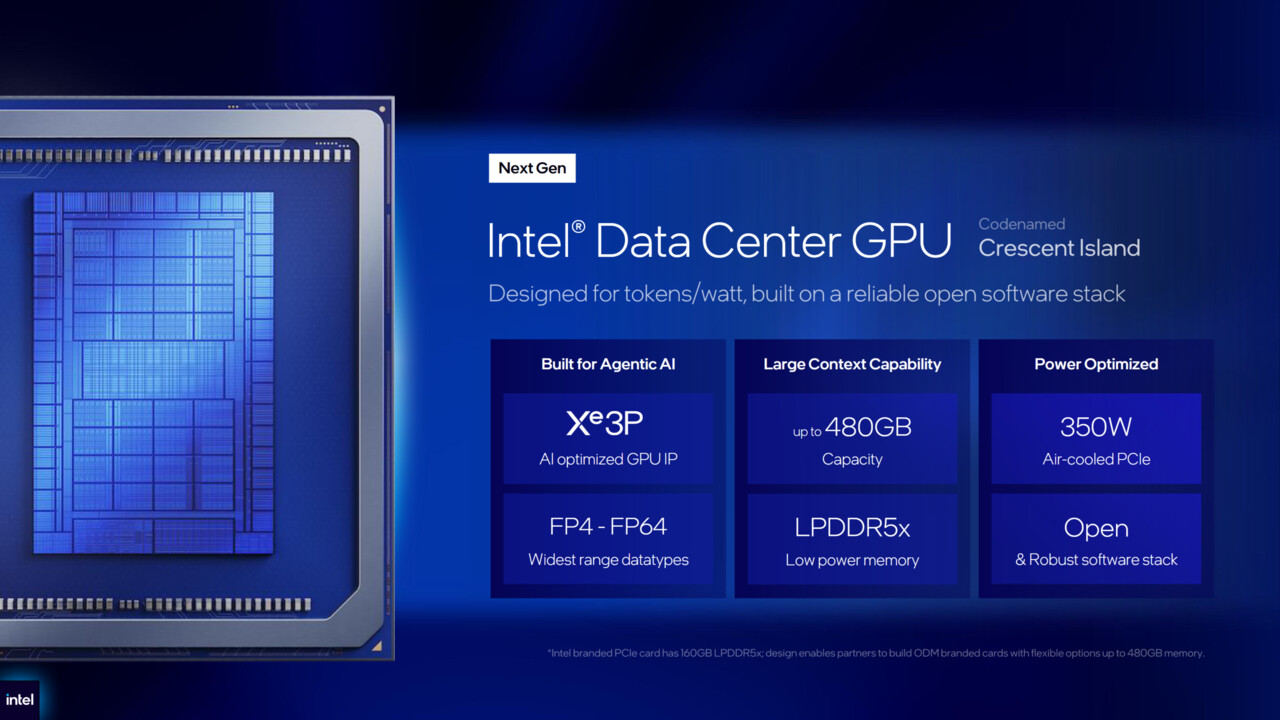
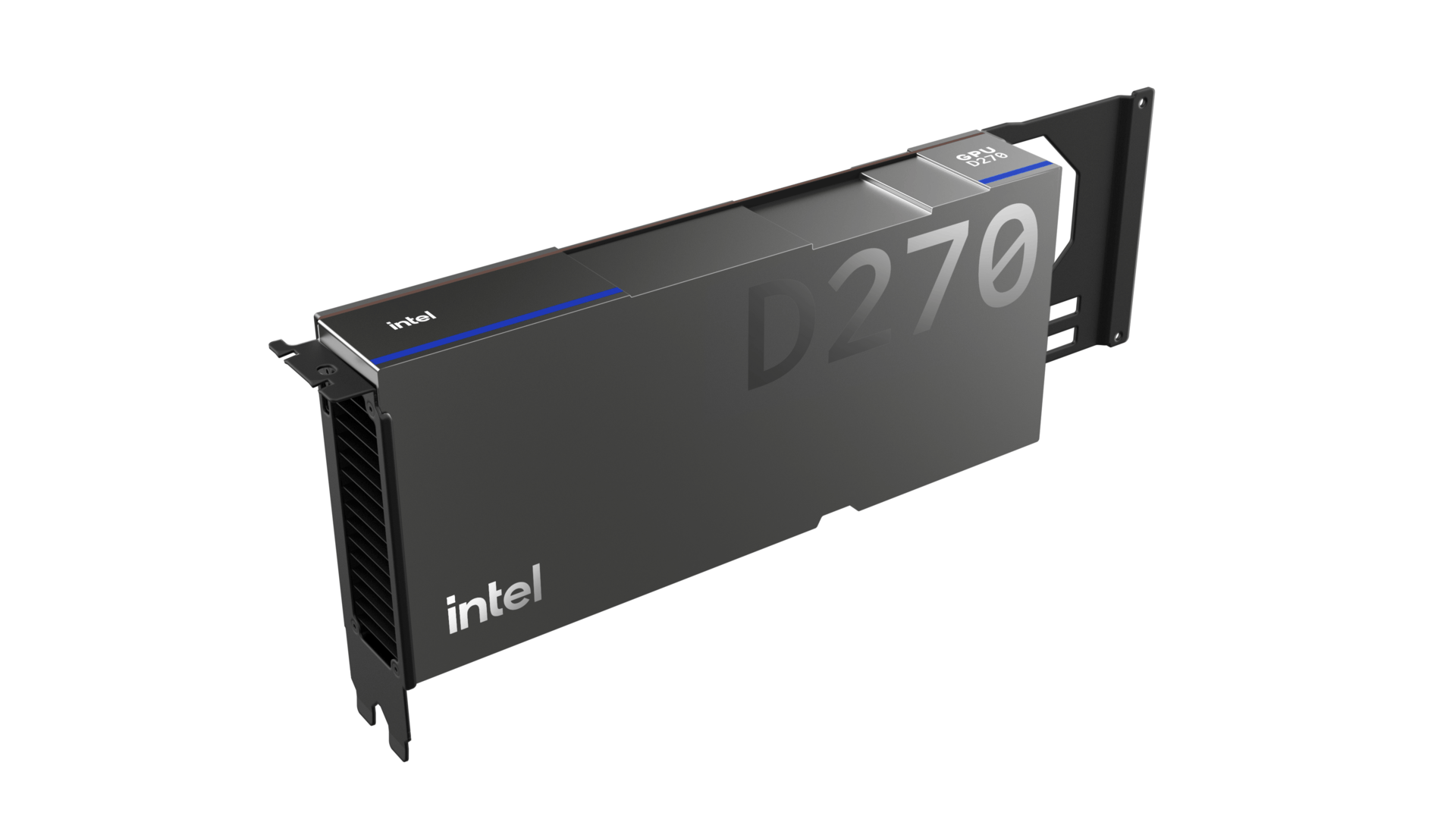
If the Xeon 6+ racks are the muscle, the new D270 GPU is the intelligence. Based on the long-awaited Xe3P architecture, the D270—codenamed "Crescent Island"—is designed to handle the heavy lifting of modern AI workloads, specifically focusing on inference and large-scale model training.
Technical Specifications
- Architecture: Xe3P (Crescent Island)
- Memory: Up to 480 GB of LPDDR5X
- Bandwidth: 1.5 TB/s
- Performance: 1.3 Petaflops (FP8)
- Power Efficiency: 350W TDP
The choice of LPDDR5X, combined with a staggering 1.5 TB/s of bandwidth, suggests that Intel is prioritizing memory throughput for memory-bound AI tasks. By capping the TDP at 350W, Intel is positioning the D270 as a highly efficient accelerator, suitable for dense server configurations where heat dissipation is a primary concern.
Competitive Chronology: The Race for Density
The OCP Summit 2026 comes on the heels of several major industry shifts. To understand the significance of Intel’s announcement, one must look at the recent timeline of the "Core Wars."
- Early 2026: AMD begins teasing its "Helion" platform, signaling a shift toward high-core-count CPU racks tailored for the burgeoning "Agentic AI" era.
- July 2026 (AMD Advancing AI): Partners showcase density-focused systems using the "Venice" processor architecture. These systems reached 43,008 Zen-6 cores across 42 blades.
- Late 2026 (HPE/AMD developments): High-Performance Computing (HPC) providers pushed the limits further, unveiling racks with 81,920 cores via 40 blades. However, these systems came with a massive power trade-off, consuming up to 400 kW—nearly triple the power draw of Intel’s new 46k-core solution.
- October 2026 (OCP Summit): Intel formally enters the fray, emphasizing that they can match the necessary core counts while maintaining a superior power-efficiency profile.
The competition is no longer just about who can fit the most silicon into a rack; it is about who can achieve the best performance-per-watt. While HPE’s 81k-core rack is a technical marvel, its 400 kW draw makes it difficult to deploy at scale in standard data centers. Intel’s focus on the 133 kW tier suggests they are targeting the "sweet spot" for enterprise data centers.
Official Perspective and Partner Ecosystem
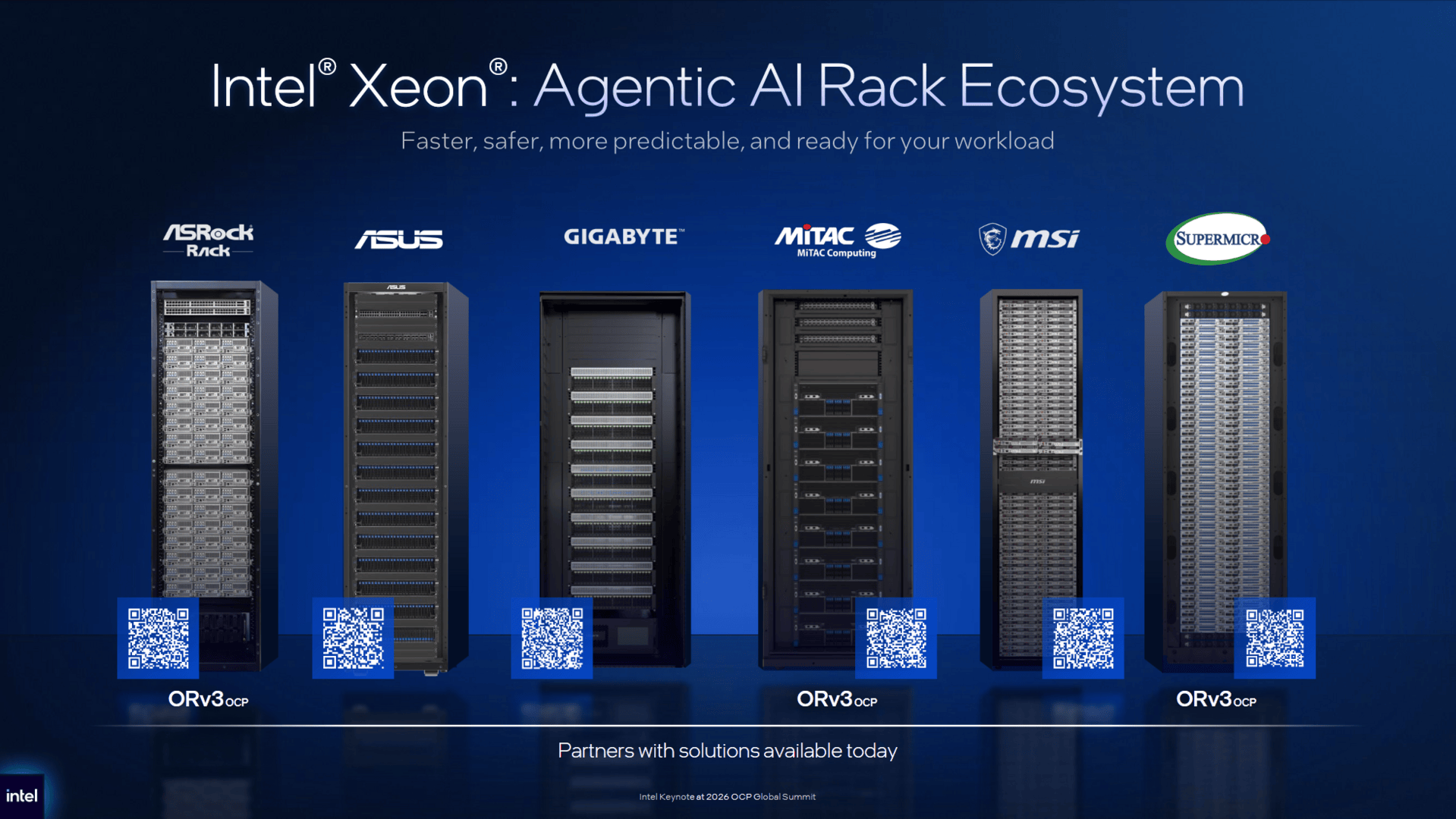
Intel has been vocal about the "ready-to-deploy" nature of the D270 series. Unlike early-stage research projects, the ecosystem surrounding Crescent Island is already robust. During the OCP presentation, Intel displayed a wide array of support from major server OEMs and cloud service providers.
"The AI era is not waiting for the hardware," a company spokesperson noted during the briefing. "Every unit we produce is essentially pre-sold. The demand for specialized silicon that doesn’t melt the power grid is the primary driver for our current manufacturing roadmap."
The fact that Intel managed to secure widespread partner support before the official launch highlights their success in aligning their software stack (oneAPI) with the hardware capabilities of the Xe3P architecture.
Strategic Implications: What This Means for the Industry
The shift toward these high-density CPU-GPU hybrid racks has profound implications for the future of cloud computing and private AI infrastructure.
1. The Death of the General-Purpose Server?
We are moving away from the "one-size-fits-all" server rack. The industry is bifurcating into two distinct paths:
- Compute-Dense CPU Racks: Targeted at virtualization, database management, and the logic-heavy "thinking" phase of Agentic AI.
- Accelerator-Heavy GPU Racks: Targeted at training, fine-tuning, and massive parallel matrix multiplications.
Intel’s strategy of releasing high-density Xeon racks alongside the D270 suggests they intend to be the primary provider for both halves of this equation.
2. Sustainability and the Power Crisis
As data centers consume an increasingly large percentage of global energy, the battle for efficiency is the new "Moore’s Law." Intel’s 133 kW rack is a direct answer to the concerns of data center operators who are running out of power capacity. If Intel can prove that their Xeon 6+ platform delivers better TCO (Total Cost of Ownership) than competitors by drawing less power per core, they will secure a significant advantage in the lucrative hyperscaler market.
3. The 18A Manufacturing Edge
The use of the 18A process node for Clearwater Forest is a high-stakes gamble for Intel. By moving to this process, Intel is betting that their foundry services can keep up with the demand. If yields remain high, Intel will have a clear performance-per-watt lead over competitors still relying on older process nodes.
Conclusion: The Path Ahead
The announcements at OCP 2026 clarify that the "AI Gold Rush" has entered its industrialization phase. It is no longer enough to have an AI chip; one must have an AI system—a rack, a cooling strategy, and a software ecosystem that can be dropped into a data center and put to work immediately.
Intel’s D270 "Crescent Island" GPU and its 46,080-core Xeon server racks represent a comprehensive answer to the infrastructure challenges of 2026. While AMD continues to push the boundaries of raw core counts and HPE remains the leader in HPC-grade supercomputer density, Intel is positioning itself as the king of the balanced, efficient, and scalable enterprise data center.
As we look toward 2027, the focus will undoubtedly shift from "How many cores can we fit?" to "How quickly can we train the next generation of agents?" With these new tools, Intel has ensured that the hardware will not be the bottleneck in that pursuit.
Note: The information contained in this report was provided by Intel under a non-disclosure agreement (NDA) prior to the official commencement of the OCP Global Summit. There was no manufacturer influence on the content of this article, nor was there any obligation to report. The only requirement stipulated by the NDA was the embargo on the publication time.