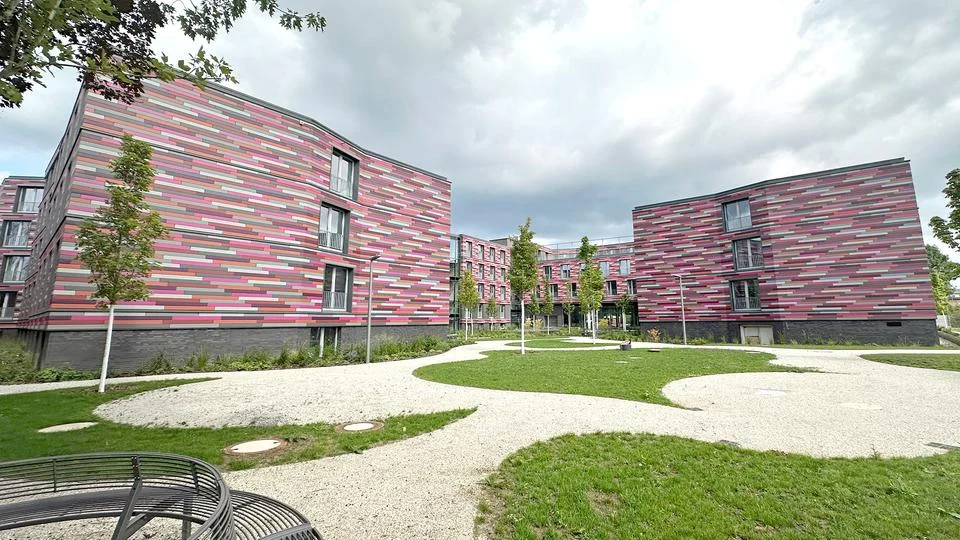
For three years, the sleek, striped façade of the "Westside" student residence on Bernhard-Itzel-Straße in Giessen has served as a silent monument to one of the most frustrating construction failures in the region’s recent history. What was intended to be a flagship project for modern, sustainable, and affordable student living became, instead, a multi-million-euro ghost building.
After years of stagnation, silence, and structural uncertainty, the Studierendenwerk Giessen has finally announced a breakthrough: the first students are scheduled to move into the facility this October. While this marks a long-awaited turning point, the project remains a cautionary tale of planning ambition clashing with technical reality.
The Vision: A Prestigous Housing Project
The "Westside" residence was never intended to be just another dormitory. Designed to house approximately 350 students, the project was billed as a blueprint for the future of student living. The facility promised to combine energy-efficient architecture with a modern, car-free living concept, catering to the evolving needs of the university population.
With a total budget of 31 million euros—supported by 16.6 million euros in funding from the State of Hesse—the expectations were high. The project was meant to alleviate the acute pressure on the Giessen housing market, where demand for affordable student accommodation consistently outstrips supply. However, in early 2023, just as the project neared its final stages, the entire endeavor ground to a halt. A significant, structural defect rendered the building uninhabitable, leading to a total vacancy that has persisted for years.
Chronology of a Construction Crisis
The origins of the disaster trace back to the building’s most touted feature: its modular design. To streamline construction, the architects opted for prefabricated bathroom units—small, self-contained pods that were lifted into the raw structure of the building via crane.
- The Inception: The "Westside" project was launched with the goal of providing 351 units, each featuring a private bathroom, setting a new standard for independence and privacy in student housing.
- The Discovery (2023): Upon inspection, it was discovered that the prefabricated bathrooms were fundamentally defective. The seals were insufficient, leading to widespread water ingress throughout the building.
- The Remediation Phase: The damage was catastrophic. To address the leaks, nearly every pipe in the building had to be replaced. In many areas, the floor screed had to be ripped out entirely to access the underlying infrastructure, effectively turning a "finished" building back into a construction site.
- The Current Outlook (2024): After extensive remediation, the Studierendenwerk has confirmed a staggered opening. In October, the first 130 units will be opened to residents, with the remainder of the building expected to be fully functional by mid-2027.
The Financial and Legal Quagmire
The question of "who is to blame" remains the most contentious aspect of the "Westside" story. The Studierendenwerk has confirmed that the search for the root cause of the failure—and the subsequent liability—remains unresolved.
Multiple independent expert reports have been commissioned, but according to the Studierendenwerk, these findings are contradictory, leading to a complex web of legal disputes. Rather than becoming embroiled in a years-long "preservation of evidence" procedure—which would have forced the construction site to remain idle indefinitely—the Studierendenwerk opted for a pragmatic, albeit painful, path.
"We have agreed with all parties involved to prioritize completion over fault-finding," explained Managing Director Gero Lottermann. "Once the roof is on, in the truest sense of the word, we will look at the remaining disputes between the parties."
This decision, while necessary to provide housing for students, comes at a high price. The extended vacancy has caused costs to balloon. While the exact final figure for the extra costs remains unquantifiable at this stage, Lottermann admits, "We are bearing the additional costs, and that hurts us." The planning bureau involved has declined to comment, citing the ongoing legal proceedings.
Supporting Data: The Desperate Need for Space
The frustration surrounding the "Westside" delay is magnified by the reality of the Giessen housing market. With over 35,000 students enrolled across the Justus-Liebig-University, the Technical University of Middle Hesse (THM), and smaller institutions, the city is a major educational hub.
Gabriel Abdi, a representative for the General Student Committee (AStA), notes that the situation for students has become increasingly dire. "I have lived in Giessen for several years, and I’ve watched the situation reach a breaking point," Abdi states. "Rents have risen by 20 to 30 percent in that time. Some students are living at the poverty line; they are dependent on these dormitories to survive."
The target set by the Hessian student unions is to provide housing for approximately 10 percent of the student body in university cities. Currently, only Marburg comes close to meeting this goal. In cities like Frankfurt, Darmstadt, Kassel, and Giessen, the shortfall is measured in thousands. In Giessen alone, there is a waiting list of over 700 students for existing facilities. With the Studierendenwerk managing only 2,678 spaces, the addition of the "Westside" units is not a luxury, but a vital necessity for the city’s social infrastructure.
Implications: A Model for the Future?
Despite the "Westside" debacle, the fundamental shift in student preferences remains clear. The demand for large shared flats with communal bathrooms is declining; today’s students overwhelmingly prioritize self-contained, furnished single apartments.
The "Westside" project reflects this, with its 351 units designed as individual apartments with small kitchenettes, alongside 19 four-person shared flats. Furthermore, the project attempts to set a standard for sustainable urban living. The site is intended to be entirely car-free, requiring residents to sign a "car-waiver declaration." To compensate, the facility provides extensive bicycle infrastructure, including 351 indoor bike parking spaces, charging stations for e-bikes, and repair stations.
Lessons Learned
The failure of the "Westside" has prompted a period of reflection for the Studierendenwerk. While prefabricated units are standard in modern, efficient construction, the lesson learned in Giessen is one of vigilance.
"Normally, prefabricated bathrooms are a good idea for efficient and sustainable building," noted the Studierendenwerk. "For future projects, we will be looking much more closely to ensure everything is truly watertight."
For student representative Gabriel Abdi, the experience is a stark reminder that efficiency should never come at the cost of quality. "We hope there are consequences, and that a mistake like this is never made again," he said. "It was an incredibly expensive lesson for everyone involved."
Conclusion
As October approaches, the "Westside" is finally set to transition from a cautionary tale to a functioning home. For the first 130 students who receive their keys, the long wait will be over. However, the shadow of the three-year delay—and the millions of euros lost in the process—will remain a significant point of discussion for the Studierendenwerk and the stakeholders of the State of Hesse for years to come.
The project stands as a testament to the fact that, in the high-stakes world of urban development, the most modern plans are only as good as the seals on the pipes. As Giessen continues to grow, the "Westside" will be remembered not just for the students it houses, but for the hard lessons it taught about accountability, oversight, and the true cost of "efficiency" in public construction.