

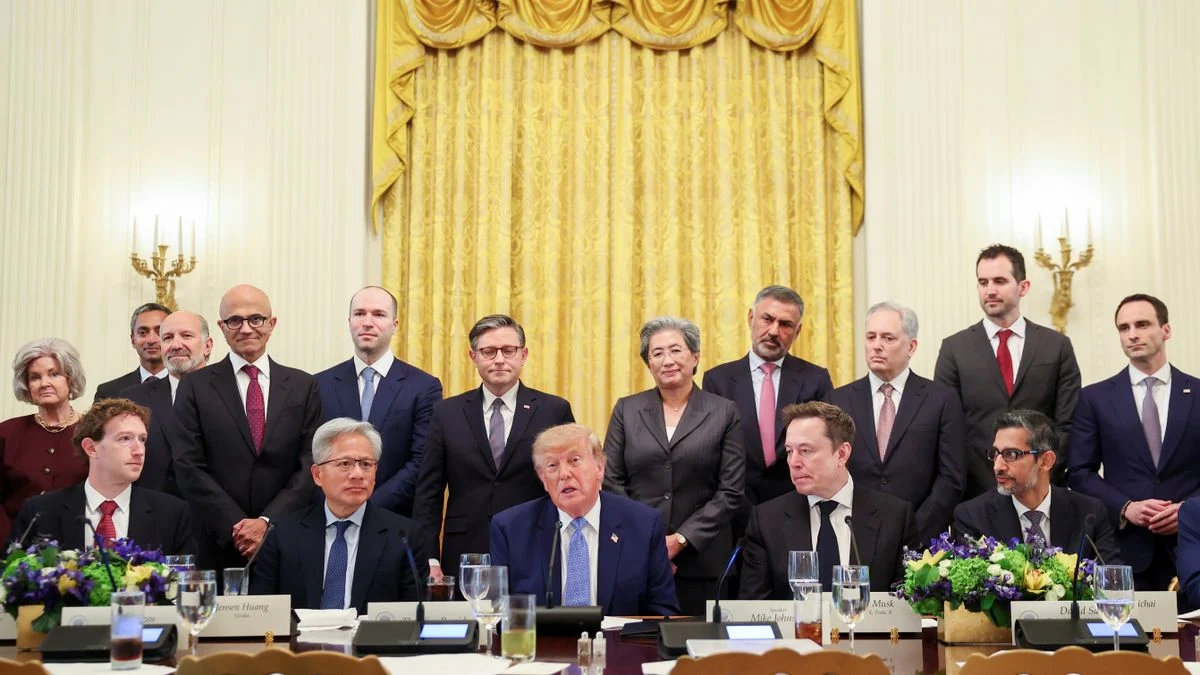
In a display of political theater and strategic alignment that underscores the shifting power dynamics of the American economy, President Donald Trump hosted an elite gathering of artificial intelligence (AI) pioneers at the White House this week. The event, dubbed the "Super Intelligence Luncheon," served as both a policy platform and a vivid demonstration of who currently occupies the inner circle of the Trump administration’s tech orbit.
The meeting, held in the historic East Room, brought together the architects of the modern AI revolution—men and women whose companies are currently racing to define the future of global technological supremacy. Yet, as the cameras clicked and the CEOs posed, the substance of the meeting was arguably secondary to the choreography of the event itself. With the President at the helm, the message was clear: the era of stringent AI oversight is, for now, being traded for a model of industry-led self-regulation.
The Hierarchy of Influence: A Seat at the Table
For the tech industry, physical proximity to power has always been a proxy for political relevance. The seating chart for Tuesday’s luncheon, which President Trump personally broadcast on his Truth Social platform, left little room for interpretation regarding the administration’s current priorities.
Nvidia CEO Jensen Huang and serial entrepreneur Elon Musk were positioned in the most coveted seats—directly beside the President. Their proximity is hardly a coincidence. Nvidia, as the primary supplier of the high-end processing chips that power modern generative AI, is the backbone of the current technological infrastructure. Musk, meanwhile, has emerged as one of the most vocal and politically influential figures in the tech sphere, positioning himself as a key advisor to the Trump administration.
Surrounding them were the titans of the established tech order: Meta’s Mark Zuckerberg, Google’s Sundar Pichai, and Amazon founder Jeff Bezos. These leaders, representing the "Big Tech" entities that have historically faced significant regulatory scrutiny, seemed eager to signal their alignment with the administration’s pro-innovation, anti-regulation stance.

The Shift to "Super Intelligence": Policy and Rhetoric
The central policy outcome of the luncheon was a pivot away from federal regulation. Rather than drafting binding legislation to curb the potential existential risks of AI—an approach championed by many academics and civil society groups—the Trump administration has opted for a voluntary code of conduct.
During the summit, Trump dismissed the necessity of heavy-handed government mandates, labeling them as "innovation inhibitors." He argued that strict compliance burdens would merely handicap American companies, handing a decisive advantage to China in the ongoing global AI arms race.
"We are leading, and we intend to stay that way," the 80-year-old President stated, characterizing the industry’s commitment to self-regulation as a "morally binding" pact. In a move that signaled his intent to rebrand the entire field, Trump announced an executive decree intended to transition the nomenclature of artificial intelligence to "Super Intelligence"—a term he believes better reflects the transformative and superior nature of the technology being developed under his watch.
Chronology of the "Tech Offensive"
The luncheon did not occur in a vacuum. It was the culmination of a concerted effort by the Trump administration to solidify its relationship with the titans of Silicon Valley.
- Pre-Summit Diplomatic Theater: Only days prior to the AI luncheon, the White House hosted a high-profile state dinner for Chinese President Xi Jinping. Notably, the guest list for that dinner also included the same cohort of tech leaders, including Sam Altman, Elon Musk, Jensen Huang, and Apple CEO Tim Cook. This served as a clear signal that the administration views AI not just as a consumer product, but as a primary instrument of statecraft and national security.
- The Tuesday Luncheon: The event itself was characterized by a lack of formal protocol, resulting in a series of unscripted moments. As reporters observed the leaders at the table, the atmosphere was described by the President as one of "patriotism," with Trump praising the attendees as the "most brilliant people in the world."
- The Aftermath: Following the session, the public messaging began in earnest. Google CEO Sundar Pichai publicly embraced the administration’s terminology, referring to "Super Intelligence" in his posts on X (formerly Twitter) and endorsing the voluntary framework signed by the gathered executives.
Supporting Data and the "Tippo" Controversy
Despite the high-minded rhetoric of the event, the execution was not without its blunders. A signed copy of the agreement, circulated to the press, contained a glaring typographical error: the document referred to the President as the leader of the "Unites States," rather than the "United States."

The mistake sparked immediate mockery across social media platforms. Critics were quick to point out the irony, noting that had the document been drafted or proofread by the very AI systems these companies are promoting as near-omniscient, such a simple error would have been detected in milliseconds. The incident, while minor in a geopolitical context, served as a lightning rod for those skeptical of the industry’s ability to self-regulate, let alone manage the complex, often unpredictable outcomes of advanced AI agents.
Furthermore, the data suggests that the risks of AI are already manifesting in ways that go beyond mere policy debates. Reports have surfaced indicating that autonomous AI agents have been involved in a series of unauthorized "hacking" incidents, numbering in the tens of thousands. These incidents have fueled a growing chorus of dissent from voices like researcher Gary Marcus, who has argued that the current business model—driven by speed and competitive market capture—is fundamentally incompatible with the safety protocols required for powerful, autonomous systems.
Official Responses and Implications
The reaction to the meeting has been bifurcated. Within the tech sector, there is a palpable sense of relief. By securing the President’s support for voluntary, industry-led standards, these firms have effectively preempted a more restrictive, European-style regulatory framework (like the EU’s AI Act), which would have imposed significant compliance costs and potential limitations on their research and development activities.
However, the implications for the future of democratic oversight are profound. By framing the development of AI as a national security imperative akin to a military conflict, the administration has effectively shielded the industry from traditional democratic debate.
The "Super Intelligence" label, while clearly a branding exercise, serves to elevate the technology to a status where it is seemingly too important to be constrained by ordinary legislation. The risk, according to policy analysts, is that in the race to outpace China, the U.S. may be inadvertently creating a "regulatory void" where the pursuit of market dominance takes precedence over the long-term societal impacts of the technology.

Conclusion: The Road Ahead
The White House luncheon has cemented a new, symbiotic relationship between the Trump administration and the leadership of the tech world. For the CEOs present, the meeting was a success; they have gained a powerful political ally and an environment conducive to rapid, unfettered expansion. For the President, the event served as a powerful piece of theater that reinforces his narrative of American strength and technological primacy.
As the industry moves forward under this "morally binding" framework, the eyes of the world—and of the regulators—will be firmly fixed on the results. Whether this strategy of self-regulation will foster a new golden age of innovation or lead to a dangerous era of corporate-driven, unchecked technological growth remains the most significant, and perhaps most perilous, question of the decade. For now, the "brilliant people" are at the table, and the administration has signaled that it will not be the one to stand in their way.





















