As the Alpine Ski World Cup season kicks off this weekend in Sölden, all eyes are fixed on a 22-year-old German phenomenon. Having narrowly missed the overall title last season, Emma Aicher is no longer just a rising star—she is the primary challenger to the most dominant force in the history of the sport, Mikaela Shiffrin. With a new tactical landscape emerging in the World Cup, the stage is set for a historic power shift.
The Main Facts: A Title Fight in the Making
The Alpine skiing world is bracing for one of the most compelling narratives in recent memory. For the past decade, the name "Mikaela Shiffrin" has been synonymous with the overall World Cup title—the "Big Crystal Globe." However, the 2026/27 season arrives with a seismic shift in the status quo.
Emma Aicher, the prodigy from the Berchtesgaden Ski Internat, finished last season a mere 87 points behind the American icon. This narrow margin has acted as a catalyst for a massive off-season of preparation. Aicher enters this campaign not as an underdog, but as a genuine favorite.
The dynamics of the competition have changed significantly. Mikaela Shiffrin, aiming to preserve her longevity and focus on select events, has announced a reduction in her technical schedule, specifically skipping several slalom fixtures. This creates a vacuum in the points race that Aicher, who intends to compete in all disciplines, is perfectly positioned to fill.
A Chronological Ascent: From Prodigy to Powerhouse
To understand Aicher’s current status, one must look back at her rapid trajectory. Her entry into the professional circuit was marked by immediate potential.
- The Debut: Making her World Cup debut on her 18th birthday, Aicher immediately signaled her intent by scoring points, a rare feat for a teenager in the unforgiving world of Alpine racing.
- The Learning Curve: For three and a half years, Aicher danced on the edge of greatness. She was a fixture in the top ten, frequently threatening the podium, but often thwarted by minor tactical errors or the sheer dominance of established veterans.
- The Breakthrough (March 2025): The Kvitfjell downhill race served as the turning point. After securing a hard-fought second place in the downhill, she returned the following day to claim her maiden World Cup victory. This win served as the psychological dam-break.
- The 2025/26 Season: Following her breakthrough, Aicher was a whirlwind. She secured ten podium finishes, proving she was the only athlete on the circuit capable of challenging for victory in speed, technical, and combined events simultaneously.
- The Olympic Moment (2026): At the Winter Games, Aicher cemented her legacy by securing a silver medal in the downhill, missing gold by a heart-stopping 0.04 seconds. Her performance in the team combined event, bolstered by the support of veteran teammate Kira Weidle-Winkelmann, showcased the mental fortitude that now defines her career.
Supporting Data: Why Aicher is a Mathematical Threat
Aicher’s candidacy for the overall title is not built on hype, but on hard statistics. Her unique profile as a "true all-rounder" is her greatest asset. In the modern era of specialization, where racers often prioritize either speed (Downhill/Super-G) or technical events (Slalom/Giant Slalom), Aicher is a rarity.
The Discipline Breakdown:
- Speed: A consistent top-tier performer in the downhill and Super-G.
- Technical: Her slalom speed has matured to the point where she is now a perennial threat to win any event she enters.
- The "Shiffrin Factor": Last season, Shiffrin’s dominance in the slalom was near-total, winning nine of ten races. By withdrawing from the Levi and Gurgl slaloms, Shiffrin is voluntarily conceding up to 200 points. Aicher, who plans to race a grueling 40-race schedule across 20 venues, is mathematically incentivized to capitalize on these absences.
The consistency shown by Aicher—placing second in both the overall and downhill standings last year—suggests that she is already at the physical peak required to carry the load of a full-season campaign.
Official Responses: Respect Among Peers
The admiration for Aicher is not limited to fans and pundits; it is echoed by the very women she competes against. Kira Weidle-Winkelmann, a stalwart of the German team, has been one of Aicher’s most vocal supporters.
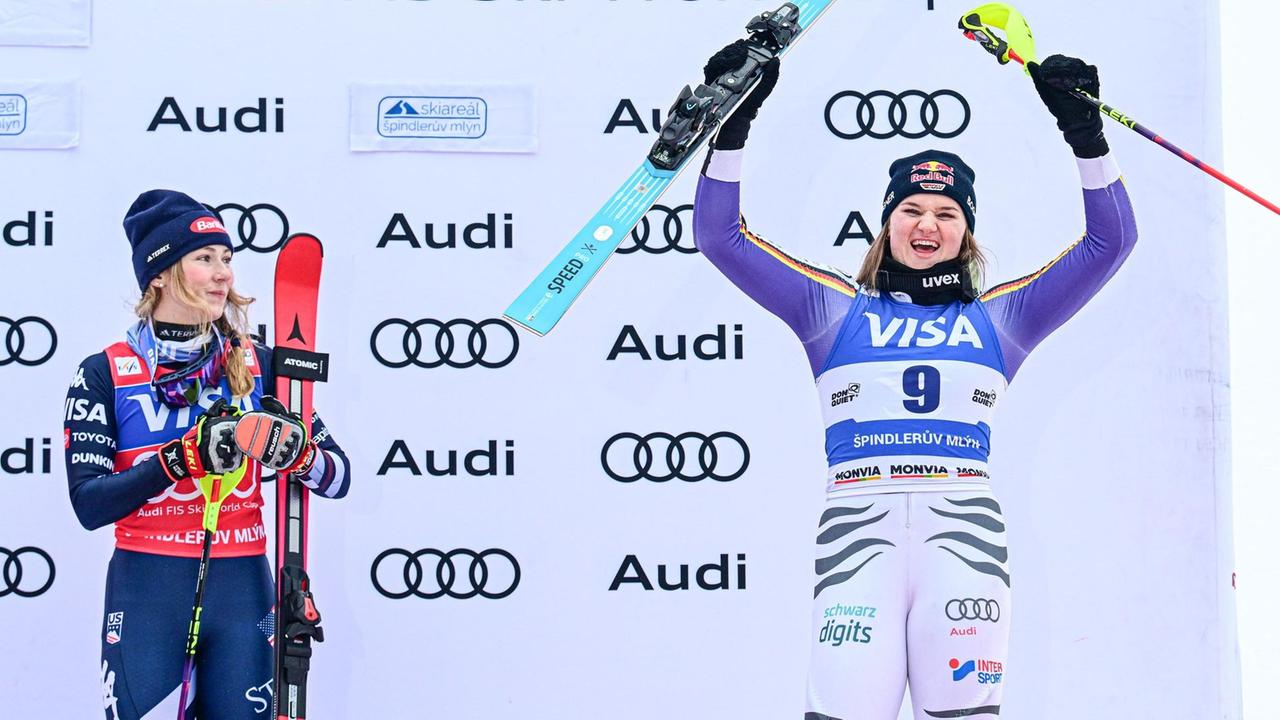
"She fights for the win in every single discipline," Weidle-Winkelmann noted during the presentation of the Bavarian Sports Prize. "Her versatility, and the fact that she maintains such a high level across all disciplines, is simply extraordinary."
Regarding the Olympic experience, Aicher’s own reflection provides insight into her character. She does not focus on the 0.04 seconds she missed for gold; she focuses on the camaraderie. "The first thing that comes to my mind when I think of the Olympics is how Kira came toward me in the finish area," Aicher said. This perspective—prioritizing the human element of sport—is often cited by coaches as the "Aicher secret sauce": a blend of extreme professional determination tempered by a grounded, calm demeanor.
Implications: The Changing of the Guard?
As the circus arrives in Sölden, the implications for the sport are profound. The Alpine World Cup is entering a transitional phase. For years, the question was simply "How much will Shiffrin win by?" Now, the question is, "Can the German challenger withstand the pressure of being the hunted?"
1. The Pressure of Expectations
Aicher has publicly stated that the overall crystal globe is a clear goal. This is a bold declaration for a 22-year-old, yet she carries it with a refreshing sense of ease. Unlike many who crack under the weight of national expectation, Aicher views the mountain as a sanctuary. "You have freedom. You have space. It is simply beautiful," she remarked in a recent interview.
2. The Tactical Shift
Shiffrin’s decision to limit her race count is a strategic pivot towards longevity. However, in the high-stakes environment of the overall standings, every race skipped is a door opened for rivals. If Aicher can maintain her current level of fitness through the 40-race marathon, she has a statistical path to the top.
3. The Future of German Skiing
For the German Alpine federation, Aicher is the cornerstone of a new era. Her success has already brought a surge of interest in the sport back home, and her humility—despite the media frenzy that follows her—has made her a favorite among sponsors and the public.
Conclusion: A Winter of Consequence
The 2026/27 season is poised to be more than just a series of races; it is a referendum on the future of women’s Alpine skiing. Emma Aicher has all the tools: the technical ability to challenge in the gates, the courage to tackle the downhill tracks, and the tactical discipline to manage a long season.
As she heads to the starting gate in Sölden, the alpine world is not merely watching another race; they are witnessing the maturation of an athlete who has already achieved what most only dream of, yet remains hungry for the one prize that defines greatness: the Big Crystal Globe. Whether she succeeds in toppling the legend in Mikaela Shiffrin remains to be seen, but one thing is certain—the race for the throne has officially begun.