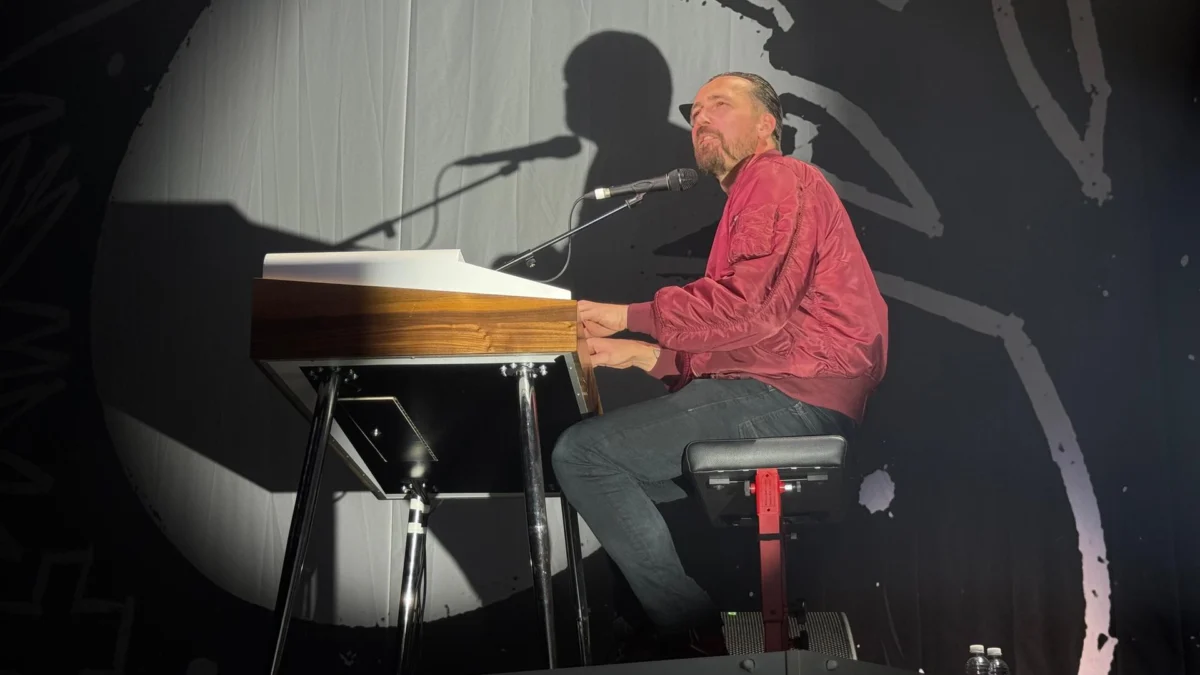
WIESBADEN – In the heart of the historic Schlachthof, a former slaughterhouse turned cultural epicenter, the air on Friday night was thick with a peculiar tension. On stage stood Daniel Pongratz—better known as Danger Dan, the cerebral and acerbic mastermind behind the Antilopen Gang. Dressed in his trademark red jacket, he did not just perform a concert; he navigated a minefield of contradictions, moving fluidly between irony, fury, raw vulnerability, and poignant political advocacy.
The evening served as a microcosm of the current German cultural debate. Following his controversial disinvitation from the ZDF satire program Die Anstalt earlier this summer, the concert felt like a litmus test for the limits of artistic expression. Yet, as the final notes faded, what remained was not the noise of the headlines, but a humanizing, deeply personal appeal that challenged the very binary nature of the public discourse surrounding him.
The Chronology of a Contradictory Evening
The evening began with a masterclass in audience management. Danger Dan opened with the track "Die meisten meiner Freunde" (Most of my friends), instantly bridging the gap between the performer and the crowd. Despite his reputation as a firebrand, he immediately displayed a disarming, grounded persona. He paused early in the set to urge the taller members of the audience to move back, ensuring that shorter fans could see and that the collective experience remained inclusive.
However, the "nice guy" act was punctured with surgical precision. Addressing the elephant in the room—the recent legal and media scrutiny regarding his lyrics—he adopted a mock-serious tone. He informed the audience that his lawyers had strictly advised him to clarify that his songs do not constitute a call to violence. He then delivered the punchline with a deadpan stare: "Of course, I am calling for violence."
This moment captured the essence of the Danger Dan persona: he weaponizes irony to mirror the absurdity of his critics. He understands that in a media landscape obsessed with soundbites, he can play the villain to highlight the nuance that is being lost.
A Musical Evolution: From Solo Piano to Orchestral Depth
Musically, the concert was a study in restraint. For much of the first half, the stage was dominated by a lone piano and the artist himself, while his backing band remained shrouded behind a translucent screen. This minimalist approach forced the audience to focus on the lyrical density of his work.
It was not until the performance of "Mingvase" that the visual landscape shifted. As the curtain rose, a string section—cello and violin—joined forces with drums and a double bass. The shift in sound was transformative; the Schlachthof’s acoustics, often a challenge for live acts, were masterfully balanced, allowing the intricate arrangements to breathe.
One of the most striking observations of the night was the absence of the "digital barrier." In an era where concerts are viewed through the glowing screens of thousands of smartphones, the audience in Wiesbaden was refreshingly present. There were no seas of tablets capturing shaky, low-quality footage; instead, there was a collective, tangible engagement. This intimacy created a safe space where, ironically, the themes of violence and political aggression in his songs were met with a remarkably gentle and considerate crowd.
Vulnerability: The Anatomy of a Personal Crisis
While the headlines focus on his politics, the true resonance of the evening lay in his vulnerability. Danger Dan shared a deeply personal narrative regarding a degenerative eye condition that will eventually lead to total blindness. He spoke of the initial despair that accompanied the diagnosis, but also of the profound shift in perspective it triggered.

"I stopped procrastinating," he confessed, explaining that the encroaching darkness had forced him to stop living for the expectations of others. During the performance of "Dass es hier so schön ist" (That it is so beautiful here), the stage lighting dimmed systematically, a literal and metaphorical representation of his fading vision. It was a haunting, cathartic moment that shifted the mood of the room from political agitation to profound empathy.
He further dismantled the public image of the "invincible rapper" by discussing his sexuality. Recounting the history behind his song "Warum es nicht geklappt hat" (Why it didn’t work out), he admitted to a long-held struggle with his own identity. He had once dismissed a past same-sex relationship as an "experiment," only to realize later that he was suppressing a fundamental part of his attraction to both men and women. By airing these private struggles, he moved beyond the caricature of the "provocateur" and became a person defined by his complex human experience.
The ZDF Controversy and the Limits of Artistic Freedom
The pivot back to politics was inevitable. The discussion surrounding his exclusion from the ZDF show Die Anstalt remained a focal point. The broadcaster had argued that segments of his lyrics could be interpreted as incitement to violence—an interpretation Danger Dan vehemently rejects.
He framed his work not as a weapon, but as a mirror. "I wanted to give people courage," he stated, referring to his recent album. He issued a firm, non-ironic appeal to his audience: the duty to stand up against racism and sexism, even within one’s own family. This was the most serious, grounded segment of the night. It stripped away the satire and left only a moral imperative.
The set culminated in the performance of "Keine Angst" (No Fear), the very song that served as the catalyst for his professional fallout with ZDF. As he played, a massive backdrop illuminated the stage with the words "KEINE ANGST." It was a bold visual declaration that effectively reclaimed the narrative from his critics. For the encore, he delivered "Das ist alles von der Kunstfreiheit gedeckt" (That is all covered by freedom of art), a song that has become an anthem for the debate over the boundaries of free speech in Germany. The audience, now fully galvanized, shouted the refrain in unison, turning the concert into a protest of sorts.
Implications: A Mirror for Modern Society
What, then, is the legacy of this performance? It would be a mistake to categorize the night as purely a political rally or purely a concert. The contradictions are the point. Danger Dan forces his audience to confront the fact that a person can be simultaneously an agitator, a vulnerable human being, a fierce critic of the status quo, and an artist who thrives on the very controversy that threatens to silence him.
The debate regarding his lyrics will not conclude with this tour. As long as artists use provocation as a diagnostic tool for societal ills, there will be institutions that react with fear or censorship. However, the scene at the Schlachthof suggests that the public is far more capable of handling complexity than some broadcasters give them credit for.
The audience did not leave with simple answers. They left having laughed at his acerbic wit, wept during his admission of illness, and reflected on their own capacity to resist injustice. By blending the private with the political, Danger Dan has managed to create a space that is as challenging as it is necessary. He remains a lightning rod for the German cultural climate, proving that in the tension between the offensive and the insightful, art finds its most vital expression.
In the final assessment, the "danger" of Danger Dan is not that he incites violence, but that he compels his audience to think, to feel, and to confront the uncomfortable realities of their own lives. As he noted during the evening, the goal was never to fit into a mold—it was to shatter it. If the crowd at the Schlachthof was any indication, he has succeeded in doing exactly that, one song at a time.