The landscape of European defense manufacturing is currently undergoing a period of profound recalibration. At the heart of this transformation lies KNDS (KMW+NEXTER Defense Systems), the industrial powerhouse responsible for the backbone of European land warfare. Following the collapse of a highly anticipated initial public offering (IPO) in July, the German federal government finds itself in a precarious position, grappling with how to secure its influence over a company deemed critical to national security.
The Failed IPO: A Collision of Valuations
In the summer of 2024, KNDS—the joint venture between Germany’s Krauss-Maffei Wegmann (KMW) and France’s Nexter—was prepared to take the leap into public markets. The IPO was intended to be a watershed moment for the European defense sector, signaling a transition toward greater capitalization to meet the surging demands of the war in Ukraine and the subsequent rearmament of NATO member states.
However, the endeavor abruptly crumbled. The primary friction point was valuation. The owner families behind the German side of the venture, the Bode and Braunbehrens families, concluded that the market’s appraisal of the firm was fundamentally insufficient. For the German government, which had earmarked €7.2 billion to acquire a 40% stake in the entity, the collapse of the IPO meant the immediate suspension of its planned state entry.
This development has left a power vacuum in the governance structure of KNDS, which is currently owned in equal parts by the French state and the German private stakeholders. As the market re-evaluates the "defense bubble," the German government is now forced to seek alternative avenues to ensure that its industrial interests are not sidelined.
Chronology: From Ambition to Stagnation
- December 2024: The German federal government publishes its "National Strategy for the Defense Industrial Base," explicitly classifying armored vehicles as a national key technology.
- Early 2024: Preparations for a potential KNDS IPO accelerate, fueled by record-high order books and the geopolitical necessity of maintaining armored fleet readiness.
- July 2024: The IPO is officially scrapped. The Bode and Braunbehrens families cite undervaluation as the deal-breaker, effectively blocking the government’s plan to purchase a 40% equity stake at a price tethered to the projected issuance value.
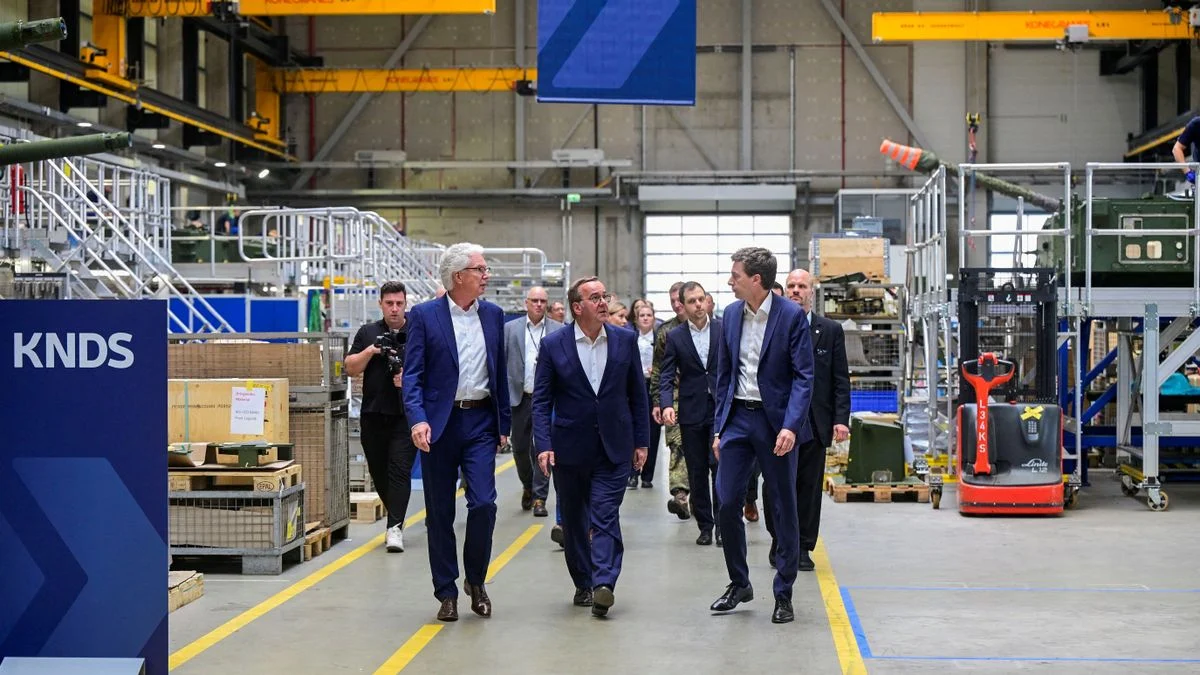
- August 2024: During a visit to the KNDS facility in Kassel, Defense Minister Boris Pistorius reaffirms the government’s unwavering commitment to securing a long-term stake in the company, regardless of the failed market debut.
Strategic Significance: Why KNDS Matters
To understand why the German government is so intent on securing a direct stake in KNDS, one must look at the technical and operational reality of the Bundeswehr. KNDS is the primary manufacturer of the Leopard 2 main battle tank—the platform that has become the gold standard of Western armored support for Ukraine. Beyond the Leopard, the company’s portfolio includes the Puma infantry fighting vehicle, the Schakal armored vehicle, the Boxer wheeled combat vehicle, and the Panzerhaubitze 2000 self-propelled artillery system.
A confidential paper from the German Ministry of Defense underscores the gravity of the situation. The document argues that KNDS Deutschland’s products are not merely commercial assets but the foundational "backbone" of the Bundeswehr’s armored and protected units. Without a secure, state-backed influence over the manufacturing pipeline, Berlin fears it could become vulnerable to shifts in corporate strategy or the competing interests of its French partners.
The Economic and Industrial Disparity
The government’s case for a state-level entry is bolstered by internal data showing a clear imbalance in current operations. Approximately 57% of KNDS’s total revenue is derived from the German branch of the conglomerate. Furthermore, the ministry notes that this dependency is likely to increase.
Current procurement trends highlight a divergence: the Bundeswehr is aggressively ordering new hardware to replace supplies sent to Ukraine and to modernize its own fleet, while French procurement cycles remain comparatively muted. This disparity has led Berlin to demand "parity of influence." The German government is seeking a governance model that provides it with the same level of voting rights and oversight as the French state on the company’s board.
Official Responses: Pistorius and the "Control" Mandate
Defense Minister Boris Pistorius has adopted an uncompromising tone regarding the matter. Speaking at the Kassel manufacturing site, Pistorius signaled that while the IPO is off the table, the strategic goal remains non-negotiable.
"We want to keep this key technology under German control—on par with our partners in France," Pistorius stated. When pressed by journalists on whether the existing ownership structure—a split between the French state and German families—could persist in the long term, he was notably evasive but firm: "We want to secure influence, in whatever form that may be."
This language suggests that the German government is moving beyond a simple stock purchase strategy. It is now exploring regulatory, contractual, or perhaps even legislative measures to ensure that the German state holds a "golden share" or equivalent veto power over the strategic decisions of KNDS, ensuring that the company’s industrial output remains aligned with Berlin’s geopolitical requirements.
Implications for the Future of European Defense
The collapse of the KNDS IPO is symptomatic of a broader malaise in the European defense industry. Investors, who initially flocked to defense stocks following the 2022 invasion of Ukraine, are now adopting a more cautious stance, questioning the sustainability of long-term government contracts and the potential for "over-valuation" in a sector heavily reliant on state budget cycles.
The Risks of Nationalization
For Germany, the challenge is twofold:
- The Partner Dilemma: Any move by Germany to increase state control over KNDS must be navigated with extreme diplomatic care to avoid alienating the French government. The Franco-German defense relationship is already strained by different operational philosophies and procurement timelines.
- The Efficiency Question: By shifting toward state-controlled or state-influenced management, there is a risk that KNDS may become less agile than a truly private or publicly traded entity. The bureaucracy of government oversight can often clash with the rapid innovation cycles required for modern warfare.
Re-evaluating the "Defense Bubble"
As the market re-prices the sector—evidenced by the volatility in stocks like Rheinmetall—the KNDS case serves as a warning. The era of "easy growth" in the defense sector, driven purely by the initial shock of geopolitical instability, is yielding to a more complex era of industrial policy.
Companies are no longer just profit-making vehicles; they are being treated as vital extensions of the state. Whether this will lead to a more resilient European defense industrial base or a fragmented landscape of state-controlled entities remains to be seen.
Conclusion: The Path Forward
The German government’s failure to secure its stake in KNDS via the IPO is a temporary setback, but it has clarified the ultimate goal: the assertion of national sovereignty over defense production. As Minister Pistorius indicated, the coming weeks will involve intense negotiations. These talks will likely determine whether KNDS continues as a balanced, binational industrial entity or evolves into a more state-integrated, quasi-public institution.
For the security of the Atlantic alliance, the stability of KNDS is essential. As the Bundeswehr continues to rely on the Leopard 2 and the Panzerhaubitze 2000, Berlin’s insistence on "control" is not just about capital; it is about the guarantee that when the next crisis arrives, the industrial capacity to respond will be firmly within the grasp of the state. The coming months will be a test of whether France and Germany can reconcile their industrial visions or if the fragmentation of European defense will continue to hinder the continent’s strategic autonomy.