For decades, the cryptic, wordless assembly manuals provided by Ikea have been a cultural touchstone—simultaneously celebrated for their universal accessibility and derided for the inevitable frustration they induce. Into this landscape of flat-pack uncertainty stepped London-based product designer Ryan Sael, with an ambitious web-based project titled "Flat Pack, Step by Step." By leveraging the power of modern artificial intelligence, Sael sought to transform static, two-dimensional paper diagrams into fluid, three-dimensional browser animations. However, as the project gained traction, it became a lightning rod for a broader debate on the limitations of "Vibe Coding" and the dangerous gap between AI-generated aesthetics and mechanical reality.
The Vision: A 3D Revolution for Flat-Pack Furniture
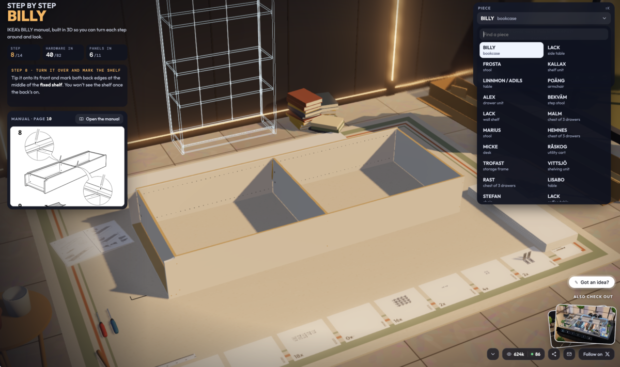
The premise of Sael’s project is deceptively simple and undeniably appealing. Users access a web-based "viewport" where they can manipulate 3D models of iconic furniture pieces like the Billy bookcase, the Lack side table, and the Kallax shelving unit. The interface allows users to rotate the furniture in 3D space, zoom in on specific joinery, and use a slider to scrub through assembly steps as if they were watching a video playback.
Sael initially introduced the project to the world via X (formerly Twitter), showcasing the Billy and Lack models. The response was immediate and enthusiastic, prompting him to rapidly expand the library to include 23 additional Ikea classics, including the Malm bed frame and the Poäng chair. To bridge the gap between innovation and familiarity, Sael integrated the original Ikea PDF manuals directly into the interface, allowing users to compare the 3D animation with the manufacturer’s official, time-tested instructions side-by-side.
Chronology: From Viral Hype to Critical Scrutiny
The trajectory of "Flat Pack, Step by Step" followed the classic arc of a viral tech project: initial awe, followed by rigorous community testing, and finally, a sobering reality check.
- The Launch: Sael deployed the application using AI-assisted development workflows, promoting it as a seamless, high-tech evolution of furniture assembly.
- The Expansion: Following a positive reception, Sael added two dozen models within days, demonstrating the rapid deployment capabilities of AI-driven coding.
- The Community Audit: As the tool spread across forums like Hacker News and tech-centric social media, enthusiasts began putting the animations to the test against real-world assembly.
- The Backlash: The discovery of significant physical errors in the animations triggered a wave of criticism, focusing on "hallucinated" assembly steps that would, if followed, lead to damaged furniture or structural failure.
Technical Foundations: The "Vibe Coding" Trap
At the heart of the project’s failure—and its technical success—is the reliance on Large Language Models (LLMs), specifically those developed by Anthropic. Sael’s development process represents a burgeoning trend often referred to as "Vibe Coding." In this paradigm, developers spend less time writing manual syntax and more time iterating through prompts, trusting the AI to translate high-level intent into functional code.

While the AI successfully generated low-poly, performant 3D assets that run smoothly even on entry-level hardware, it failed to grasp the spatial and mechanical logic of furniture assembly. On Hacker News, developers identified this as a byproduct of "Claudisms." The term refers to the tendency of the Claude AI model to adopt a highly confident, marketing-oriented tone in its output, even when the underlying technical or physical logic is demonstrably incorrect.
For instance, the AI claimed that every dowel and cam lock was placed exactly where the paper manual dictated, yet the visual output told a different story. In the Billy bookcase animation, the AI depicted shelf boards being installed upside down, which would place the cam locks on the visible top surface rather than the hidden underside. Similarly, the Lack table animation suggested that heavy-duty double-threaded screws could be hand-twisted into the tabletop, ignoring the physical reality that they require the leverage provided by the table legs themselves.
Supporting Data: When Logic Meets Geometry
A technical review of the project reveals a disconnect between graphical fidelity and mechanical accuracy. Japanese tech outlet Gigazine conducted a practical assessment, noting that while the application is technically impressive in its fluidity, it falls short of being a reliable instruction manual.
The project utilizes "low-poly" modeling—a technique that reduces the number of geometric faces in a 3D object to ensure high performance on web browsers. This technical choice is sound, as it allows for immediate interaction without requiring high-end GPUs. However, the accuracy of these models is compromised by the AI’s lack of "spatial reasoning." When the AI generates a "helper line" in the animation, it often fails to align with the actual pre-drilled holes in the furniture components, leading to potential frustration for users who might try to force parts that do not fit.
Interestingly, this is not the only attempt at this concept. A developer under the pseudonym "geminiboy" released a competing 3D prototype shortly before Sael’s project. While the geminiboy version lacked the polished lighting effects and glossy UI of Sael’s project, it was praised by the developer community for being more "honest" and "readable," proving that in instructional design, clarity and accuracy far outweigh graphical flair.
The Official Response and the "Human-in-the-Loop" Problem
When confronted with the errors, Ryan Sael was candid. He admitted on Hacker News and X that the project was a solo endeavor created under significant time constraints. He acknowledged that he lacked the resources to manually audit every single step generated by the AI for every model in the catalog.
His response highlights the central dilemma of modern AI-assisted development: the "Human-in-the-Loop" requirement. In traditional software development, a team of quality assurance testers would have spent weeks verifying the geometry and assembly sequences. In the "Vibe Coding" era, the human is often relegated to the role of a "prompter," leaving a dangerous gap between the AI’s output and the final user experience. Sael’s appeal for "forgiveness" for the inaccuracies underscores that, while the tools are powerful, they are not yet a substitute for the meticulous, human-centric design work that companies like Ikea have refined over decades.
Implications: The Future of Instructional Design
Does an interactive 3D model offer a genuine improvement over the classic, wordless paper manual? The consensus among many observers is "not necessarily."
Ikea’s original manuals are masterpieces of visual communication. They rely on extreme simplification, removing all extraneous information to focus solely on the sequence of parts. By contrast, Sael’s 3D animations—while flashy—can actually become a distraction. A camera flying around a 3D object may obscure the exact orientation of a screw or the specific placement of a bracket, whereas a static 2D diagram provides a single, unambiguous "truth."
Ikea itself has recognized the value of 3D modeling, utilizing high-fidelity renders for their digital catalogs and home-planning software. However, they have been careful not to replace their core assembly instructions with interactive animations. The company’s continued reliance on simple, printable PDFs suggests they understand that in a high-stress environment—such as a living room floor surrounded by wood panels and hardware—less is often more.
Conclusion: The Persistence of Physical Reality
The "Flat Pack, Step by Step" project is a fascinating case study in the current state of AI. It serves as a reminder that while generative AI can simulate the appearance of competence, it cannot yet replicate the deep understanding of physics, structural integrity, and pedagogical clarity required to teach someone how to build a shelf.
As AI continues to integrate into the creative process, the "Flat Pack" saga offers a vital lesson: the value of a product lies not just in its visual execution, but in its reliability. Until AI can be "trained" on the nuances of mechanical assembly—understanding that a board has an "up" and a "down," or that a screw needs a pilot hole—these digital guides will remain a high-tech novelty rather than a replacement for the humble, yet highly effective, paper manual. For now, the best way to build a Billy bookcase remains exactly what it has always been: a set of clear, static pictures, a screwdriver, and a healthy dose of patience.