BERLIN – On October 7, 2026, the city of Berlin stood as a somber focal point of remembrance, marking three years since the catastrophic October 7, 2023, terrorist attacks by Hamas on Israel. As the world reflected on the deadliest day for the Jewish people since the Holocaust, the German capital hosted a series of high-profile commemorative events, even as the shadow of the ongoing regional conflict in the Middle East—now encompassing Gaza, Lebanon, and Iran—continued to manifest in the city’s streets.
The Tragedy: Three Years Later
The events of October 7, 2023, remain etched in global history. Hamas militants breached the Gaza-Israel border, launching a multi-front assault on civilian kibbutzim, military installations, and the Nova music festival. The resulting violence claimed the lives of approximately 1,200 people, the vast majority of whom were civilians. Furthermore, some 250 individuals were abducted as hostages into the Gaza Strip, setting off a chain reaction of regional devastation.
In the ensuing three years, the conflict has reshaped the geopolitical landscape of the Middle East. Israel’s subsequent military campaign in Gaza has resulted in widespread destruction and a massive loss of life. By late 2026, the violence has metastasized, drawing in actors from the Lebanon-based Hezbollah to the Iranian state, leading to a broader, volatile confrontation that continues to test international diplomacy.
Commemoration and Solidarity at the Bebelplatz
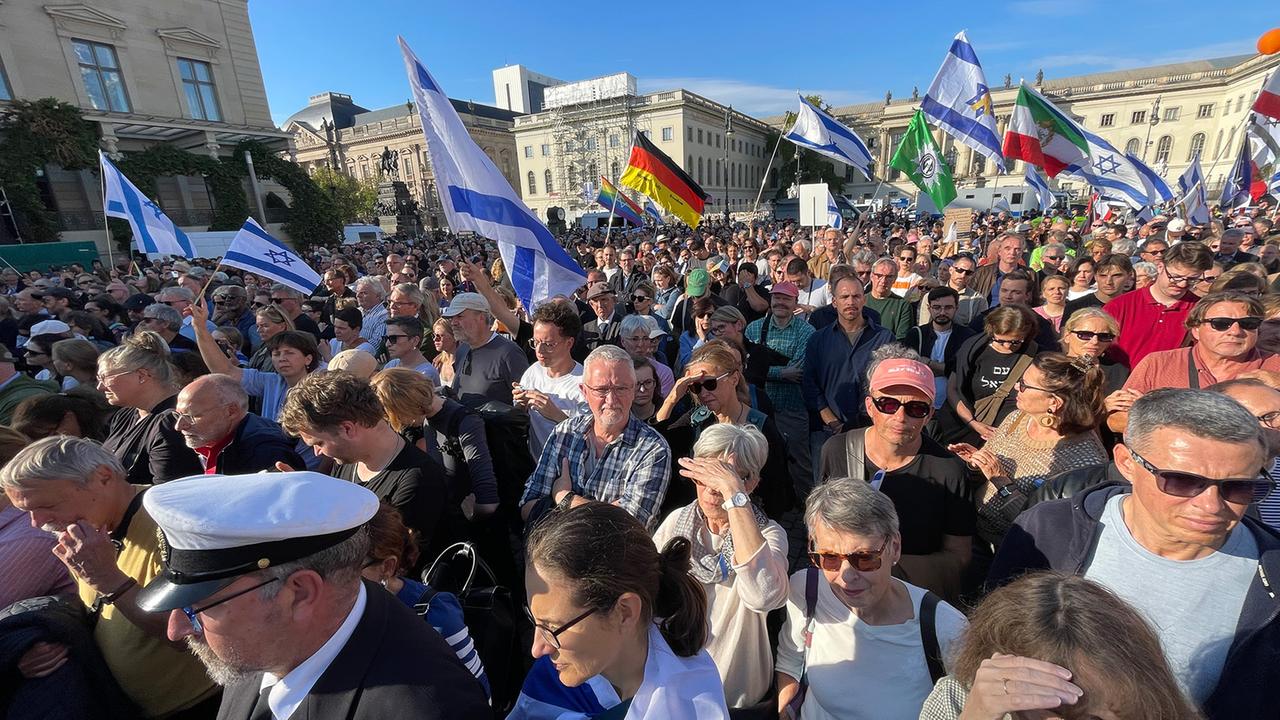
In Berlin, the epicenter of the remembrance was the historic Bebelplatz—a site of profound historical resonance, having served as the location for the Nazi book burnings in 1933. Hundreds gathered to pay their respects, creating a visual display of solidarity against the backdrop of a city struggling to contain surging antisemitism.
Federal Interior Minister Alexander Dobrindt (CSU) delivered a keynote address that underscored the moral imperative facing modern Germany. Standing before the crowd, which included the Israeli Ambassador to Germany, Ron Prosor, Dobrindt issued a stern warning against those who challenge Israel’s right to exist.
"Those who question the existence of Israel are not part of Germany and must not become part of it," Dobrindt declared. He emphasized that the fight against antisemitism is not merely a policy goal but a fundamental "duty of every German." Reflecting on the rise of hate speech and intimidation, he described antisemitism as an "abominable poison" that threatens to corrupt the fabric of German society. His objective, he noted, is to ensure that Germany remains a safe, welcoming land for Jews, acknowledging that the nation still has a long way to go to combat the rising tide of intolerance.
Personal Accounts and Symbolic Presence
The weight of the day was brought into sharp relief by the personal testimony of Noga Friedmann, whose husband—a soldier in an elite unit—was killed during the initial Hamas assault. Her presence served as a poignant reminder that behind the geopolitical statistics lie thousands of shattered families.
The event drew a diverse coalition of political and cultural figures. Among those in attendance were Berlin’s Finance Senator Stefan Evers, Education Senator Katharina Günther-Wünsch (both CDU), Innensenatorin Iris Spranger (SPD), and the former Senator for Culture, Joe Chialo. Prominent cultural figures, including the actress Iris Berben, also joined the vigil, lighting candles in memory of the victims.
Notably, while the crowd was dominated by blue-and-white Israeli flags, observers noted the presence of several Iranian flags, highlighting the complex and often confrontational nature of the diaspora politics currently playing out in the German capital.
Security Mobilization: A City on High Alert
The atmosphere in Berlin was heavy with security concerns. The Berlin Police force mobilized approximately 1,000 officers to manage a day that featured eight separate pro-Israel solidarity events and two pro-Palestinian demonstrations.
Strict security protocols, including thorough bag checks, were implemented at all major gathering points. At the Brandenburg Gate, a visual installation displaying the faces of the victims of the October 7 massacre became a site of quiet contemplation for politicians, including Green Party figures Bettina Jarasch and Werner Graf, as well as the SPD’s state chairman, Steffen Krach. In a symbolic act of solidarity, the Brandenburg Gate was illuminated with the Israeli flag throughout the evening.
Further services were held at the central synagogue of the Chabad Jewish community, and a multifaith memorial service took place at the Kaiser-Wilhelm-Gedächtniskirche in Charlottenburg, attended by Brandenburg’s Minister-President Dietmar Woidke. Meanwhile, Berlin’s Governing Mayor, Kai Wegner (CDU), spent the anniversary in Israel, working to strengthen the city’s partnership with Tel Aviv during this period of existential crisis.
Escalation: Protests and Police Intervention
While the memorial services remained peaceful, the evening took a volatile turn as the pro-Palestinian protests commenced. A demonstration titled "Down with Colonialism" drew roughly 700 participants—significantly higher than the 150 organizers had initially registered.
Tensions boiled over as the march moved through the streets of Kreuzberg. Demonstrators chanted slogans such as "Until total Liberation" and "Power to the People – Glory to the resistance." When the group encountered a separate, smaller counter-demonstration of people carrying Israeli flags, the rhetoric turned hostile, with protesters shouting, "Fuck You Israel – Viva Palestine."
Police were forced to intervene as the situation descended into physical altercations. According to police reports, officers were subjected to kicking and shoving. Authorities ultimately dissolved the protest in the late evening, citing widespread public disorder. Several individuals were arrested, with charges ranging from physical assault of officers to the display of prohibited symbols—specifically those associated with the Hamas terrorist organization.
Implications: The German Dilemma
The events of October 7, 2026, underscored the deep-seated divisions currently defining the German social contract. The government’s firm commitment to "Staatsräson" (the concept that Israel’s security is a core element of Germany’s state reason) is being tested by a demographic shift and the influence of international conflicts on domestic harmony.
The rise in antisemitic incidents over the last three years has forced German policymakers into a defensive posture. The political consensus, represented by figures like Dobrindt, seeks to draw a hard line: the integration of migrants and the protection of civil liberties must not come at the expense of Jewish safety or the recognition of Israel’s right to self-defense.
However, as the protests in Kreuzberg demonstrated, the discourse surrounding the Israeli-Palestinian conflict has become a battleground for identity politics, with the potential to ignite civil unrest. The government’s challenge remains twofold: protecting the right to freedom of assembly while simultaneously preventing the normalization of hate speech and extremist ideologies that target the Jewish community.
Looking Ahead: A Fractured Consensus
As the anniversary concluded, the message from the German leadership remained one of resolve. Yet, the images of police cordons, the arrests of individuals carrying terrorist insignia, and the open hostility on the streets of Berlin serve as a grim reminder that the events of October 7, 2023, are far from being "history."
For the victims’ families, for the Jewish community in Germany, and for the political establishment, the path forward is fraught with uncertainty. As the conflict in the Middle East continues to show no signs of a permanent ceasefire, the ripples of that violence will continue to reach the heart of Berlin, testing the strength and resilience of Germany’s democratic institutions. The events of this week have proven that while Berlin remembers the past, it is currently struggling to navigate a deeply polarized and volatile present.