


By Sports Desk | September 27, 2026
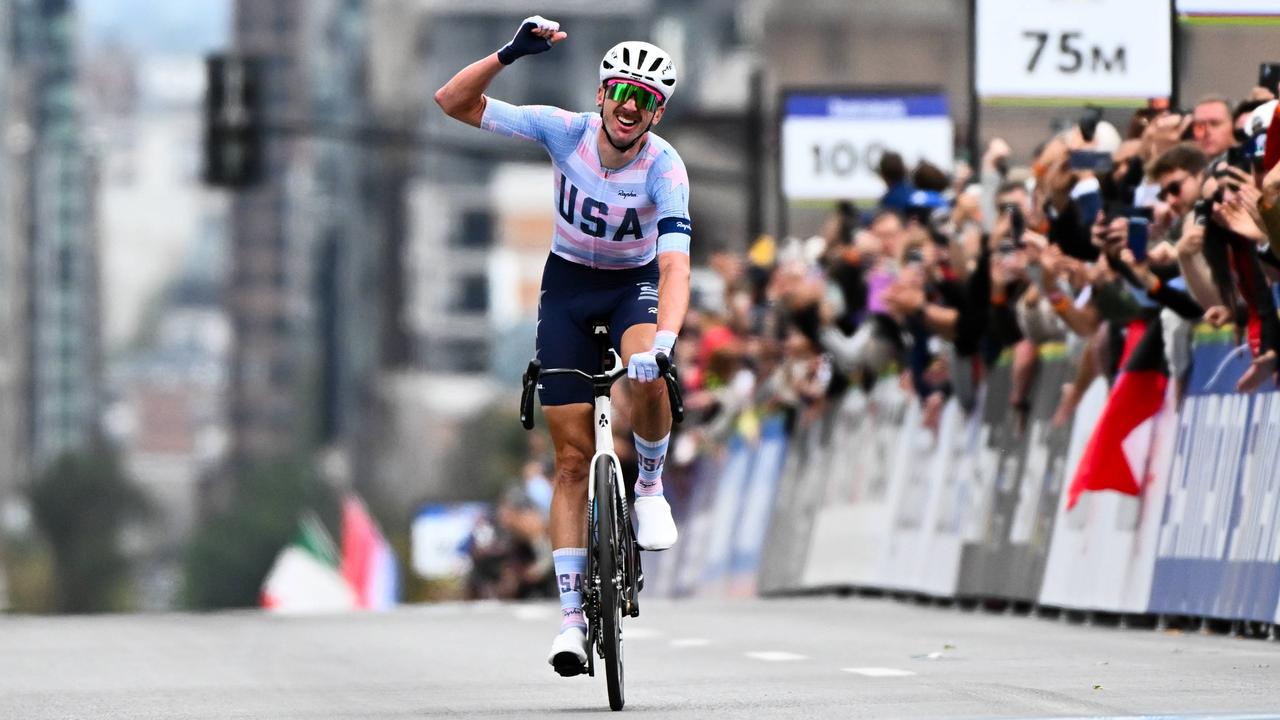
In a display of tactical brilliance and sheer physical fortitude, American cycling sensation Brandon McNulty etched his name into the annals of sporting history on Sunday. Amidst the challenging, climb-heavy terrain of Montreal, the 28-year-old launched a daring, long-range solo assault that saw him cross the finish line as the newly crowned road race World Champion.
McNulty’s victory, which marks the first time an American has worn the prestigious rainbow jersey since Lance Armstrong in 1993, brought a dramatic conclusion to the 2026 UCI Road World Championships. In doing so, he succeeded the injured Slovenian superstar Tadej Pogačar, whose quest for a three-peat was derailed by injuries sustained during the Vuelta a España.
A Masterclass in Endurance and Strategy
The race, spanning a grueling 273.4 kilometers, was designed to punish the weak. Featuring the iconic climbs of the Mont Royal circuit—a route familiar to many on the WorldTour—the peloton faced 3,800 meters of cumulative elevation gain.
McNulty, who had previously signaled his affinity for the Canadian course by winning the 2025 Grand Prix Cycliste de Montréal, executed his race plan with surgical precision. While the peloton spent the first half of the day reeling in a 16-man breakaway that included German champion Felix Engelhardt, McNulty remained tucked away, conserving his energy for the decisive moments.
The turning point occurred 33 kilometers from the finish. With the race entering its final, chaotic phase, McNulty surged away from the main group. While the favorites—including the tactical powerhouse Remco Evenepoel and rising stars like Paul Seixas and Isaac Del Toro—looked to one another to initiate a chase, the window of opportunity slammed shut. By the time the chasers organized a coherent pursuit, the gap had become insurmountable.
The Road to Glory: A Chronological Breakdown
The day began under crisp, autumnal conditions in Montreal, with the peloton facing 13 laps of the demanding city circuit.
- 0–100km: The Breakaway Forms: An aggressive opening saw a group of 16 riders establish a gap that stretched to nearly nine minutes. Felix Engelhardt represented Germany’s hopes, keeping the pressure high on the peloton to force the powerhouse nations to work early.
- 100–200km: The Squeeze: As the race entered the final 100 kilometers, the intensity surged. The peloton began to dismantle the breakaway, with national teams setting a blistering pace that saw the gap plummet as riders struggled with the repetitive, steep gradients of the Mont Royal climb.
- 240km: The McNulty Gambit: With 33 kilometers remaining, McNulty attacked. It was not a tentative move, but a full-commitment push. His acceleration caught the lead group off guard, and he immediately established a gap of 30 seconds, which rapidly grew to over a minute.
- 260km: The Standoff: Behind him, a tactical stalemate ensued. Nations like Belgium and France, lacking a clear cohesion, hesitated to burn their remaining domestiques. This hesitation allowed the American to maintain a gap that hovered around 45 seconds despite the best efforts of the chasing pack.
- The Finish Line: Exhausted and visibly drained, McNulty crossed the line solo, arms outstretched in disbelief. Behind him, Australian powerhouse Michael Matthews edged out Dutch legend Mathieu van der Poel in a frantic sprint for the silver and bronze medals, respectively.
"I Was Dying Out There": The Champion’s Reflection
In the immediate aftermath of the race, McNulty struggled to process the magnitude of his achievement. "I don’t even know what’s happening," he told reporters, his voice raspy and his body slumped against a barrier. "I was dying out there. Those last 33 kilometers felt like an eternity. I knew that if I hesitated, they would catch me, so I just kept my head down and pushed until the pain became background noise."
McNulty’s win is a testament to the depth of the current American generation of cyclists. Having spent his career as a trusted lieutenant to riders like Pogačar, today he proved he is capable of standing on the highest step of the podium in his own right.
The German Perspective: A Challenging Day
For the German national team, the day was one of resilience rather than glory. With the squad centered around Florian Lipowitz, hopes were high for a top-ten finish. However, the sheer brutality of the course took its toll early.
Lipowitz, who has battled back from a serious crash at the Tour de France in July, lost contact with the elite group roughly 75 kilometers from the finish. "It was a super hard day," Lipowitz admitted in a post-race interview. "I just lacked the punch on the final climbs. The last hour was simply too long for me today, but I am proud to have fought to the end."
Lipowitz eventually finished 47th, with teammate Georg Zimmermann finishing as the best-placed German in 38th position. The wait for a German successor to Rudi Altig—the last German to win the road world title in 1966—continues for at least another year.
Tactical Implications and the "Pogačar Factor"
The absence of Tadej Pogačar, the undisputed king of the 2024 and 2025 seasons, undoubtedly altered the tactical landscape of the race. Without the Slovenian’s aggressive "race-from-anywhere" style, the peloton was left to figure out a new hierarchy.
Analysts note that the hesitation of teams like Belgium and the Netherlands to close down McNulty speaks to a lack of a clear leader. In previous years, Pogačar’s presence would have forced an immediate, unified response from every major team. Without that gravitational center, the race became a tactical chess match that ultimately favored the brave.
Looking Ahead: The Impact of the 2026 World Championship
McNulty’s victory serves as a watershed moment for cycling in the United States. Following the retirement of several high-profile stars and the shifting focus of the sport toward European dominance, an American victory in the road race is expected to provide a significant boost to the sport’s domestic profile.
Furthermore, the result highlights the changing nature of modern racing. The trend toward long-range attacks—a style popularized by Pogačar and Remco Evenepoel—is clearly the new gold standard. Riders can no longer wait for a sprint finish; they must be willing to go into the "red zone" with dozens of kilometers remaining to distance the world’s best.
As the cycling world looks toward the 2027 season, all eyes will be on McNulty. He will spend the next 12 months wearing the rainbow jersey, a symbol that carries not just prestige, but the weight of expectation. Whether he can defend the title next year remains to be seen, but for now, the American has written himself into the history books as the man who conquered Montreal.
Summary Table: Top 5 Finishes
| Place | Rider | Nationality | Time Gap |
|---|---|---|---|
| 1st | Brandon McNulty | USA | Gold |
| 2nd | Michael Matthews | Australia | +0:22 |
| 3rd | Mathieu van der Poel | Netherlands | +0:25 |
| 4th | Paul Seixas | France | +0:28 |
| 5th | Isaac Del Toro | Mexico | +0:31 |
Note: Results reflect the official UCI classification at the conclusion of the 273.4km event.


