By Investigative Desk
In a quiet corner of Mörlenbach-Bonsweiher, the fabric of a family’s life was shredded in a matter of minutes, not by natural disaster or accident, but by a deliberate act of mechanical violence. Nicole Gerstner and her three children, once secure in their home, are now navigating the aftermath of a bizarre and traumatic "bagger attack"—a situation that has left a community in shock and a family facing an uncertain future. While the physical structure of their home lies in ruins, a massive outpouring of public solidarity has provided a glimmer of hope amidst the wreckage.
The Anatomy of a Tragedy: Main Facts
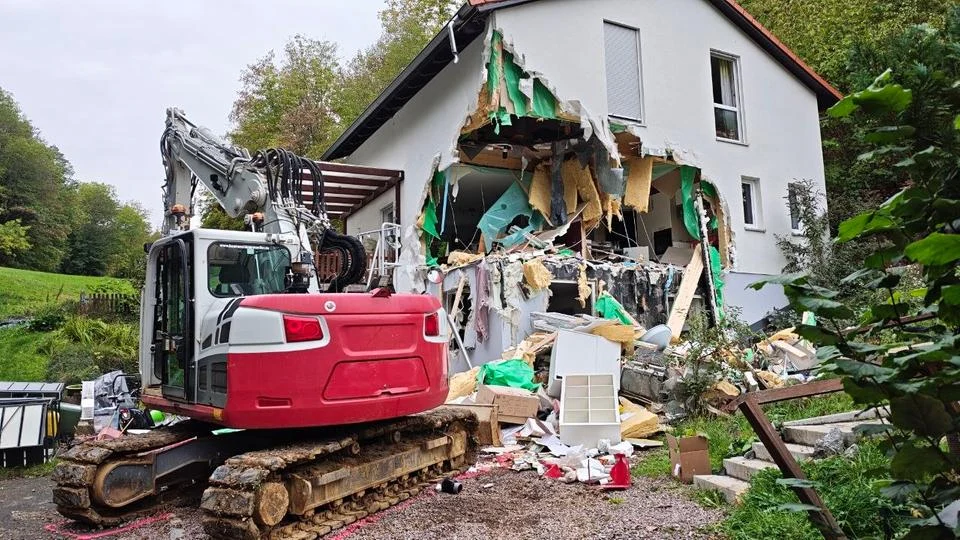
On a seemingly ordinary Sunday, the tranquility of the Bergstraße region was shattered. A 44-year-old neighbor, acting on delusional impulses, commandeered an excavator and proceeded to systematically demolish the residence of the Gerstner family. The attack resulted in the structural failure of a significant portion of the exterior wall, rendering the home uninhabitable and leaving the family displaced.
The damage is not merely aesthetic; it is structural and catastrophic. Preliminary estimates from law enforcement indicate that the destruction could amount to several hundred thousand euros. Compounding the family’s misery is a cold reality of modern insurance policies: vandalism perpetrated by individuals in this specific manner is often excluded from standard coverage. For Nicole Gerstner, the 46-year-old mother at the center of this crisis, the financial devastation is matched only by the emotional toll of losing the place she called home.
Chronology of the Attack: Ten Minutes of Terror
The events leading up to the destruction began long before the heavy machinery arrived on the scene. According to Gerstner, the perpetrator had been exhibiting erratic behavior for days, including baseless accusations that the family was directing "radiation" toward him.
On the day of the incident, the morning had been peaceful. Gerstner had prepared breakfast, with the scent of freshly baked marble cake filling the house—a domestic scene that serves as a painful contrast to what followed. The children alerted their mother to the neighbor’s presence outside. When Gerstner confronted him, the man coldly stated, "It is being demolished now."
What ensued was, in Gerstner’s words, "the worst ten minutes of my life." While the family scrambled to contact the police and evacuate the premises, the rhythmic, crushing sound of the excavator’s bucket against the masonry echoed through the neighborhood. By the time the police arrived, the damage was already done. The perpetrator, having acted on his unfounded conviction that he was removing a source of radiation, was eventually subdued and taken into custody, then transferred to a psychiatric facility.

The Burden of Financial Ruin
The financial implications of the attack are staggering. As the family attempts to process the loss, they have discovered that their insurance policy does not cover such extreme acts of vandalism. "I am not insured against vandalism," Gerstner explained. "Not against people who take a bagger and tear down our house."
The situation is particularly poignant given the family’s recent efforts. For the past year, the Gerstners had been renovating their basement, pouring time, money, and hope into the project. The goal was to create a space for Gerstner’s husband, who is currently receiving care. The project was slated for completion by the end of October. Now, that investment—and the labor behind it—lies under piles of rubble, twisted metal, and discarded insulation.
Supporting Data: A Wave of Solidarity
In the wake of the news, the community’s response has been nothing short of extraordinary. Friends of the family launched a GoFundMe campaign, hoping to alleviate some of the immediate financial burden. The response was immediate and overwhelming. By Wednesday evening, less than 72 hours after the attack, nearly €40,000 had been raised.
"It is so incomprehensible, this support," Gerstner told the press, clearly struggling to articulate the weight of the moment. For a family that feels betrayed by a neighbor and abandoned by their insurance provider, the gesture from strangers has been a vital lifeline. It serves as a reminder that even in the face of senseless destruction, human empathy remains a powerful restorative force.
Official Responses and Legal Implications
The case has prompted a complex investigation by the Darmstadt Public Prosecutor’s Office. The charges center on the destruction of buildings, but the legal path forward is inextricably linked to the suspect’s mental state.
The Psychiatric Evaluation
A court-appointed expert has been tasked with assessing the perpetrator’s criminal culpability. The outcome of this assessment will determine whether the suspect faces a standard criminal trial or if the case will be handled within the framework of forensic psychiatry. The suspect’s own statements, posted on his personal website shortly after the attack, indicate a deep-seated disconnect from reality—specifically his belief that he was performing a service by eliminating a "radiation source."
Structural Integrity and Recovery
For the Gerstners, the legal proceedings are a distant concern compared to the immediate physical challenges. The house has been declared a high risk for collapse. It is currently swaddled in plastic sheeting, a fragile bandage over a mortal wound. Access to the property is strictly prohibited until a structural engineer can determine if any personal belongings—photographs, documents, and family heirlooms—can be safely recovered. Until then, the family remains in the care of relatives, living in the limbo of displacement.

Implications: The Fragility of Neighborhood Safety
This incident raises uncomfortable questions about the nature of modern living and the safety of one’s own home. While such an extreme act of violence is rare, it highlights the vulnerability of residents to the mental health crises of those living in proximity.
The "surreal" nature of the event, as described by Gerstner, points to a broader anxiety regarding the stability of our private environments. The fact that a neighbor can, in a fit of delusion, dismantle a home with industrial equipment has left the residents of Mörlenbach-Bonsweiher shaken.
Furthermore, the insurance gap revealed by this case may spark a wider debate regarding risk assessment and the scope of coverage for homeowners. If a standard policy does not cover such an act, the burden of recovery falls entirely on the victim, potentially leading to long-term financial catastrophe for families who have committed no fault.
Conclusion: A Long Road Ahead
Nicole Gerstner, her three children, and her husband are currently in a period of intense transition. They are processing the loss of their home, the trauma of the attack, and the uncertainty of their future. The €40,000 raised by the community is a start, but it is a fraction of the cost required to rebuild or relocate.
As the legal wheels begin to turn and the structural engineers perform their assessments, the family remains the focal point of a local narrative defined by tragedy and resilience. The image of the red excavator standing silent against the backdrop of a destroyed home remains an indelible symbol of the senselessness of the attack. However, the outpouring of support from the public—the thousands of euros, the messages of comfort, and the willingness to help—stands as a powerful counter-narrative. In the face of a neighbor’s destructive mania, the family has learned that they are not alone. Their home may be shattered, but the community’s response has provided a temporary, yet essential, foundation for them to begin the arduous process of rebuilding their lives.